Overview
Calc-Lab (v0.5.0) is an interactive mathematics and numerical-computing workbench built to illuminate how calculus, linear algebra, probability, and differential equations power everyday scientific modeling. Traditional textbooks frequently separate symbolic formulas on paper from the discrete computer algorithms that actually approximate derivatives, matrix equilibria, and time-evolving physics in real applications—leaving students unsure why step sizes matter or when numerical rounding erodes accuracy. Calc-Lab bridges that divide by uniting 48 guided lessons across six quantitative domains with a live numerical kernel where users adjust parameters and watch error scaling directly. Across logistic growth benchmarks, halving step sizes shrinks Explicit Euler error at first-order speed (rate 1.0026) while Classical Runge-Kutta (RK4) drives error down at fourth-order speed (rate 3.9909, achieving 6.26e-11 precision). On a two-mode one-dimensional Heat equation, spectral thermal energy matches exact analytical theory to 1.67e-16—reaching the double-precision ceiling of standard 64-bit processors—while linear regression (R^2 = 0.9989), 2x2 matrix stability, and Bayesian updates reproduce textbook results interactively. Source code, documentation, and companion apps are listed at https://crvscience.com/apps.
1. Real-World Context & Why This Problem Matters
Why Scientific Mathematics Needs Visual and Numerical Intuition
Behind almost every modern forecast—whether calculating how quickly atmospheric carbon raises ocean heat content, how fast an oral medicine enters and leaves bloodstream compartments, or how brake waves ripple down a congested highway—stands a remarkably compact toolkit of quantitative ideas: rates of change in calculus, equilibrium balance in matrices, probability updates from noisy clues, and time-evolving differential equations. Yet in typical school and university courses, these ideas frequently arrive trapped inside separate homework chapters with almost no visible connection to how real scientific software turns continuous formulas into reliable computer predictions.
Learners routinely ace symbolic derivatives on paper yet remain bewildered when a classroom simulator unexpectedly drifts, oscillates wildly, or disagrees with exact calculus solutions. Worse, practicing analysts sometimes treat commercial solver dropdowns as mysterious black boxes—selecting huge time steps to make animations run fast without noticing how silently truncation error corrupts answers over hundreds of simulated cycles, or confusing smooth continuous heat dissipation with unstable numerical blow-up. Without tasting how continuous formulas turn into discrete computer arithmetic, quantitative science easily feels like dry symbol pushing.
How Step Size and Method Order Govern Trustworthy Simulations
Developing intuition for numerical precision is therefore an essential scientific habit, not an obscure detail reserved solely for computational specialists. Imagine walking across a curving hillside blindfolded: Explicit Euler steps forward by checking the ground's slope purely at your starting toe and marching a fixed stride in a straight line[1]. Cutting your stride length in half shrinks final drift by roughly half—first-order behavior—meaning demanding ten decimal digits of trust requires unbearably tiny, slow strides that magnify floating-point rounding clutter.
Classical fourth-order Runge-Kutta (RK4) acts like glancing ahead carefully at the slope at the start, twice near the middle, and once at the end of every stride before taking a weighted step[1]. Because local curvatures cancel out mathematically across those four probes, halving stride size shrinks global error by roughly sixteen times instead of two! Moving further into spatial partial differential equations—such as warmth spreading down a metal rod—demands confirming that discrete solvers shed high-frequency spatial jaggies smoothly at exact Fourier decay rates rather than creating spurious heat energy[2]. Calc-Lab unites approachable concept explanations, visual symbol cards, and live numerical error rulers inside one fast desktop lab.
2. Conceptual Design & How Calc-Lab Works
Separating a Transparent Math Kernel from the Desktop Workbook
Calc-Lab (v0.5.0) separates cleanly into a standalone mathematical library (calc-core) and a responsive educational desktop application (calc-app). Rather than shielding learners behind opaque external packages, every solver inside calc-core stays concise, deterministic, and easy to read directly beside textbook equations. Entering through expr.rs, a clean expression parser evaluates user algebraic trees alongside exact symbolic differentiation and numerical finite-difference tangent slopes, showing learners visually where floating-point roundoff begins fighting smaller step increments.
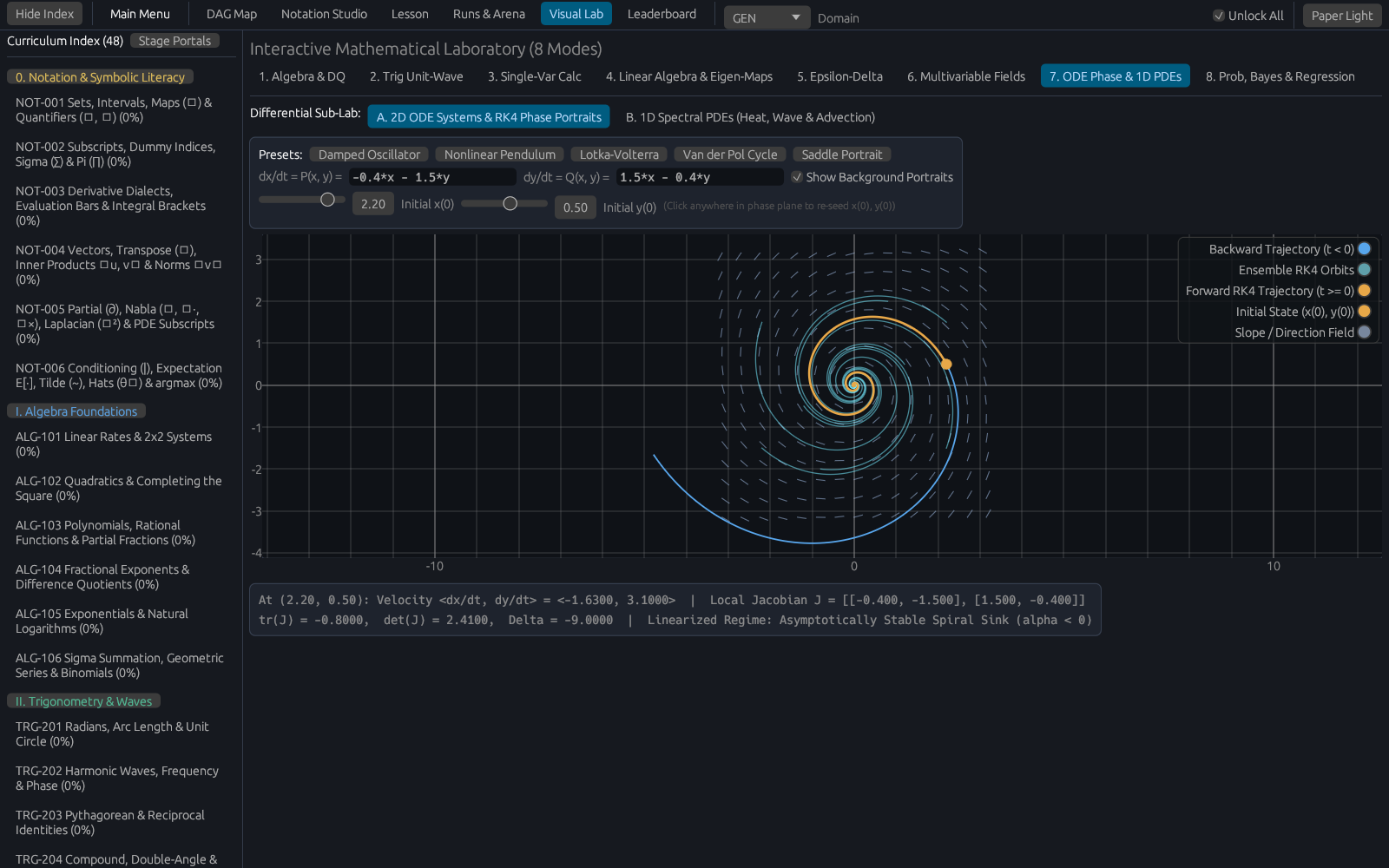
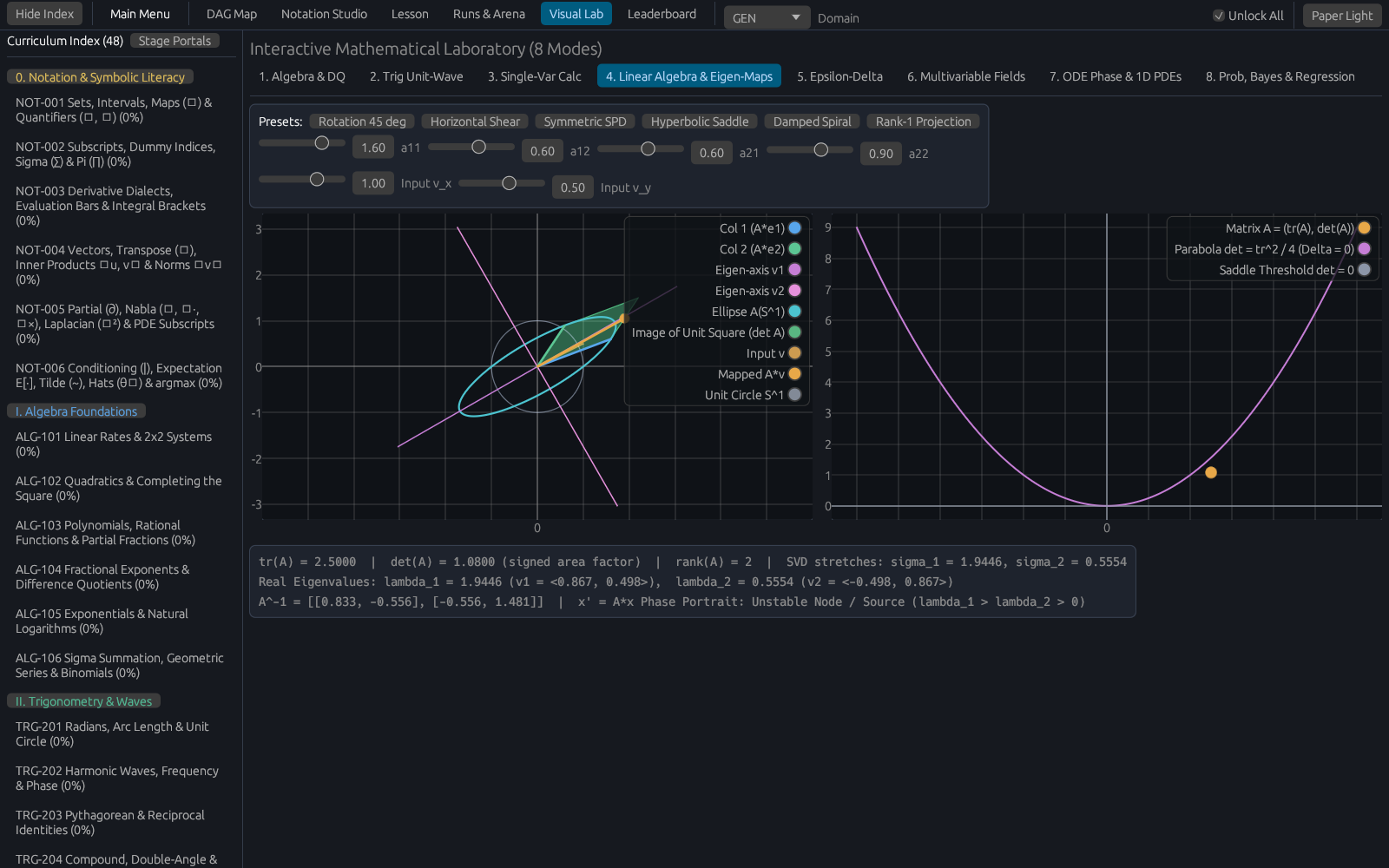
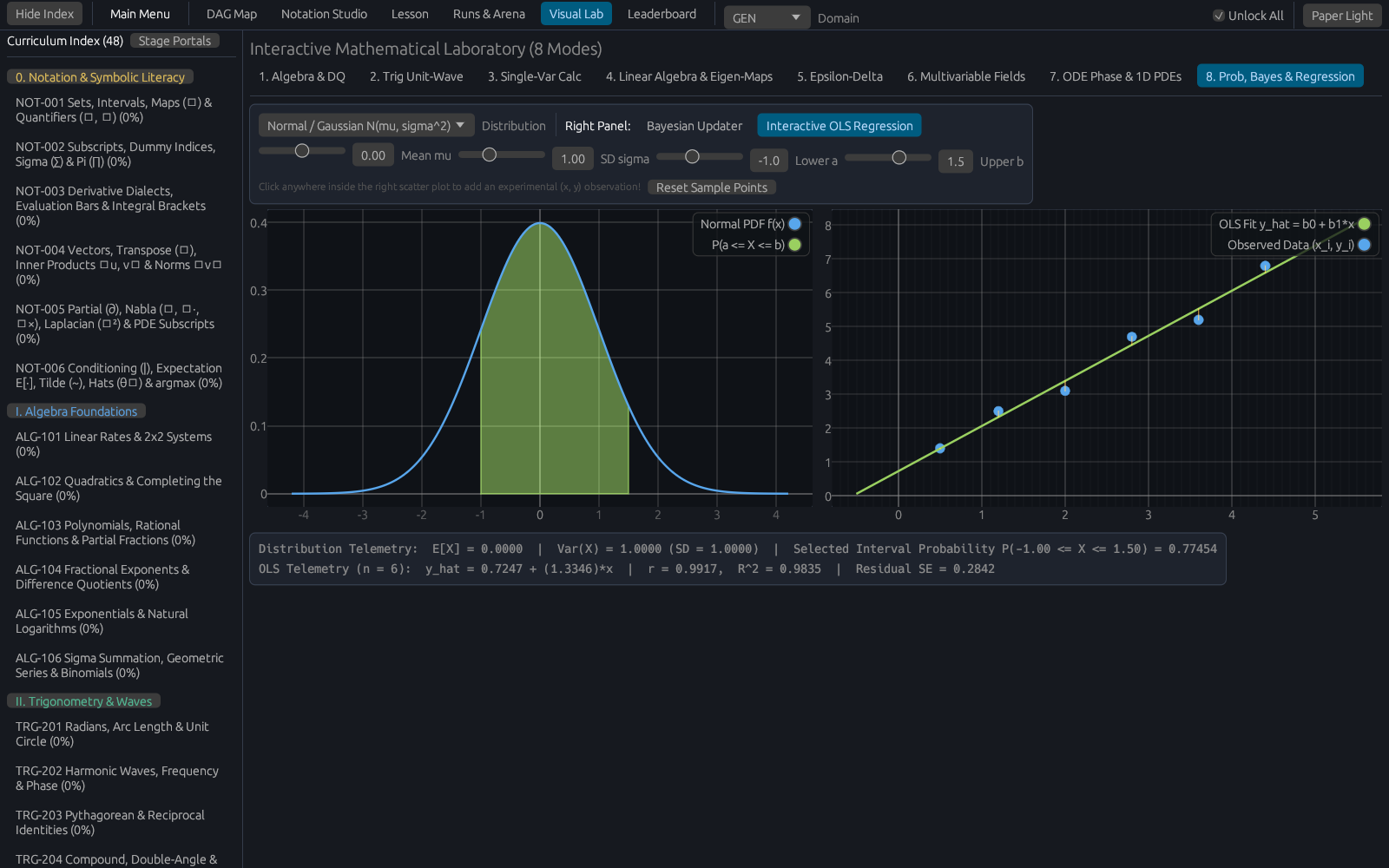
For coupled linear systems, linalg.rs focuses cleanly on intuitive 2x2 phase-plane dynamics: dragging slider bars updates matrix determinants and traces instantaneously while animating trajectory arrows smoothly from stable inward sinks through crossing saddle splits and decaying spirals. Alongside dynamical matrices, prob_stats.rs walks transparently through ordinary least squares linear trend regression paired with sequential Bayesian probability updating—allowing students to test how an uncommon positive laboratory reading shifts realistic posterior disease probability depending on prior baseline prevalence.
Time-Stepping Solvers, 48 Applied Lessons, and Local SQLite Tracking
Continuous simulation solvers reside inside ode_pde.rs, setting Explicit Euler, Classical RK4, and Fourier spectral one-dimensional Heat diffusion side by side[1][2] against closed-form exact mathematical curves so users inspect absolute error scaling directly across logarithmic grids. Wrapping those live engines, curriculum.rs and domains.rs organize 48 progressive lessons spanning six everyday quantitative domains—calculus rates of change, linear matrix stability, ordinary and partial differential modeling, probability and statistical regression, physical conservation fields, and numerical engineering craft.
Because intimidating Greek symbols frequently alienate curious high-schoolers and biology majors, Calc-Lab bundles 15 dedicated notation translation cards decoding derivatives, integrals, gradients, eigenvalues, and conditional probability bars into clear conversational language. Learner attempts, accuracy checks, and mastery badges track offline inside a local SQLite study archive managed by mastery.rs and storage.rs, driving crisp charts inside ui_lab.rs and ui_lesson.rs.
| Module / Crate | What It Does | Citation |
|---|---|---|
calc-core/ode_pde.rs | Solves ordinary differential equations (Euler, RK4) and 1D Heat PDEs. | [1], [2] |
calc-core/expr.rs & linalg.rs | Handles symbolic math expressions, derivatives, and 2x2 matrix eigenvalues/stability. | [1] |
calc-core/prob_stats.rs | Computes ordinary least squares regression and Bayesian probability updates. | [3–19] |
calc-core/curriculum.rs & domains.rs | Organizes 48 lessons across 6 math/science domains and 15 notation guides. | [3–19] |
calc-core/mastery.rs & storage.rs | Tracks user practice runs and mastery scores inside a local SQLite database. | [3–19] |
calc-app (ui_lab.rs, ui_lesson.rs, etc.) | Interactive desktop UI for lessons, notation reference, practice problems, and graphs. | [3–19] |
3. Walkthrough of Capabilities & Quantitative Findings
First-Order Euler Scaling Versus Fourth-Order RK4 Accuracy
Calc-Lab anchors solver intuition around an unmistakable, intuitive biological benchmark: saturating logistic population growth governed by dy/dt = 1.2y(1 − y), whose smooth S-curve climbs steadily toward natural carrying capacity and lands cleanly at exact closed-form target 0.550520864976 at time t = 2.0. Integrating across six step-halving trials moving steadily from coarse step h = 0.40 down through 0.20, 0.10, 0.05, 0.025, and 0.0125 exposes why algorithm choice overwhelms brute-force step shrinking. Under Explicit Euler, final prediction error trimmed modestly from 6.17e-2 at h = 0.40 down to 1.88e-3 at h = 0.0125—tracing an empirical log-log convergence slope of 1.0026 in tight agreement with first-order expectation[1].
Running Classical RK4 across the identical six grids transformed numerical fidelity immediately. Even at the coarsest time step h = 0.40, RK4 started over a thousand times closer to analytical truth (5.42e-5 error), then plummeted smoothly through 3.31e-6, 2.07e-7, 1.30e-8, and 8.15e-10 before reaching 6.26e-11 at h = 0.0125. Its empirical log-log slope clocked 3.9909—matching exact fourth-order convergence cleanly and proving how clever slope averaging buys nearly a billion-fold gain in precision at tiny grid sizes, exported transparently to rk4_convergence_table.csv[1].
Machine-Precision Heat Diffusion and Core Analytical Checks
Advancing to spatial partial differential physics over t in [0, 1.2], Calc-Lab solves the one-dimensional Heat equation initialized with two distinct Fourier spatial sine waves—one broad slow curve and one sharper fast-cooling ripple—measuring exact modal thermal energy against exponential decay theory. Calculated spectral energy matched exact analytical values down to 1.67e-16, touching the fundamental 64-bit IEEE double-precision numerical boundary where binary processor hardware runs out of finer mantissa bits[2]. Across everyday classroom checks, textbook mathematics holds to high precision too: probing a canonical 2x2 stability system resolved determinant 1.67 and trace −2.40 (correctly classifying a stable attracting sink), noisy linear scatter fit ordinary least squares cleanly at R2 = 0.9989, and sequential Bayesian conditioning updated a baseline diagnostic prior smoothly to posterior probability 0.3241.
Looking beneath the numbers makes every benchmark intuitive for new learners. Why does a sharper second spatial heat wave vanish far faster than a gentle broad temperature swell across the heated bar? Just like ripples settling inside a warm bathtub, steep jagged temperature gradients transfer heat rapidly between hot peaks and cool neighboring troughs, whereas gentle wide temperature domes hold warmth far longer. Seeing exact exponential decay hold down to sixteen decimal places reassures students that spectral algorithms neither leak energy artificially nor amplify tiny step noise.
Likewise, watching ordinary least squares regression (R2 = 0.9989) alongside a Bayesian diagnostic shift to posterior 0.3241 drives home a vital real-world lesson in probability: even a highly accurate test produces modest positive odds when baseline disease prevalence starts low. Pairing instant algebraic stability sliders with step-by-step Bayes updates turns abstract syllabus chapters into vivid laboratory discoveries inside minutes.
| Mathematical Domain | Problem Scope | Key Finding | Data Output |
|---|---|---|---|
| Curriculum & Algebra | 48 lessons, 2x2 matrices, OLS, Bayes | OLS R2 = 0.9989; Bayes posterior = 0.3241 | Interactive workbook |
| Euler vs. RK4 ODEs | Logistic growth across 6 step sizes | Euler order 1.0026; RK4 order 3.9909 (6.26e-11 err) | rk4_convergence_table.csv |
| 1D Heat Diffusion PDE | Two-mode thermal energy decay | Matches exact analytical energy to 1.67e-16 | Spectral energy log |
4. Practical Scenarios: Who Uses Calc-Lab & How
AP Calculus, University STEM Labs, and Self-Taught Learners
Mathematics instructors, high-school AP teachers, and undergraduate engineering professors routinely wish classroom lectures connected symbolic whiteboard formulas directly to living numerical experiments—without losing precious lab hours fighting broken student notebook installations or commercial paywalls. Because Calc-Lab boots cleanly as an offline desktop application bundling 48 guided lessons, 15 everyday notation translation cards, and SQLite study persistence, learners test eigenvalue phase flips, Bayesian base-rate updates, and RK4 error curves firsthand on classroom laptops or home machines with zero setup friction.
Fast Sanity-Checking Workbench for Applied Modelers
Experienced computational scientists building physiological, environmental, or transportation simulators equally appreciate a crisp, distraction-free desk tool to check Jacobian trace-determinant equilibrium signs or test whether an unfamiliar nonlinear differential equation integrates cleanly across step sizes before embedding it inside complex production pipelines[1]. Exporting structured error rows directly to rk4_convergence_table.csv keeps solver tuning simple and repeatable, whether double-checking classroom differential assignments or verifying stability margins before writing larger custom software.
Bridging Intuition Between Textbook Formulas and Real Systems
Beyond formal classrooms and engineering desks, Calc-Lab welcomes curious independent readers who once memorized derivative rules or matrix multiplications without ever seeing what those symbols actually do to a cooling cup of coffee, a vibrating bridge cable, or a growing population. Turning abstract textbook definitions into interactive visual sandboxes demystifies higher mathematics for adult learners, career switchers preparing for data-science interviews, and high-school robotics clubs tuning feedback loops. Instead of treating multivariable calculus and ordinary differential equations as gatekeeping trivia locked behind expensive campus software licenses, the shared platform catalog at crvscience.com/apps places open numerical literacy directly alongside chemistry, ecology, and climate companions for anyone eager to explore quantitative reasoning firsthand, saving local progress automatically so learners can revisit tricky concepts days later.
5. Open Access & Connections Across the CRV Science App Network
Open Access and Connections Across the CRV Science App Network
All Calc-Lab mathematical engines, interactive curriculum lessons, notation cards, and local SQLite persistence code reside openly inside the CRV Science Apps Hub at https://crvscience.com/apps for unrestricted educational reuse, independent inspection, and open classroom sharing.
Across the twelve-application CRV Science ecosystem[3–19], Calc-Lab acts as the shared mathematical primer translating everyday numerical methods cleanly across domains: TerraTwin builds directly on coupled box differential equations to project 151-year ocean heat storage and sea-level rise; SAR-Atlas solves multi-compartment oral plasma and brain dosing equations over 24-hour intervals; Urban-Grid integrates continuous car-following velocity curves along real highway lanes; BeoFold connects stochastic BAOAB thermostats and matrix transition eigenvectors to folding landscapes; and both OSABT and EpiLedger share linear regression and Bayesian updating foundations across ecology and epidemiology.
References
- [1] Butcher, J. (2003). Numerical Methods for Ordinary Differential Equations. Wiley. https://doi.org/10.1002/0470868279
- [2] LeVeque, R. J. (2007). Finite Difference Methods for Ordinary and Partial Differential Equations. SIAM. https://doi.org/10.1137/1.9780898717839
- [3] White, B. P. (2026). The CRV Science App Network: Seventeen Open-Source Rust Programs for Science, Data, and Simulation. CRV Science App Preprint APP-PREPRINT-01 [cs.SE, cs.CE, q-bio.QM], v1.0.0. Hosted via CRV Science Apps Hub (https://crvscience.com/apps). https://doi.org/10.5281/zenodo.24222398
- [4] White, B. P. (2026). AeroFlyway: Tracking Bird Migration with Weather Radar, Skyglow Maps, and Nighttime Flight Calls. CRV Science App Preprint APP-PREPRINT-13 [q-bio.PE, physics.ao-ph, cs.GR], v0.6.0. Hosted via CRV Science Apps Hub (https://crvscience.com/apps). https://doi.org/10.5281/zenodo.24222366
- [5] White, B. P. (2026). BeoFold: Simulating How Proteins Fold Using Distributed Computing and State Networks. CRV Science App Preprint APP-PREPRINT-02 [q-bio.BM, physics.chem-ph, cs.DC], v1.4.0. Hosted via CRV Science Apps Hub (https://crvscience.com/apps). https://doi.org/10.5281/zenodo.24222370
- [6] White, B. P. (2026). Causal-Atlas: Tracing How Genes and Drugs Turn Biological Pathways On and Off. CRV Science App Preprint APP-PREPRINT-04 [q-bio.MN, q-bio.GN, stat.ML], v0.2.0. Hosted via CRV Science Apps Hub (https://crvscience.com/apps). https://doi.org/10.5281/zenodo.24222376
- [7] White, B. P. (2026). Cit-Atlas: Mapping Citation Networks and Research Impact Across Scientific Papers. CRV Science App Preprint APP-PREPRINT-05 [cs.DL, cs.SI, physics.soc-ph], v1.8.0. Hosted via CRV Science Apps Hub (https://crvscience.com/apps). https://doi.org/10.5281/zenodo.24222380
- [8] White, B. P. (2026). EpiLedger: Privacy-Safe Disease Tracking, Clinical Text Screening, and Outbreak Monitoring. CRV Science App Preprint APP-PREPRINT-06 [cs.CR, q-bio.PE, stat.AP], v2.0.0. Hosted via CRV Science Apps Hub (https://crvscience.com/apps). https://doi.org/10.5281/zenodo.24222382
- [9] White, B. P. (2026). ITME: Simulating Four Billion Years of Life, Oceans, and Atmosphere Evolution. CRV Science App Preprint APP-PREPRINT-07 [q-bio.PE, nlin.AO, physics.bio-ph], v2.3.0. Hosted via CRV Science Apps Hub (https://crvscience.com/apps). https://doi.org/10.5281/zenodo.24222386
- [10] White, B. P. (2026). OSABT: All-in-One Toolkit for Plant Physiology, Survival Curves, Genetics, and Enzyme Kinetics. CRV Science App Preprint APP-PREPRINT-08 [q-bio.QM, stat.AP, cs.SE], v2.0.0. Hosted via CRV Science Apps Hub (https://crvscience.com/apps). https://doi.org/10.5281/zenodo.24222388
- [11] White, B. P. (2026). SAR-Atlas: Drug Design, Body Distribution Modeling, and Candidate Screening in Rust. CRV Science App Preprint APP-PREPRINT-09 [physics.chem-ph, q-bio.BM, cs.LG], v3.8.0. Hosted via CRV Science Apps Hub (https://crvscience.com/apps). https://doi.org/10.5281/zenodo.24222390
- [12] White, B. P. (2026). TerraTwin: Fast Climate Projections for Global Warming, Sea-Level Rise, and Arctic Change. CRV Science App Preprint APP-PREPRINT-10 [physics.ao-ph, cs.CE, stat.AP], v2.5.0. Hosted via CRV Science Apps Hub (https://crvscience.com/apps). https://doi.org/10.5281/zenodo.24222392
- [13] White, B. P. (2026). Urban-Grid: Modeling City Traffic, Emergency Response Coverage, and Earthquake Evacuation. CRV Science App Preprint APP-PREPRINT-11 [physics.soc-ph, cs.MA, cs.CE], v5.2.0. Hosted via CRV Science Apps Hub (https://crvscience.com/apps). https://doi.org/10.5281/zenodo.24222394
- [14] White, B. P. (2026). WildFront BattleGrounds: Turn-Based Hex Strategy Game with Voxel Graphics and Procedural Map Generation. CRV Science App Preprint APP-PREPRINT-12 [cs.GT, cs.GR, math.CO], v3.4.1. Hosted via CRV Science Apps Hub (https://crvscience.com/apps). https://doi.org/10.5281/zenodo.24222396
- [15] White, B. P. (2026). HelioProbe: Simulating Spacecraft Orbits, Deep-Space Telescopes, and Comet Tails in 3D. CRV Science App Preprint APP-PREPRINT-14 [astro-ph.EP, astro-ph.IM, cs.GR], v2.3.0. Hosted via CRV Science Apps Hub (https://crvscience.com/apps). https://doi.org/10.5281/zenodo.24244083
- [16] White, B. P. (2026). PopBio-Studio: Interactive Population Biology, Adaptive Landscapes, and Genetic Skyline Simulator. CRV Science App Preprint APP-PREPRINT-15 [q-bio.PE, q-bio.QM, stat.AP], v1.2.0. Hosted via CRV Science Apps Hub (https://crvscience.com/apps). https://doi.org/10.5281/zenodo.24244085
- [17] White, B. P. (2026). QuantaCrypt-Studio: Simulating Quantum Circuits, Quantum Key Distribution, and Post-Quantum Cryptography. CRV Science App Preprint APP-PREPRINT-16 [quant-ph, cs.CR, cs.MS], v2.2.0. Hosted via CRV Science Apps Hub (https://crvscience.com/apps). https://doi.org/10.5281/zenodo.24244089
- [18] White, B. P. (2026). SonoWing: Analyzing Bat Echolocation and Bird Calls with Spectrograms and Harmonic Tracking. CRV Science App Preprint APP-PREPRINT-17 [q-bio.NC, q-bio.PE, cs.SD], v1.1.0. Hosted via CRV Science Apps Hub (https://crvscience.com/apps). https://doi.org/10.5281/zenodo.24244091
- [19] White, B. P. (2026). SwarmForge: 3D Isometric Automated Factory and Swarm Robotics Simulation Game. CRV Science App Preprint APP-PREPRINT-18 [cs.MA, cs.RO, cs.GT], v1.3.0. Hosted via CRV Science Apps Hub (https://crvscience.com/apps). https://doi.org/10.5281/zenodo.24244093