CRV Science App Preprint
Open-Source Scientific Apps & Network Engines
Independent high-performance Rust applications across aeroecology, astrodynamics, bioacoustics, population biology, quantum computing, swarm robotics, protein folding, differential equations, causal genomics, scientometrics, privacy epidemiology, biostatistics, QSAR/PBPK, climate twins, urban evacuations, and voxel game theoryโstrictly separated from CRV Science Labs (bio-suite / RuNIE).
Public CRV Science GitHub Repositories
Concise 2โ3 column repository index for the 18 public crvscience-* Rust software crates (excludes crvscience-labs / RuNIE).
AeroFlyway v0.6.0
Bird migration mapping tool combining flight simulation, city light-pollution risk, weather radar profiles, and nighttime bird call audio detection.
BeoFold v1.4.0
Protein folding simulator built to run across multiple computers, pairing temperature-swap sampling with kinetic state networks.
Calc-Lab v0.5.0
48-lesson interactive math workbench covering calculus, linear algebra, differential equations, probability, and scientific notation.
Causal-Atlas v0.2.0
Gene-expression analysis app that finds which upstream signals drive cellular changes and which drugs reverse them.
Cit-Atlas v1.8.0
Research paper network tool that gathers records from major scholarly APIs, detects topic clusters, and scores citation impact.
EpiLedger v2.0.0
Public health toolkit for privacy-safe case reporting, encrypted record matching, symptom note filtering, outbreak growth tracking, and wastewater variant estimates.
ITME v2.3.0
Long-term Earth and life simulator tracking major evolutionary milestones, oxygen and carbon dioxide shifts, and branching family trees.
OSABT v2.0.0
20-module biology and statistics workbench covering leaf photosynthesis, river oxygen balance, survival curves, population genetics, DNA cloning, and enzyme rates.
SAR-Atlas v3.8.0
Medicinal chemistry workbench combining drug-likeness scoring, blood-to-brain dosing models, binding energy cycles, and smart compound screening.
TerraTwin v2.5.0
Fast climate model simulating 1950โ2100 warming pathways, ocean heat uptake, sea-level rise, heat stress, and polar warming.
Urban-Grid v5.2.0
City infrastructure simulator uniting car-by-car traffic flow, ambulance station placement, and earthquake lifeline recovery.
WildFront BattleGrounds v3.4.1
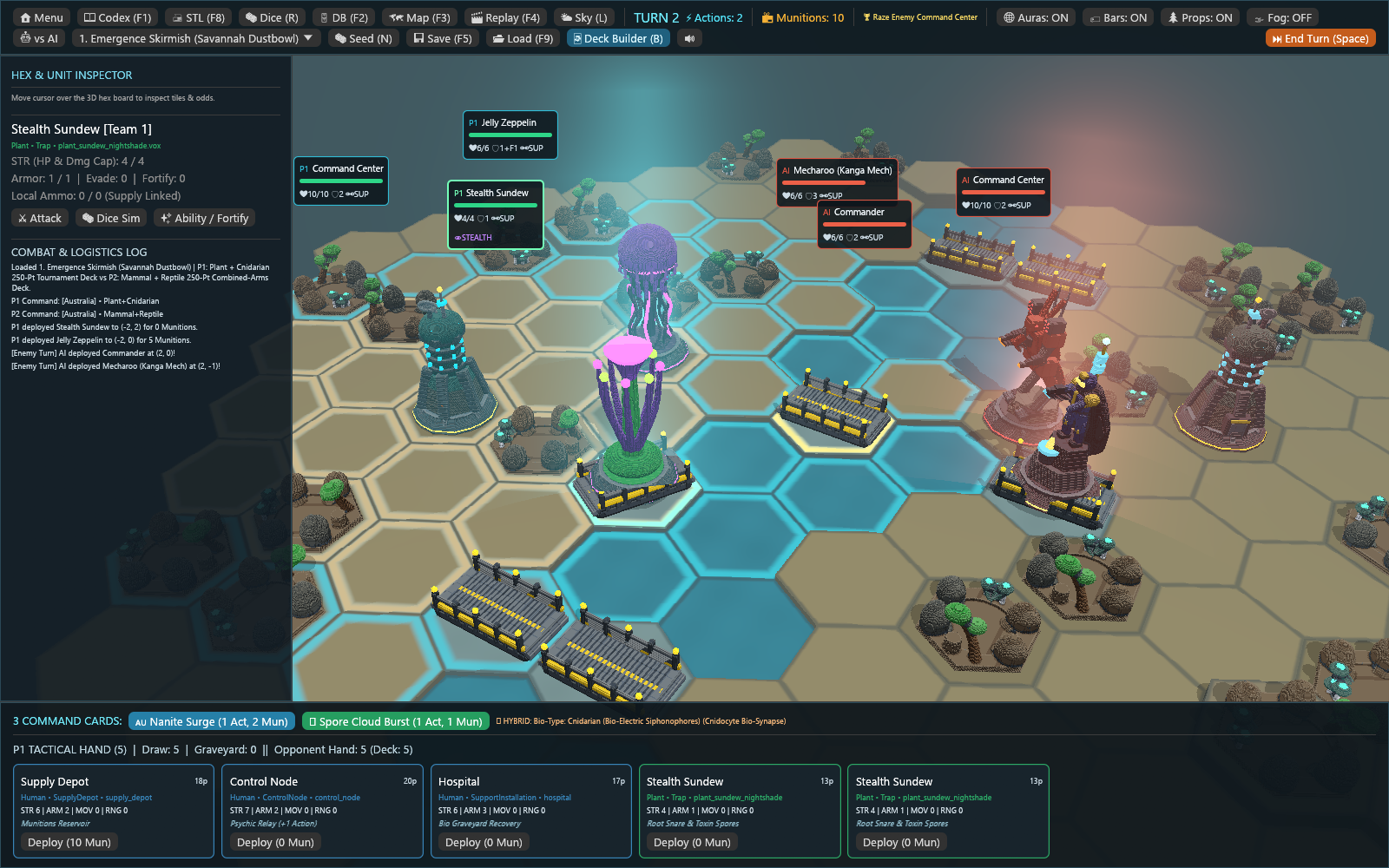
Turn-based hex strategy game combining deterministic match replays, 152-card game-theory balance checks, procedural maps, and 64-tree 3D voxel rendering.
HelioProbe v2.3.0
3D space-mission and astronomy simulator modeling spacecraft trajectories, Sun-Earth L2 telescopes, dynamic comet tails, and icy-moon cryobots.
PopBio-Studio v1.2.0
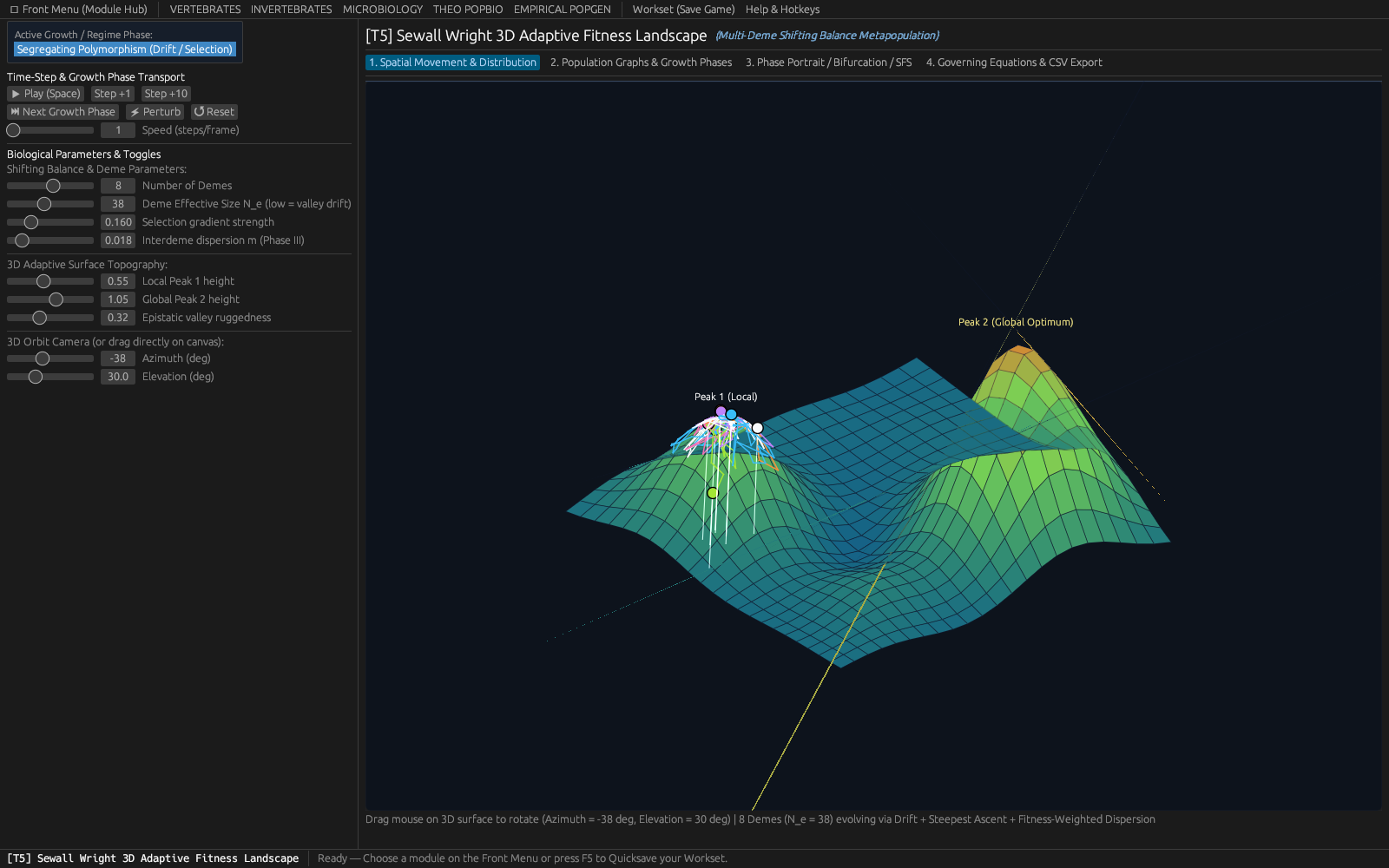
Population biology workbench combining Sewall Wright 3D adaptive landscapes, Leslie/Lefkovitch matrices, Bayesian skyline plots, and haplotype networks.
QuantaCrypt-Studio v2.2.0
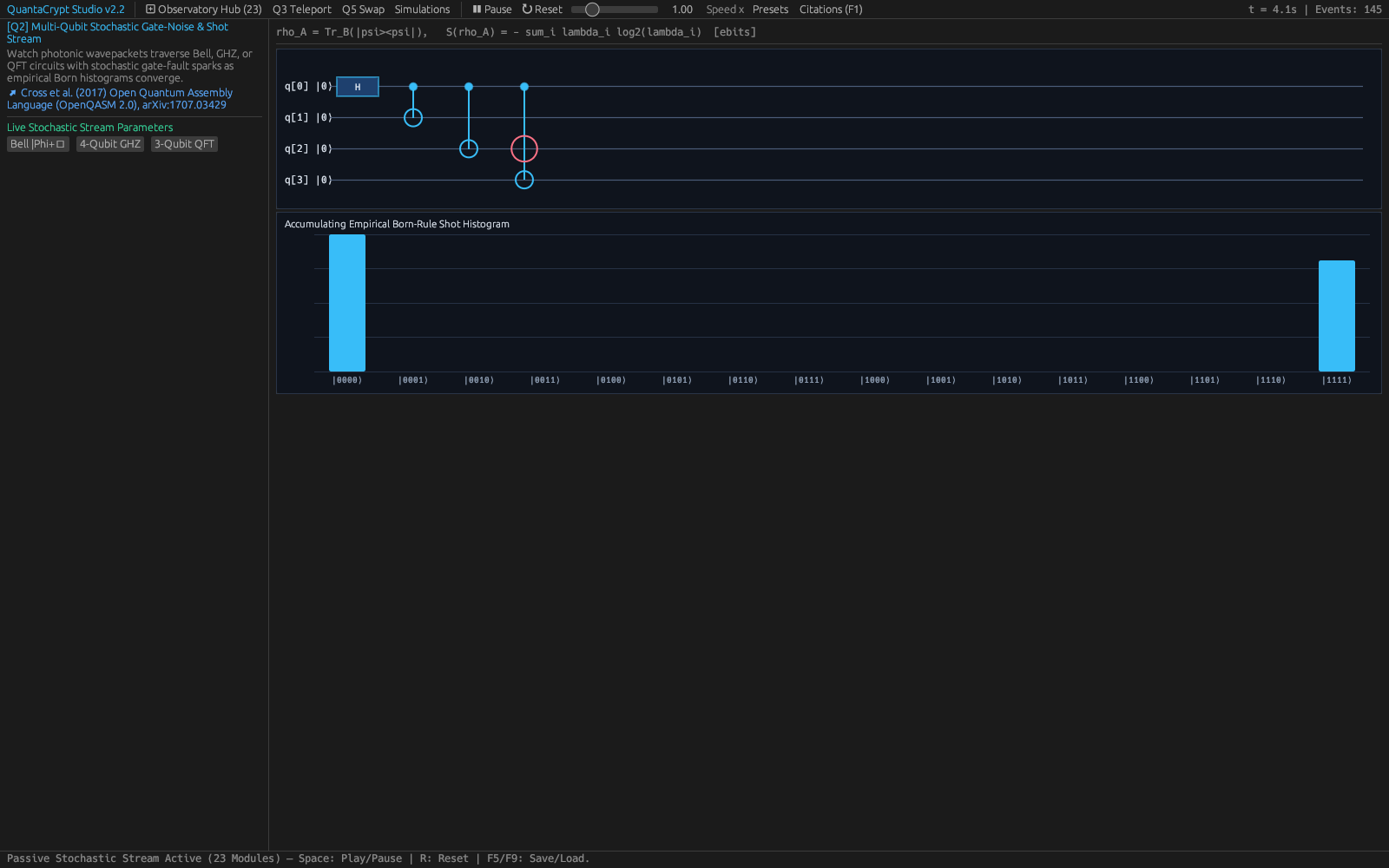
23-module quantum and cryptography workbench spanning double-slit intuition, noisy qubit/qudit circuits, photonic QKD, lattice PQC, and surface-code error correction.
SonoWing v1.1.0
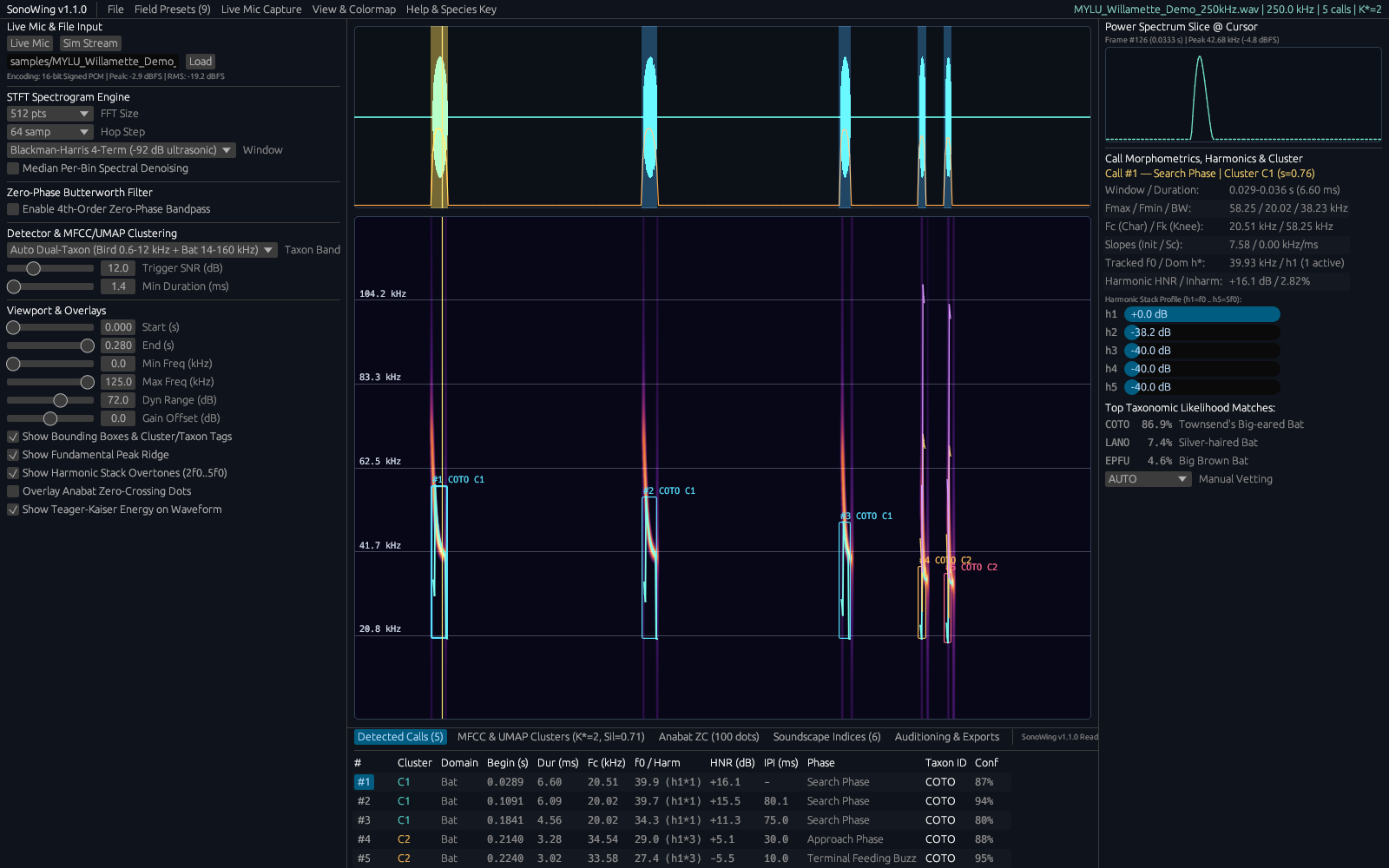
Sonic and ultrasonic bioacoustics workbench featuring STFT spectrograms, harmonic tracking, MFCC/UMAP call clustering, live microphone capture, and GUANO WAV export.
SwarmForge v1.3.0
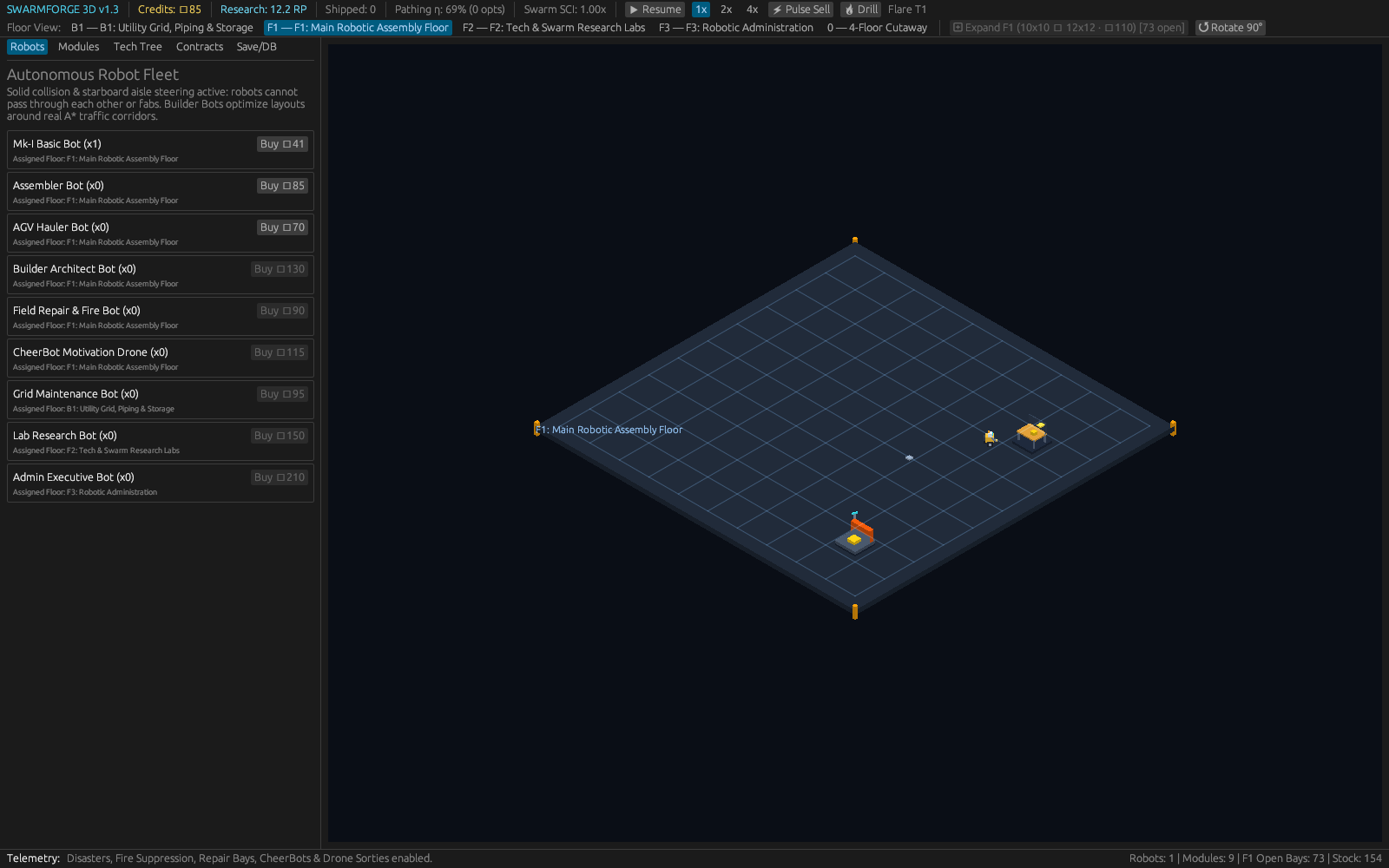
3D isometric factory and swarm-intelligence game featuring multi-floor robot pathfinding, disaster suppression, tech-tree scaling, and SQLite save persistence.
NeuroSpace Lab v1.6.0
3D neural topology and computational neuroscience workbench spanning 15 neural architectures from perceptrons and MoE transformers to six-layered cerebral cortex grey matter (L1โL6), optogenetics, and causal lesions across 7 benchmark datasets.
App Preprints & Cross-Network Technical Survey
Dedicated preprint feed for the 18 public Rust applications and the overarching network summary (APP-PREPRINT-01โ19). Kept strictly separate from CRV Science Labs bio-suite monographs. Tracked via apps-rss.xml.
The CRV Science App Network: Seventeen Open-Source Rust Programs for Science, Data, and Simulation
This overarching network overview introduces the seventeen open-source Rust applications hosted on the CRV Science Apps Hub (https://crvscience.com/apps), explaining how the public software ecosystem is organized, why clear, accessible exposition matters, and how individual repositories interoperate cleanly across domains. Designed deliberately for open community use and strictly separated from internal laboratory discovery feeds, the seventeen public programs organize into four clear pillars totaling 485 modular Rust source files: Earth, Space & Bioacoustics (AeroFlyway, HelioProbe, ITME, SonoWing, TerraTwin), Molecular, PopBio & Biotech (BeoFold, Causal-Atlas, OSABT, PopBio-Studio, SAR-Atlas), Public Health & Urban Systems (EpiLedger, Urban-Grid), and Math, Quantum & Swarm/Voxel Systems (Calc-Lab, Cit-Atlas, QuantaCrypt-Studio, SwarmForge, WildFront BattleGrounds). Each application pairs native offline execution with transparent module inventories, reproducible CSV/JSON outputs, CFF citation files, and mutual Zenodo Concept DOI links uniting all eighteen dedicated software preprints.
BeoFold: Simulating How Proteins Fold Using Distributed Computing and State Networks
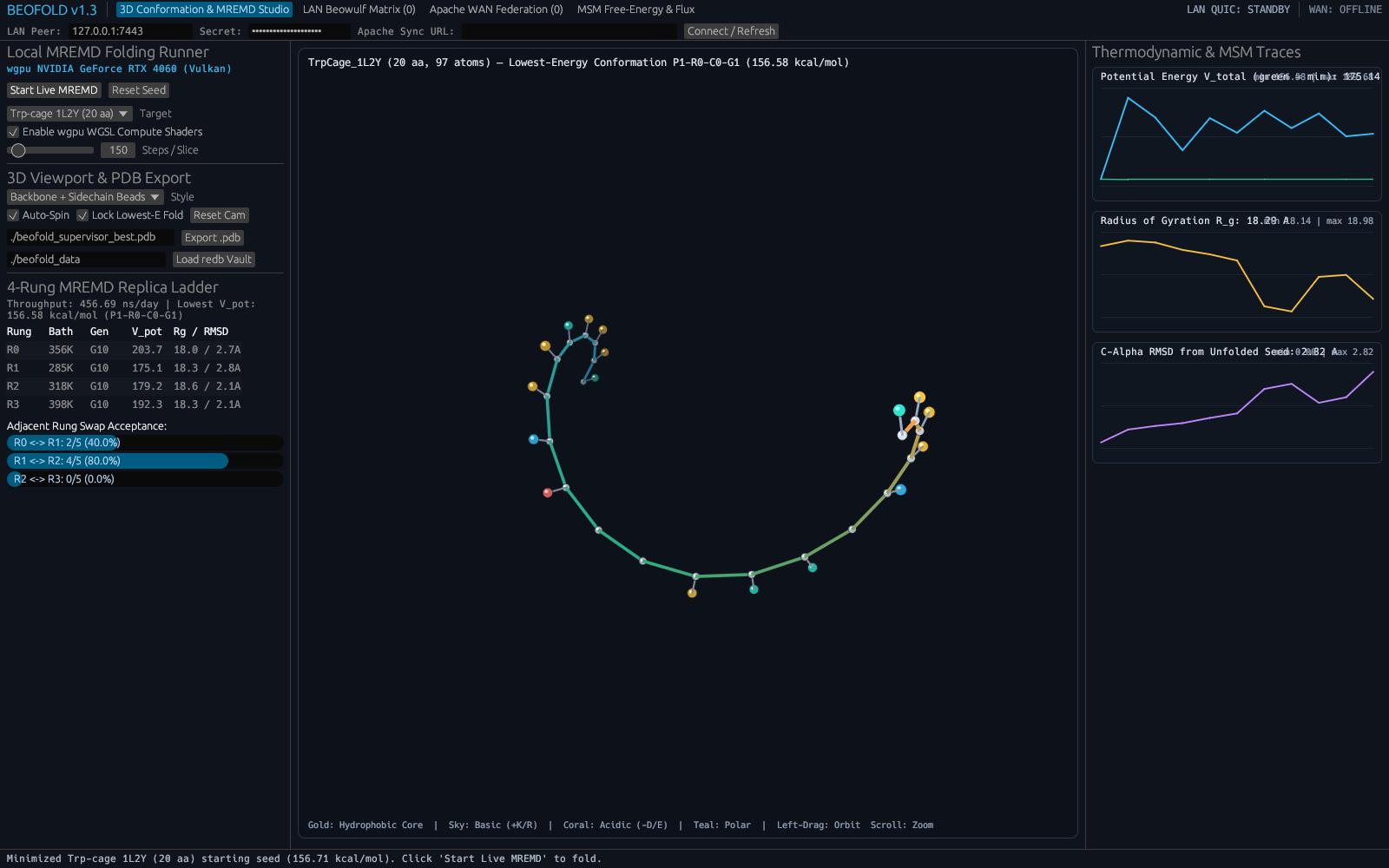
BeoFold (v1.4.0) is an open-source molecular simulation and cluster-networking program built to investigate how short amino-acid chains fold into stable, functional three-dimensional protein structures. Simulating protein folding inside a single conventional computer at normal biological temperatures is remarkably slow because flexible molecules spend almost all of their time bouncing inside shallow, partially folded pockets separated by tall energy walls. BeoFold solves that sampling trap by orchestrating parallel replicas across multiple temperaturesโallowing warm copies to cross energy barriers and trade shapes cleanly with cooler copiesโwhile optionally linking ordinary lab desktops over encrypted QUIC and Raft consensus networking. Once snapshots accumulate, BeoFold converts thousands of noisy atomic coordinates into a clear network of stable states and folding speeds. On the classic 20-amino-acid Trp-cage model protein, BAOAB thermal integration held kinetic motion steady near 282.3828 K, four temperature tiers from 285 K to 405 K achieved a 47.89% exchange rate down to 156.6821 kcal/mol, and spectral state clustering mapped three distinct structural basins with near-exact time-reversibility.
Calc-Lab: Interactive Calculus, Linear Algebra, and Differential Equation Solver Workbench
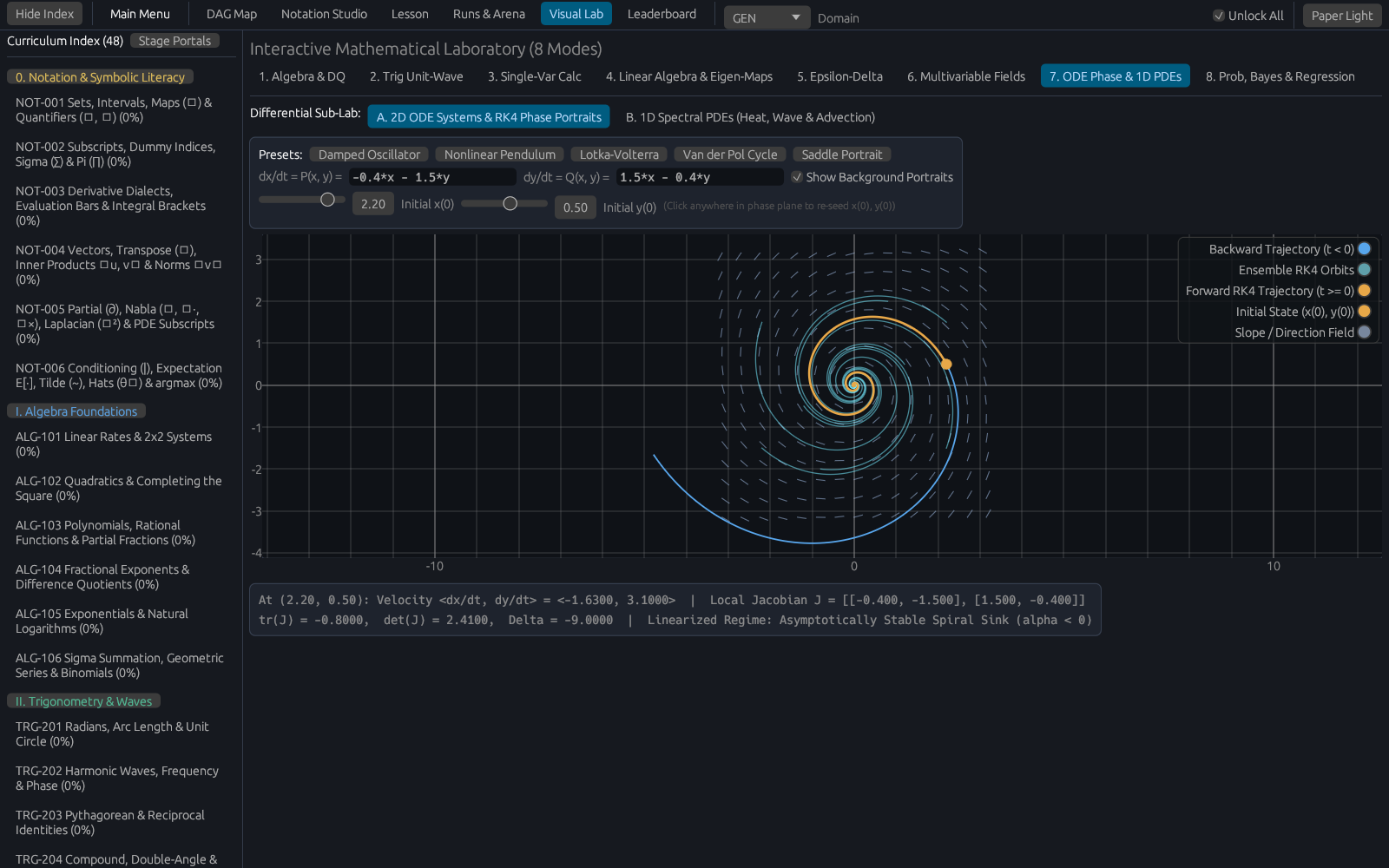
Calc-Lab (v0.5.0) is an interactive mathematics and numerical-computing workbench built to illuminate how calculus, linear algebra, probability, and differential equations power everyday scientific modeling. Traditional textbooks frequently separate symbolic formulas on paper from the discrete computer algorithms that actually approximate derivatives, matrix equilibria, and time-evolving physics in real applicationsโleaving students unsure why step sizes matter or when numerical rounding erodes accuracy. Calc-Lab bridges that divide by uniting 48 guided lessons across six quantitative domains with a live numerical kernel where users adjust parameters and watch error scaling directly. Across logistic growth benchmarks, halving step sizes shrinks Explicit Euler error at first-order speed (rate 1.0026) while Classical Runge-Kutta (RK4) drives error down at fourth-order speed (rate 3.9909, achieving 6.26e-11 precision). On a two-mode one-dimensional Heat equation, spectral thermal energy matches exact analytical theory to 1.67e-16โreaching the double-precision ceiling of standard 64-bit processorsโwhile linear regression (R^2 = 0.9989), 2x2 matrix stability, and Bayesian updates reproduce textbook results interactively.
Causal-Atlas: Tracing How Genes and Drugs Turn Biological Pathways On and Off
Causal-Atlas (v0.2.0) is an open-source functional genomics application designed to help biomedical researchers, pharmacology teams, and students make clear sense of large gene-expression experiments (such as RNA-seq). Traditional pathway checklists typically only ask whether altered genes cluster inside an annotated biological category, discarding a critical clue: whether individual genes changed up or down in the exact direction a regulator is known to push them. Causal-Atlas restores biological directionality inside an offline desktop and terminal program by comparing fold changes against signed causal "activates" and "inhibits" edges, ranking candidate upstream master switches with directional Z-scores, tracing multi-step regulatory chains, and matching disease expression signatures against drug perturbation profiles to pinpoint candidate compounds that flip sick cellular programs back toward baseline. On inflamed human blood-vessel cells (HUVEC + TNF), Causal-Atlas identified TNF (z = +4.47) and NFKB1 (+4.00) as principal drivers, detected Dexamethasone (z = โ2.65) as an opposing regulator, and prioritized BMS-345541 (โ93.84) atop drug-reversal candidates.
Cit-Atlas: Mapping Citation Networks and Research Impact Across Scientific Papers
Cit-Atlas (v1.8.0) is an open-source scientometrics workstation built to gather, clean, organize, and analyze scientific citation networks without fragile scraping scripts or API lockouts. Modern literature reviews often draw records from multiple public scholarly indexes simultaneouslyโOpenAlex, Crossref, PubMed, and Semantic Scholarโeach enforcing different rate limits and producing duplicate metadata entries when combined naively. Cit-Atlas coordinates polite, per-provider traffic pacing alongside automatic congestion circuit breakers, merges duplicate records across databases by DOI and normalized title, detects coherent research topics with graph community algorithms, and computes both citation prestige and novelty disruption. Across 128 parallel requests over eight worker threads, every external API stayed strictly above its minimum spacing floor (109 ms to 990 ms) with zero burst violations. On a curated 47-paper, 78-edge cross-disciplinary graph spanning six fields, Louvain modularity separated five clean research communities (Q = 0.6612), Infomap cut random-walk description length by 19.52%, deduplication reconciled noisy records at F1 = 1.00, and disruption metrics contrasted foundational breakthroughs like Shannon (1948, CD = +1.00) with consolidating surveys.
EpiLedger: Privacy-Safe Disease Tracking, Clinical Text Screening, and Outbreak Monitoring
EpiLedger (v2.0.0) is an open-source public health informatics workstation designed so local clinics, epidemiologists, and regional health agencies can track infectious outbreaks accurately while protecting individual patient confidentiality. Releasing small-town case counts or cross-linking clinic databases poses severe re-identification hazards, yet withholding public health summaries blinds schools and hospitals when transmission accelerates. EpiLedger bridges privacy and surveillance inside one offline-first application uniting Laplace differential privacy with strict cumulative budget accountants, SHA-256 tamper-evident release ledgers, encrypted Bloom-filter record linkage across clinics, clinical triage note negation screening, real-time Cori reproduction-number (Rt) tracking, and wastewater viral variant estimation. Across 253 weeks of U.S. measles records, privacy noise stayed below one case per week (MAE = 0.972), ledger hashing flagged simulated single-cell edits immediately, encrypted record matching scored F1 = 1.00, clinical filtering excluded all 37 negated mentions with zero false alerts, Cori estimation captured peak Rt = 10.27, and wastewater variant estimation resolved a JN.1-to-XEC transition cleanly (mean L1 error 0.00765).
ITME: Simulating Four Billion Years of Life, Oceans, and Atmosphere Evolution
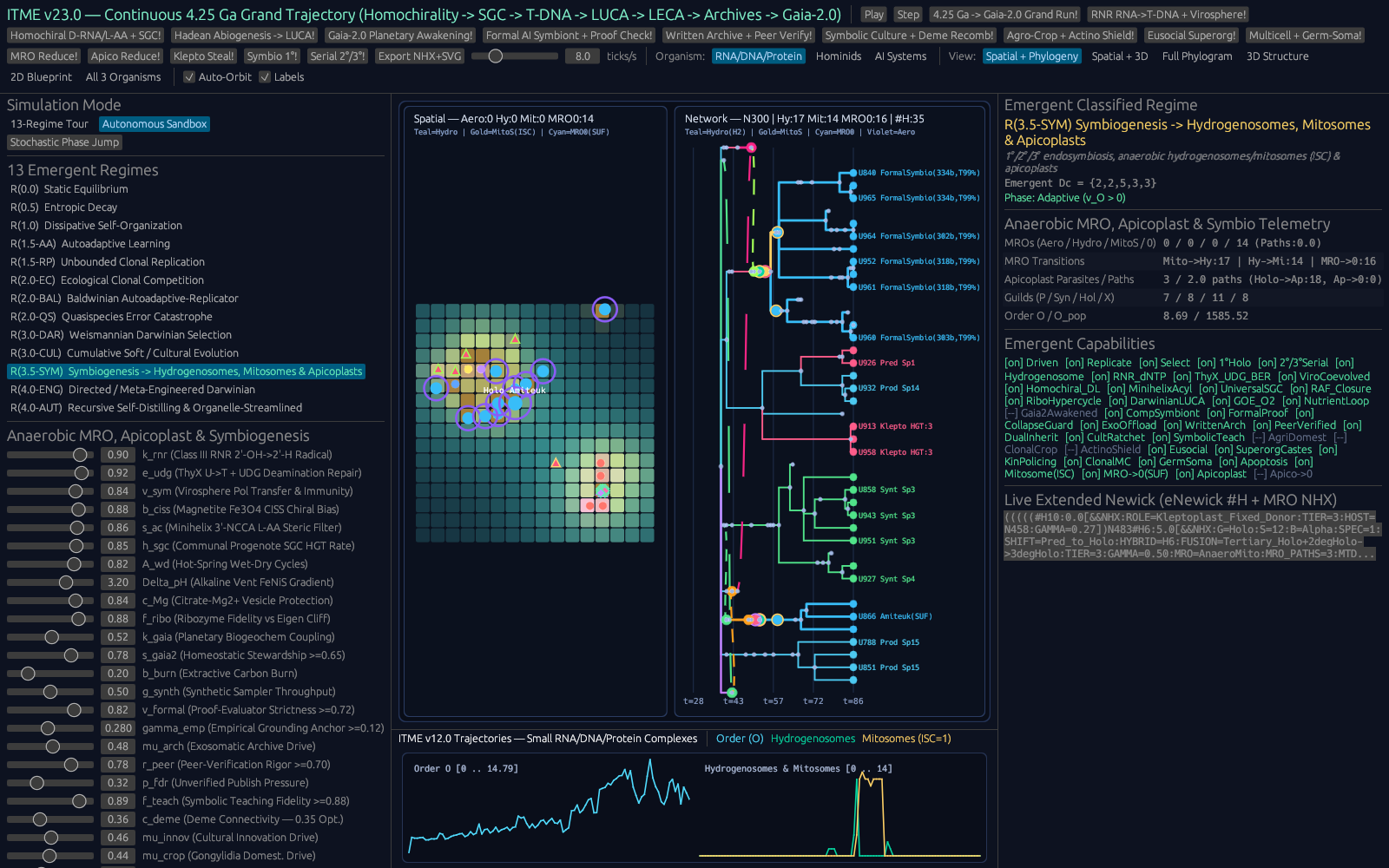
ITME (v2.3.0, Information-Theoretic Macroevolution) is an open-source deep-time Earth-and-biosphere simulator designed to study how biological complexity and planetary atmospheric chemistry co-evolved across 4.25 billion years. Rather than treating oceans, continents, and skies as static backdrops beneath evolving species, ITME simulates the tight two-way feedback connecting them: whenever evolving populations unlocked major transitionsโsuch as self-replicating protocells, oxygenic photosynthesis during the Great Oxidation Event, endosymbiotic eukaryotic mergers, and multicellular ecosystemsโgenomes accumulated functional heritable information while life profoundly remade atmospheric oxygen and carbon dioxide worldwide. Across an 8-epoch, 96-tick trajectory spanning 4.25 billion years, five active inheritance channels lifted heritable mutual information from 85.43 bits to 1,113.63 bits while planetary oxygen rose from 0.060 to 0.852 and atmospheric CO2 drew down from 1,180 to 220 ppm. Following an extreme extinction shock, diversity rebuilt smoothly back to 34 lineages (conservation correlation ฯ = 0.9349) within a 47-leaf Newick phylogeny preserving 578 splits and 61 endosymbiotic mergers.
OSABT: All-in-One Toolkit for Plant Physiology, Survival Curves, Genetics, and Enzyme Kinetics
OSABT (v2.0.0, Open-Source Applied Biostatistics Toolkit) is an all-in-one desktop, terminal, and command-line workbench uniting 20 quantitative engines essential to modern biology labs, ecological field stations, and molecular genetics courses. Everyday biological investigations constantly cross disciplinary boundariesโjumping from leaf gas-exchange curves and stream dissolved-oxygen budgets to toxicology survival regressions, sequence population genetics, DNA cloning assembly, and enzyme inhibition kineticsโyet each calculation typically lives inside separate spreadsheet templates or brittle scripts. OSABT ends that fragmentation in one fast, dependency-free native Rust executable. Across representative biological and laboratory datasets, OSABT fitted C3 leaf photosynthesis at R^2 = 0.999957, modeled stream oxygen balance to 0.000281 mg/L RMSE, resolved Cox survival hazard ratios cleanly (HR = 7.81, Probit LC50 = 27.00), measured population divergence across 28 FASTA records (Hudson Fst = 0.7945), cleaved and assembled exact 1,047-bp plasmid fragments (99.6% Golden Gate ligation fidelity), and solved competitive and tight-binding enzyme kinetics down to R^2 >= 0.999995.
SAR-Atlas: Drug Design, Body Distribution Modeling, and Candidate Screening in Rust
SAR-Atlas (v3.8.0) is an open-source medicinal chemistry and pharmacokinetics workbench built to help drug-discovery researchers and students evaluate whether promising candidate compounds carry the balanced physical properties, oral absorption, brain penetration, and binding stability needed to succeed as real medicines. Many small molecules bind strongly to a purified target in test tubes yet fail later in development because they dissolve poorly in gut fluids, clear too quickly through the liver, or are expelled at the protective blood-brain barrier. SAR-Atlas integrates four complementary screening pipelines inside one offline desktop application: multiparameter drug-likeness scoring (CNS MPO and QED) alongside matched-molecular-pair activity-cliff detection, 24-hour oral blood-and-brain physiologically based pharmacokinetic (PBPK) modeling, maximum-likelihood relative binding free energy (RBFE) thermodynamic cycle closure, and pool-based Bayesian active learning. Evaluated across 26 CNS and peripheral reference drugs, SAR-Atlas identified 11 balanced Pareto leads and 5 sharp activity cliffs; in 24-hour oral dosing it separated brain-entering Haloperidol (Kp,uu = 0.923, 82.41% receptor occupancy) from excluded Lapatinib (Kp,uu = 0.062, 0.15% occupancy); and it reconciled 6-cycle Dopamine D2 thermodynamic loop errors down to 0.000 kcal/mol.
TerraTwin: Fast Climate Projections for Global Warming, Sea-Level Rise, and Arctic Change
TerraTwin (v2.5.0) is an interactive desktop Earth-system simulator designed to help educators, students, coastal resilience teams, and policy readers explore how 21st-century energy and emissions decisions shape global warming, sea-level rise, extreme heat stress, and polar warming from 1950 through 2100. Full three-dimensional supercomputer climate models reproduce remarkable atmospheric detail yet demand days or weeks per trajectoryโfar too slow for interactive classroom comparisons. TerraTwin translates established radiative forcing physics and ocean thermal inertia into a fast coupled Earth model executing smoothly across all four canonical Shared Socioeconomic Pathway (SSP) emissions trajectories in milliseconds. Across continuous 151-year projections, year-2100 warming spans +1.530 ยฐC under rapid mitigation (SSP1-1.9) to +5.558 ยฐC under fossil-heavy growth (SSP5-8.5), while 0โ2,000 m ocean thermal expansion pushes sea-level rise from 15.84 cm to 112.20 cm, coastal storm surges climb from 1.311 m to 2.054 m, and high-northern Arctic warming outpaces tropical warming by 2.51x to 2.56x.
Urban-Grid: Modeling City Traffic, Emergency Response Coverage, and Earthquake Evacuation
Urban-Grid (v5.2.0) is an open-source metropolitan infrastructure, transportation, and emergency-resilience simulator built to analyze everyday vehicle traffic, emergency-medical station placement, seismic bridge fragility, and disaster evacuation together on real city street maps. Conventionally, traffic engineers, ambulance dispatch planners, and earthquake engineers run disconnected modelsโmissing how morning rush-hour bottlenecks, concurrent busy 911 calls, or closed river spans compound each other during emergencies. Urban-Grid imports authentic OpenStreetMap road networks and GTFS transit routes so users can explore car-by-car IDM/MOBIL traffic dynamics, stochastic hypercube queueing for four-minute NFPA 1710 response, Cascadia Mw 9.0 seismic bridge damage and 90-day utility recovery, and contraflow highway evacuation alongside post-quake fire spread inside one 3D GPU workbench. On a 9.16 lane-km urban corridor, microscopic traffic ramped cleanly up to 10,350 vehicles/hr with zero crashes; four-apparatus queueing siting lifted expected 4-minute coverage to 81.95% with 100% second-due backup; and seismic bridge retrofits boosted 90-day lifeline recovery from 97.97% to 99.18% while evacuating 2,585 residents without fire overruns.
WildFront BattleGrounds: Turn-Based Hex Strategy Game with Voxel Graphics and Procedural Map Generation
WildFront BattleGrounds (v3.4.1) is an open-source turn-based hexagonal tactical strategy game written in Rust featuring procedural arena synthesis, a 152-card deck builder, an expected-value AI tactician, lockstep TCP multiplayer, and a custom 64-tree 3D voxel raymarching graphics engine. Designed specifically for interactive entertainment and algorithmic craft rather than biological simulation, WildFront BattleGrounds combines discrete mathematics, competitive game-theory balancing, and real-time computer graphics engineering under one roof. Procedural hex arenas spanning 127 to 217 tiles preserve exact mirror and rotational symmetry across 160 checks while ensuring unobstructed maneuver routes across 732 path evaluations. Deterministic 64-bit FNV-1a hashing keeps 237 turn transitions bit-identical between saved replays and remote multiplayer peers. Auditing the entire 152-card tactical roster establishes tight deployment cost alignment with combat utility (Pearson r = 0.998889) across 102 Veteran AI matches, while hierarchical 64-tree voxel compression packs 170 3D models by 8.89x into 47.71 MB and traces 268,976 CPU debug rays per second.
AeroFlyway: Tracking Bird Migration with Weather Radar, Skyglow Maps, and Nighttime Flight Calls
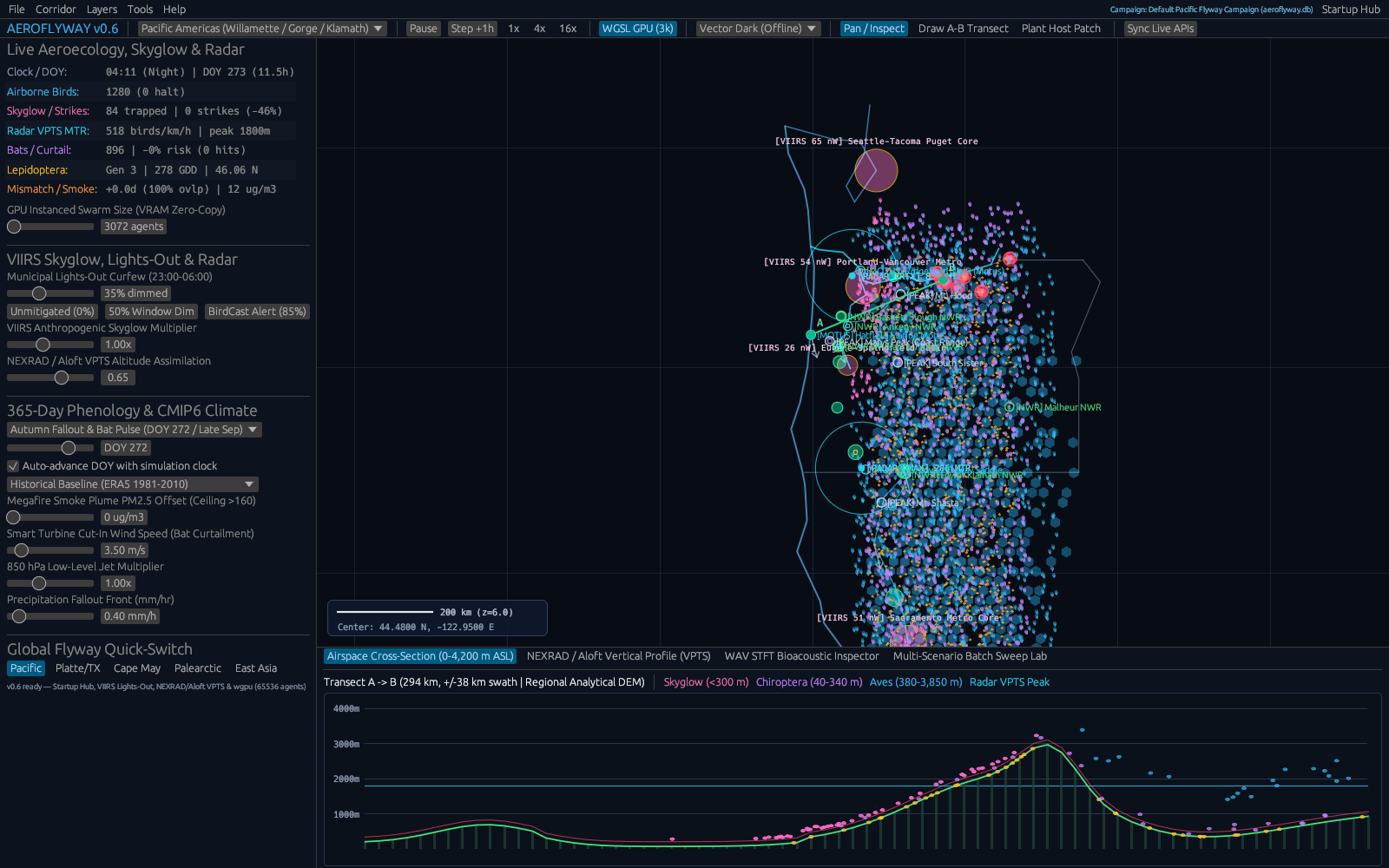
AeroFlyway (v0.6.0) is an open-source program built to help ornithologists, wildlife planners, educators, and community observers visualize and investigate nighttime bird migration. Every spring and autumn, billions of songbirds cross dark skies between wintering and breeding grounds, navigating through shifting winds and past brightly lit cities that can disorient flocks and draw them toward glass facades. Until now, studying this hazard meant juggling separate tools for weather radar tables, rooftop audio recordings, and city light maps. AeroFlyway unifies all three inside a fast, offline desktop and command-line program: an agent-based flight and light-pollution simulator, a weather-radar vertical profile reader, and a nighttime flight-call acoustic classifier. Across an Atlantic flyway scenario with 1,000 virtual migrants, dimming urban skyglow by 80% lowered collision risk by 94.4% (cutting strikes from 35 to 1). On Mid-Atlantic weather radar records, the reader separated clutter from migration traffic peaking over Dover, Delaware at 1,507.7 birds/km/hr near 600 m altitude, while acoustic filtering separated high-pitched warbler calls (7.324 kHz) from lower thrush calls (3.461 kHz).
HelioProbe: Simulating Spacecraft Orbits, Deep-Space Telescopes, and Comet Tails in 3D
HelioProbe (v2.3.0) is an open-source 3D space-mission and astronomy simulator built in native Rust to help students, educators, and spaceflight enthusiasts explore how spacecraft navigate the Solar System, operate telescopes at the Sun-Earth L2 point, study active comet tails, and land cryobots on icy moons. Understanding orbital mechanics can feel abstract when presented only as equations on paper, because Hohmann transfers, gravity-assist slingshots, and Lagrange-point halo orbits unfold across vast three-dimensional distances and changing velocities. HelioProbe brings these physical laws into one interactive offline desktop workbench: a Keplerian and N-body orbital propagator, a Sun-Earth L2 observatory and eccentric comet tail module, a multi-band planetary surface and ocean-world cryobot explorer, and a hardware-accelerated 3D renderer. Users can launch probes from Earth, watch solar-wind ion tails point radially away from the Sun while dust tails curve along orbital paths, inspect simulated multi-spectral instrument readings, and track mission milestones in a local SQLite log.
PopBio-Studio: Interactive Population Biology, Adaptive Landscapes, and Genetic Skyline Simulator
PopBio-Studio (v1.2.0) is an open-source native Rust workbench that unites classical population ecology, evolutionary genetics, and molecular phylogenetics inside one interactive desktop application. Students and researchers frequently learn logistic growth, Sewall Wright adaptive landscapes, Leslie age-structured matrices, Bayesian Skyline demographic plots, and median-joining haplotype networks in disconnected software tools. PopBio-Studio brings all of these models together offline with deterministic random-number seeding, real-time animated plots, and built-in biological example alignments (including Isle Royale wolf mitochondrial DNA, Tribolium archipelago sequences, and chromosomal sweeps). Users can watch populations expand or collapse across competitive landscapes, inspect dominant eigenvalues and elasticities of stage-structured life tables, infer past effective population sizes from coalescent intervals, and construct parsimonious median-joining haplotype networks with SVG export.
QuantaCrypt-Studio: Simulating Quantum Circuits, Quantum Key Distribution, and Post-Quantum Cryptography
QuantaCrypt-Studio (v2.2.0) is an open-source 23-module passive stochastic quantum computing and cryptography workbench built in safe Rust. Quantum mechanics and post-quantum security often seem disconnected or intimidating: beginners struggle to picture wave-particle interference and entanglement, while security engineers need concrete ways to compare quantum key distribution (BB84, E91, B92) against lattice-based post-quantum cryptography (ML-KEM) and fault-tolerant surface codes. QuantaCrypt-Studio bridges that gap inside one self-contained offline desktop app. Users can step through classic quantum-intuition experiments (double-slit, Mach-Zehnder, Stern-Gerlach, quantum Zeno), build and export OpenQASM qubit circuits with realistic Kraus noise channels, simulate higher-dimensional qudits, test eavesdropping detection in photonic QKD, inspect lattice cryptography and Shor/Grover attacks, and explore surface-code error correction and variational algorithms (VQE, QAOA).
SonoWing: Analyzing Bat Echolocation and Bird Calls with Spectrograms and Harmonic Tracking
SonoWing (v1.1.0) is an open-source native Rust bioacoustics workbench built for analyzing bat echolocation calls, bird songs, and full-spectrum ecological soundscapes. Studying nocturnal bats or dense dawn choruses requires inspecting ultrasonic frequencies well above human hearing (up to 250 kHz and beyond), extracting individual call contours, tracking harmonic overtones, and clustering hundreds of field recordings by acoustic similarity. Many field biologists rely on fragmented proprietary viewers or slow scripts to open large WAV files with embedded GUANO metadata. SonoWing brings high-speed STFT spectrograms, automated call extraction, harmonic ridge tracking, MFCC/UMAP acoustic clustering, ecoacoustic diversity indices, live microphone monitoring, and GUANO-compliant WAV export into one safe-Rust desktop studio.
SwarmForge: 3D Isometric Automated Factory and Swarm Robotics Simulation Game
SwarmForge (v1.3.0) is an open-source 3D isometric automated robotic factory and swarm-intelligence simulation game written in native Rust. Coordinating dozens of autonomous robots inside a multi-floor factory requires balancing spatial pathfinding, task allocation, battery energy, congestion avoidance, and emergency response to hazards such as localized fires. SwarmForge turns those multi-agent systems challenges into an interactive strategy and simulation game: players place fabrication cells, charging pads, and suppression towers across stacked factory floors, unlock swarm-scaling technologies, dispatch builder, hauler, and cheer drones, and watch real-time isometric factory production unfold. Under the hood, deterministic collision-aware pathfinding, tech-tree throughput multipliers, hazard mitigation, and SQLite WAL save persistence ensure smooth gameplay and reproducible multi-agent behavior.
NeuroSpace Lab: 3D Neural Network Topology, Structural Plasticity, and Six-Layered Cerebral Cortex Simulation in Safe Rust
NeuroSpace Lab (v1.6.0) is an open-source 3D neural network topology and cortical wetware workstation for comparing 15 distinct architectures across five evolutionary tiersโfrom classical perceptrons and sparse Mixture-of-Experts transformers to six-layered cerebral cortex grey matter (L1โL6)โon seven reproducible scientific benchmark domains with interactive optogenetic clamping, causal lesioning, and persistent experiment snapshots.