Overview
HelioProbe (v2.3.0) is an open-source 3D space-mission and astronomy simulator built in native Rust to help students, educators, and spaceflight enthusiasts explore how spacecraft navigate the Solar System, operate telescopes at the Sun-Earth L2 point, study active comet tails, and land cryobots on icy moons. Understanding orbital mechanics can feel abstract when presented only as equations on paper, because Hohmann transfers, gravity-assist slingshots, and Lagrange-point halo orbits unfold across vast three-dimensional distances and changing velocities. HelioProbe brings these physical laws into one interactive offline desktop workbench: a Keplerian and N-body orbital propagator, a Sun-Earth L2 observatory and eccentric comet tail module, a multi-band planetary surface and ocean-world cryobot explorer, and a hardware-accelerated 3D renderer. Users can launch probes from Earth, watch solar-wind ion tails point radially away from the Sun while dust tails curve along orbital paths, inspect simulated multi-spectral instrument readings, and track mission milestones in a local SQLite log. Source code, documentation, and companion apps are listed at https://crvscience.com/apps.
1. Real-World Context & Why This Problem Matters
Why Orbital Motion and Deep-Space Missions Are Hard to Picture
Spaceflight obeys precise gravitational and radiative laws, yet those rules often run counter to everyday intuition on Earth. On a highway or across an ocean, reaching a destination ahead of you simply means steering straight toward it and pressing the accelerator. In orbit, however, a spacecraft trying to catch a planet or rendezvous with a station cannot simply point its nose at the target and fire its thrusters; speeding up raises the craft into a higher, slower orbit that falls further behind, while braking drops it inward into a faster track that overtakes from below. Even more subtle are gravitational slingshots around giant planets such as Jupiter, halo orbits balanced around the Sun-Earth L2 point 1.5 million kilometers beyond Earth, and the twin tails of active comets—where charged plasma streams straight outward along the solar wind while heavier dust grains lag behind in a curved arc.
Modern space science missions—from magnetospheric constellations[1] and ion-mass spectrometers[2] to deep-space infrared observatories—depend on coordinating trajectory timing, instrument pointing, and power budgets years before launch. Textbooks typically split Keplerian math, telescope station-keeping, and planetary surface science into separate chapters filled with static two-dimensional ellipses. HelioProbe unites all of them inside one real-time 3D workbench where every burn, gravity assist, and scan produces immediate visual and quantitative feedback.
Think of navigating the Solar System like stepping onto a system of concentric, moving merry-go-rounds. Jumping to an outer ring requires a carefully timed push along your current motion, followed by a long coasting arc and a second circularizing push when you arrive at the outer track. If you launch on the wrong date, the destination planet is on the far side of the Sun when your spacecraft crosses its orbit. HelioProbe turns those invisible timing rules into clear 3D orbit ribbons and interactive launch-window maps so learners can see immediately why interplanetary missions wait for specific synodic alignments.
Connecting Trajectories, L2 Telescopes, and Surface Cryobots
HelioProbe (v2.3.0) lets users move smoothly from wide-angle Solar System navigation down to close-up comet flybys and subsurface icy-moon exploration. Rather than requiring remote cloud servers, browser plugins, or heavyweight game engines, the entire physics kernel, planetary catalog, and 3D shader pipeline run locally as a single compiled desktop binary. Every mission launch, fuel calculation, and scientific scan persists cleanly to a local SQLite database so students and hobbyists can pause, inspect telemetry, and compare alternative mission architectures side by side.
By pairing accessible 3D visual intuition with real astrodynamics equations and structured target dossiers, HelioProbe lowers the barrier between casual stargazing and quantitative mission design. Anyone curious about why space telescopes park behind Earth's night side, how probes survive Jupiter's crushing atmosphere, or how melt-probes might reach Europa's hidden ocean can test those scenarios directly on an ordinary laptop.
2. Conceptual Design & How HelioProbe Works
Orbital Solvers, L2 Observatories, and 3D Shader Rendering
HelioProbe organizes its spaceflight physics and visual rendering into thirteen modular Rust source files with clear responsibilities. Core orbital math lives in physics.rs and astrodynamics_lab.rs, solving Kepler's equation iteratively for elliptical, parabolic, and hyperbolic paths, computing Hohmann minimum-energy transfers alongside fast-transit delta-v budgets, generating porkchop launch-window contour maps across departure and arrival dates, and evaluating Jupiter gravity-assist velocity deflections.
Mission targets—spanning rocky inner worlds, gas giants, icy moons, deep-sky nebulae, and public ephemeris records—are managed by catalog.rs and public_data.rs. Each celestial body carries consistent physical parameters (semi-major axis, eccentricity, orbital inclination, mass, radius, and surface/atmospheric profile) together with multi-band scientific notes covering optical, infrared, radio, and particle-field observations.
Beyond planetary transfers, l2_comets.rs models three-dimensional Lissajous halo loops around the Sun-Earth L2 Lagrange point alongside eccentric comets whose solar-wind ion tails and micrometer dust tails dynamically scale and orient relative to heliocentric distance. Spacecraft kinematics, atmospheric entry profiles, and subsurface ocean-world cryobot deployments are handled in probes.rs and surface_ops.rs, while renderer_3d.rs, cosmos.wgsl, gui.rs, gamification.rs, and tech_tree.rs power the 3D scene, mission progression, instrument upgrades, and interactive console.
Keeping the orbital propagator decoupled from the WGSL shader renderer ensures that every numerical delta-v readout, Lagrange stability metric, and entry pressure profile can be inspected deterministically in the verification suite (tests/simulation_tests.rs, 8/8 checks passing) independently of screen resolution or frame rate.
| Module / Crate | What It Does | Citation |
|---|---|---|
physics.rs & astrodynamics_lab.rs | Keplerian solver, Hohmann and fast-transit delta-v calculations, porkchop launch-window grids, and Jupiter gravity-assist slingshots. | Burch et al. (2015) [1] |
l2_comets.rs | Sun-Earth L2 Lissajous halo observatories and dynamic dual solar-wind ion and dust comet tails. | Yau et al. (2015) [2] |
catalog.rs & public_data.rs | Curated Solar System planets, moons, deep-sky nebulae, multi-band science findings, and public ephemeris ingestion. | CRV Science Apps Network [3–19] |
probes.rs & surface_ops.rs | Spacecraft transit state machine, Galileo atmospheric entry crush-depth profile, and icy-moon cryobot puck deployment. | CRV Science Apps Network [3–19] |
renderer_3d.rs & cosmos.wgsl | Hardware-accelerated 3D camera projection, depth-sorted orbit ribbons, starfield shaders, and planetary rendering. | CRV Science Apps Network [3–19] |
gui.rs, gamification.rs & tech_tree.rs | Interactive mission console, science-point progression, instrument tech tree, and local SQLite mission persistence. | CRV Science Apps Network [3–19] |

3. Walkthrough of Capabilities & Quantitative Findings
Launch Windows, Gravity Assists, and Dual Comet Tails
In interactive mission scenarios, HelioProbe computes realistic delta-v requirements across inner and outer Solar System transfers and maps optimal departure-arrival windows in the astrodynamics lab. Comparing a fuel-optimal Hohmann transfer to Mars against a faster high-energy transit immediately illustrates the fundamental engineering trade-off between propellant mass and travel time. When a probe approaches Jupiter, the gravity-assist solver demonstrates how swinging behind a moving planet alters heliocentric speed and direction without expending onboard propellant, enabling rapid outer-system trajectories toward icy moons such as Europa, Enceladus, and Titan.
Around Sun-Earth L2, the simulator visualizes three-dimensional halo paths where space observatories maintain continuous solar power and stable thermal shielding while keeping Earth, Moon, and Sun behind their sunshields. Nearby, eccentric comets accelerate inward toward perihelion, brightening dramatically as volatile ices sublimate. Charged gas molecules respond almost instantaneously to radial solar-wind pressure and interplanetary magnetic fields[1][2], producing a straight blue-cyan ion tail pointing directly away from the Sun, whereas micrometer-scale dust grains follow modified Keplerian paths under radiation pressure to form a broader, curved golden fan trailing along the comet's wake.
In atmospheric entry and icy-moon scenarios, the surface operations module tracks Galileo-style pressure-depth curves into Jupiter's upper atmosphere—showing rising temperature and barometric crush limits—and estimates sub-ice melt-channel cryobot puck deployments through kilometers of cryogenic ice down to deep-ocean interfaces. Users can switch cleanly between trajectory planning, active probe telemetry, and instrument data cards without losing context.
A typical learning session in HelioProbe illustrates how seamlessly these pieces fit together. Opening the 3D Solar System view, a user can select an Earth-to-Jupiter mission, inspect the synodic launch window on the porkchop contour map, and watch how departing during the optimal blue-green valley trims total delta-v dramatically compared with an off-window burn. As the simulated probe coasts outward past Mars and the asteroid belt, zooming in reveals how Jupiter's immense orbital velocity bends the probe's path during closest approach, boosting heliocentric speed for an onward flyby toward Saturn or Enceladus without burning extra propellant. Switching tabs to the Sun-Earth L2 observatory module shows why an infrared space telescope orbits in a continuous three-dimensional Lissajous loop rather than sitting stationary at the exact balance point—keeping solar panels illuminated while shielding delicate optics from Earthshine and sunlight alike. Finally, advancing a periodic comet toward perihelion lets students toggle solar-wind speed and dust grain size, watching the narrow blue plasma tail snap radially outward while the broader golden dust fan sweeps backward along the orbital wake.
Throughout each run, HelioProbe logs science points, unlocked instrument tiers, and target discoveries inside local SQLite mission records. Instead of hiding physics behind scripted cutscenes, every visual ribbon—whether a porkchop transfer arc, an L2 Lissajous loop, or a comet's split tails—reflects live numerical integration over the underlying orbital elements.
| Subsystem | Verified Scope | Suite Result |
|---|---|---|
| Kepler & Astrodynamics | Hohmann, fast-transit delta-v & porkchop grids | Verified in tests/simulation_tests.rs |
| Gravity Assist & L2 | Jupiter slingshot & Sun-Earth L2 Lissajous halo | 8/8 simulation checks passed |
| Comet Tails & Cryobots | Dual ion/dust tails, Galileo entry & icy-moon pucks | 13 Rust modules (v2.3.0) |
4. Practical Scenarios: Who Uses HelioProbe & How
Astronomy Classrooms, Planetariums, and Mission Prototyping
Astronomy instructors use HelioProbe during lectures and laboratory sessions to demonstrate retrograde planetary loops, Kepler's second law of equal areas in equal times, L2 station-keeping geometry, and comet tail orientation without needing external web tools or fragile Python notebooks. Students can test how changing perihelion distance, orbital eccentricity, or launch date reshapes delta-v budgets and flight durations, seeing quantitative consequences immediately on screen.
Science communicators and planetarium educators use the multi-band scan cards and 3D flybys to explain how real space observatories and ocean-world probes gather complementary evidence across wavelengths—linking infrared dust mapping to magnetospheric plasma measurements[1][2]. Hobbyists and mission-design learners can also save and reload mission states locally, experiment with tech-tree instrument upgrades, and compare fast-transit trajectories against minimum-energy Hohmann transfers side by side.
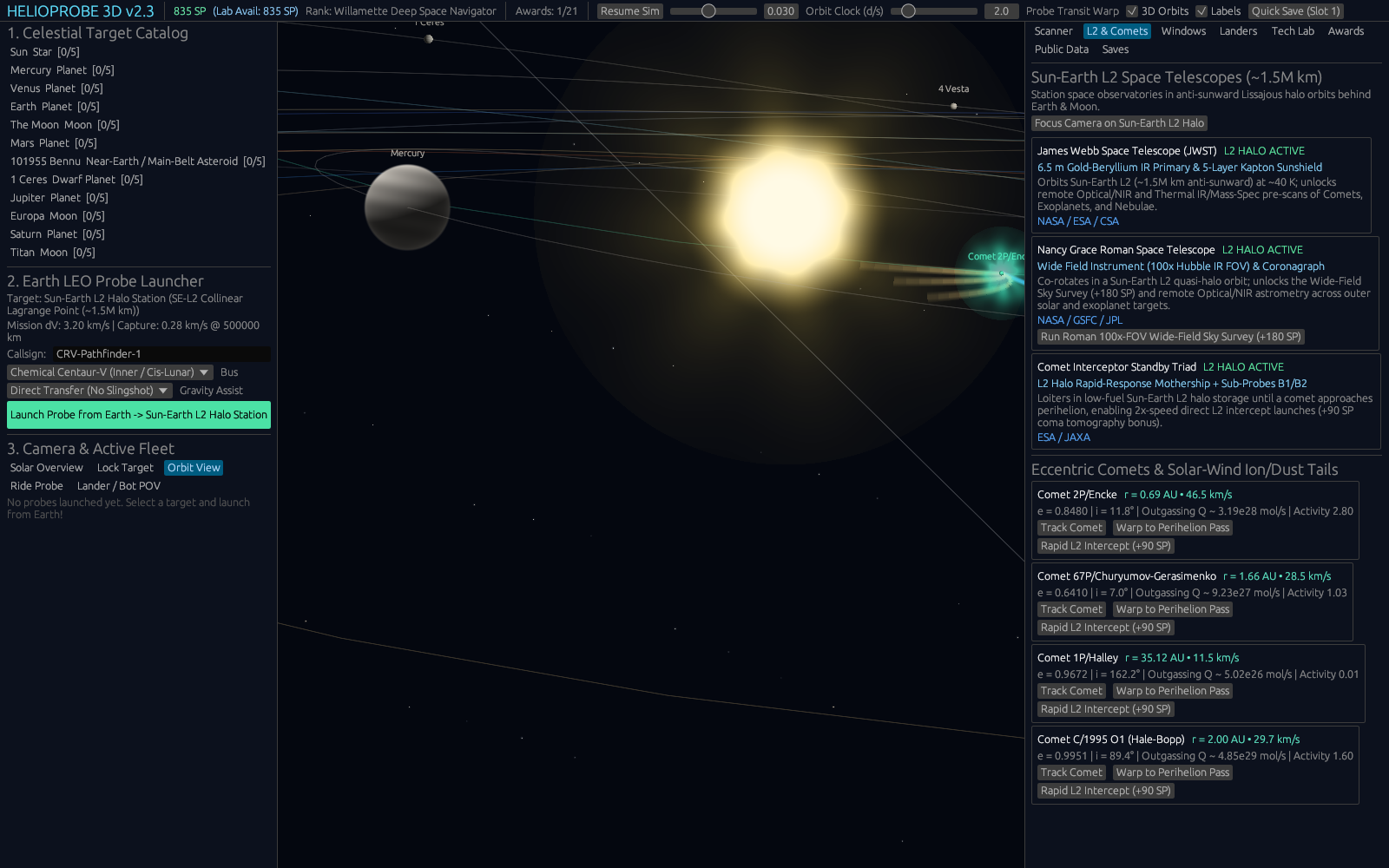
Because the application runs offline in native Rust, it works reliably in classrooms with restricted network access, remote observatory outreach events, and independent study desks alike.
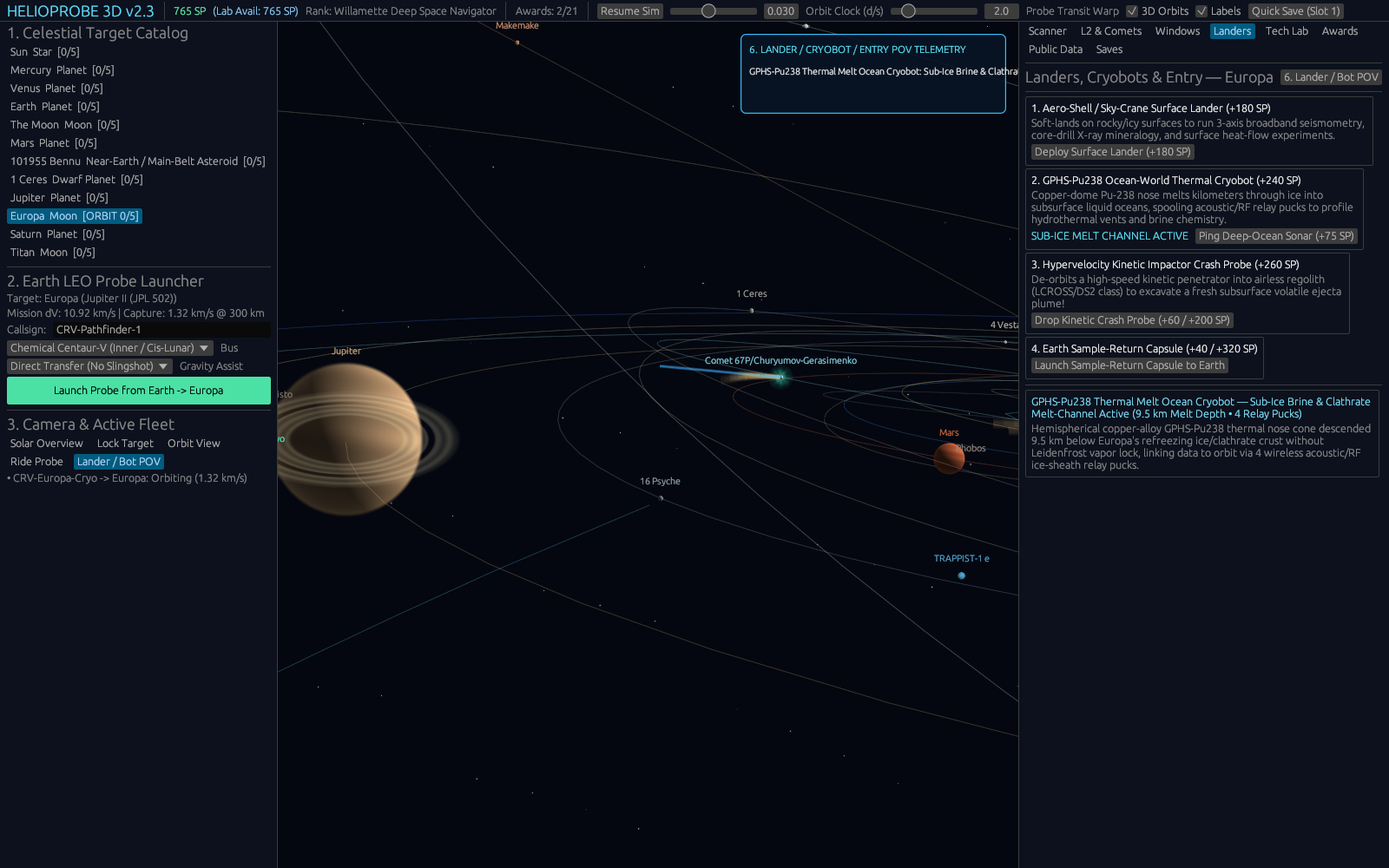
5. Open Access & Connections Across the CRV Science App Network
Open Access and Connections Across the CRV Science App Network
HelioProbe is released openly under the MIT license with full Rust source code, WGSL shaders, verification tests, and sample mission scenarios on GitHub. Every build embeds clear metadata and exports structured mission logs so learners can inspect both the code and the resulting trajectory figures.
Within the CRV Science Apps suite[3–19], HelioProbe anchors the spaceflight and planetary-astronomy pillar, complementing Earth-system climate projections in TerraTwin, ultrasonic and atmospheric sensing in SonoWing and AeroFlyway, and numerical differential-equation solvers in Calc-Lab.
References
- [1] Burch, J. L., et al. (2015). Magnetospheric Multiscale Overview and Science Objectives. Space Science Reviews. https://doi.org/10.1007/s11214-015-0164-9
- [2] Yau, A. W., et al. (2015). The Enhanced Polar Outflow Probe (e-POP) Mission: Science Objectives and Instrumentation. Space Science Reviews. https://doi.org/10.1007/s11214-015-0149-8
- [3] White, B. P. (2026). The CRV Science App Network: Seventeen Open-Source Rust Programs for Science, Data, and Simulation. CRV Science App Preprint APP-PREPRINT-01 [cs.SE, cs.CE, q-bio.QM], v1.0.0. Hosted via CRV Science Apps Hub (https://crvscience.com/apps). https://doi.org/10.5281/zenodo.24222398
- [4] White, B. P. (2026). AeroFlyway: Tracking Bird Migration with Weather Radar, Skyglow Maps, and Nighttime Flight Calls. CRV Science App Preprint APP-PREPRINT-13 [q-bio.PE, physics.ao-ph, cs.GR], v0.6.0. Hosted via CRV Science Apps Hub (https://crvscience.com/apps). https://doi.org/10.5281/zenodo.24222366
- [5] White, B. P. (2026). BeoFold: Simulating How Proteins Fold Using Distributed Computing and State Networks. CRV Science App Preprint APP-PREPRINT-02 [q-bio.BM, physics.chem-ph, cs.DC], v1.4.0. Hosted via CRV Science Apps Hub (https://crvscience.com/apps). https://doi.org/10.5281/zenodo.24222370
- [6] White, B. P. (2026). Calc-Lab: Interactive Calculus, Linear Algebra, and Differential Equation Solver Workbench. CRV Science App Preprint APP-PREPRINT-03 [math.NA, cs.MS, cs.CY], v0.5.0. Hosted via CRV Science Apps Hub (https://crvscience.com/apps). https://doi.org/10.5281/zenodo.24222372
- [7] White, B. P. (2026). Causal-Atlas: Tracing How Genes and Drugs Turn Biological Pathways On and Off. CRV Science App Preprint APP-PREPRINT-04 [q-bio.MN, q-bio.GN, stat.ML], v0.2.0. Hosted via CRV Science Apps Hub (https://crvscience.com/apps). https://doi.org/10.5281/zenodo.24222376
- [8] White, B. P. (2026). Cit-Atlas: Mapping Citation Networks and Research Impact Across Scientific Papers. CRV Science App Preprint APP-PREPRINT-05 [cs.DL, cs.SI, physics.soc-ph], v1.8.0. Hosted via CRV Science Apps Hub (https://crvscience.com/apps). https://doi.org/10.5281/zenodo.24222380
- [9] White, B. P. (2026). EpiLedger: Privacy-Safe Disease Tracking, Clinical Text Screening, and Outbreak Monitoring. CRV Science App Preprint APP-PREPRINT-06 [cs.CR, q-bio.PE, stat.AP], v2.0.0. Hosted via CRV Science Apps Hub (https://crvscience.com/apps). https://doi.org/10.5281/zenodo.24222382
- [10] White, B. P. (2026). ITME: Simulating Four Billion Years of Life, Oceans, and Atmosphere Evolution. CRV Science App Preprint APP-PREPRINT-07 [q-bio.PE, nlin.AO, physics.bio-ph], v2.3.0. Hosted via CRV Science Apps Hub (https://crvscience.com/apps). https://doi.org/10.5281/zenodo.24222386
- [11] White, B. P. (2026). OSABT: All-in-One Toolkit for Plant Physiology, Survival Curves, Genetics, and Enzyme Kinetics. CRV Science App Preprint APP-PREPRINT-08 [q-bio.QM, stat.AP, cs.SE], v2.0.0. Hosted via CRV Science Apps Hub (https://crvscience.com/apps). https://doi.org/10.5281/zenodo.24222388
- [12] White, B. P. (2026). SAR-Atlas: Drug Design, Body Distribution Modeling, and Candidate Screening in Rust. CRV Science App Preprint APP-PREPRINT-09 [physics.chem-ph, q-bio.BM, cs.LG], v3.8.0. Hosted via CRV Science Apps Hub (https://crvscience.com/apps). https://doi.org/10.5281/zenodo.24222390
- [13] White, B. P. (2026). TerraTwin: Fast Climate Projections for Global Warming, Sea-Level Rise, and Arctic Change. CRV Science App Preprint APP-PREPRINT-10 [physics.ao-ph, cs.CE, stat.AP], v2.5.0. Hosted via CRV Science Apps Hub (https://crvscience.com/apps). https://doi.org/10.5281/zenodo.24222392
- [14] White, B. P. (2026). Urban-Grid: Modeling City Traffic, Emergency Response Coverage, and Earthquake Evacuation. CRV Science App Preprint APP-PREPRINT-11 [physics.soc-ph, cs.MA, cs.CE], v5.2.0. Hosted via CRV Science Apps Hub (https://crvscience.com/apps). https://doi.org/10.5281/zenodo.24222394
- [15] White, B. P. (2026). WildFront BattleGrounds: Turn-Based Hex Strategy Game with Voxel Graphics and Procedural Map Generation. CRV Science App Preprint APP-PREPRINT-12 [cs.GT, cs.GR, math.CO], v3.4.1. Hosted via CRV Science Apps Hub (https://crvscience.com/apps). https://doi.org/10.5281/zenodo.24222396
- [16] White, B. P. (2026). PopBio-Studio: Interactive Population Biology, Adaptive Landscapes, and Genetic Skyline Simulator. CRV Science App Preprint APP-PREPRINT-15 [q-bio.PE, q-bio.QM, stat.AP], v1.2.0. Hosted via CRV Science Apps Hub (https://crvscience.com/apps). https://doi.org/10.5281/zenodo.24244085
- [17] White, B. P. (2026). QuantaCrypt-Studio: Simulating Quantum Circuits, Quantum Key Distribution, and Post-Quantum Cryptography. CRV Science App Preprint APP-PREPRINT-16 [quant-ph, cs.CR, cs.MS], v2.2.0. Hosted via CRV Science Apps Hub (https://crvscience.com/apps). https://doi.org/10.5281/zenodo.24244089
- [18] White, B. P. (2026). SonoWing: Analyzing Bat Echolocation and Bird Calls with Spectrograms and Harmonic Tracking. CRV Science App Preprint APP-PREPRINT-17 [q-bio.NC, q-bio.PE, cs.SD], v1.1.0. Hosted via CRV Science Apps Hub (https://crvscience.com/apps). https://doi.org/10.5281/zenodo.24244091
- [19] White, B. P. (2026). SwarmForge: 3D Isometric Automated Factory and Swarm Robotics Simulation Game. CRV Science App Preprint APP-PREPRINT-18 [cs.MA, cs.RO, cs.GT], v1.3.0. Hosted via CRV Science Apps Hub (https://crvscience.com/apps). https://doi.org/10.5281/zenodo.24244093