Overview
ITME (v2.3.0, Information-Theoretic Macroevolution) is an open-source deep-time Earth-and-biosphere simulator designed to study how biological complexity and planetary atmospheric chemistry co-evolved across 4.25 billion years. Rather than treating oceans, continents, and skies as static backdrops beneath evolving species, ITME simulates the tight two-way feedback connecting them: whenever evolving populations unlocked major transitions—such as self-replicating protocells, oxygenic photosynthesis during the Great Oxidation Event, endosymbiotic eukaryotic mergers, and multicellular ecosystems—genomes accumulated functional heritable information while life profoundly remade atmospheric oxygen and carbon dioxide worldwide. Across an 8-epoch, 96-tick trajectory spanning 4.25 billion years, five active inheritance channels lifted heritable mutual information from 85.43 bits to 1,113.63 bits while planetary oxygen rose from 0.060 to 0.852 and atmospheric CO2 drew down from 1,180 to 220 ppm. Following an extreme extinction shock, diversity rebuilt smoothly back to 34 lineages (conservation correlation ρ = 0.9349) within a 47-leaf Newick phylogeny preserving 578 splits and 61 endosymbiotic mergers. Source code, documentation, and companion apps are listed at https://crvscience.com/apps.
1. Real-World Context & Why This Problem Matters
Co-Evolution Across Four Billion Years on a Changing Planet
Four and a quarter billion years ago, early Earth orbited a significantly fainter young Sun wrapped inside an oxygen-starved atmosphere dominated by volcanic carbon dioxide, methane hazes, and mineral-rich hydrothermal seas. Somehow, across deep geological eras, that raw abiotic chemistry matured into a resilient living biosphere blanketed in terrestrial forests, carbonate reefs, vertebrate animals, and complex nervous systems breathing oxygen-rich air. Bridging those worlds demanded life discover rare major evolutionary transitions: stray polymers cooperating inside bounded protocells, metabolic enzymes splitting water with sunlight, independent microbes fusing permanently into eukaryotic partners via endosymbiosis, and cooperative cells dividing labor inside intricate multicellular organisms[1].
Why Deep-Time Models Need Two-Way Biological and Atmospheric Feedback
Critically, biological milestones never played out across passive mineral scenery. Every time evolving populations unlocked stronger ways to encode, copy, and share reliable adaptive instructions—quantifiable objectively through Adami physical complexity and heritable mutual information[2]—the biosphere remade oceans and skies around itself. When early cyanobacteria released reactive oxygen gas during the Great Oxidation Event while burying organic carbon deeply in sediments, greenhouse CO2 stepped steadily downward across eons, buffering temperatures beneath a gradually brightening Sun while igniting abrupt planetary transitions[3].
Conventional population-genetics engines typically lock environmental chemistry completely fixed, whereas classic geological climate box models bake biological productivity into static lookup constants. ITME (Information-Theoretic Macroevolution) couples living evolutionary adaptation directly with global O2 and CO2 cycling inside a single interactive desktop laboratory.
2. Conceptual Design & How ITME Works
Eight Evolutionary Regimes Over Spatial Planetary Habitats
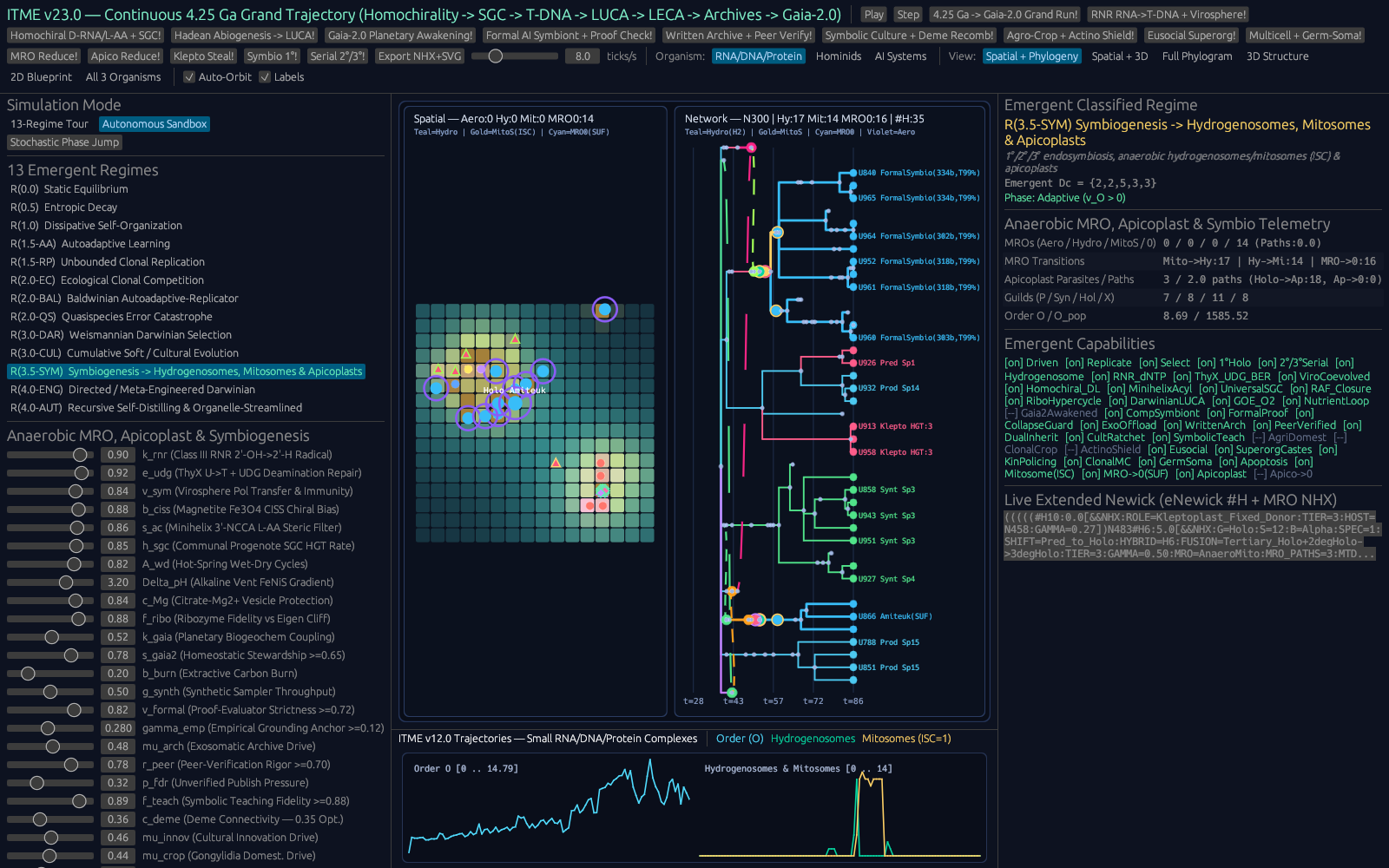
ITME (v2.3.0) maps 4.25 billion years of planetary transformation cleanly across eight progressive macroevolutionary regimes declared inside regimes.rs, stepping seamlessly from prebiotic Hadean hydrothermal vents through self-replicating protocells, oxygenic photosynthesis, eukaryotic cell mergers, Cambrian ecological expansion, and modern Gaia-scale self-regulation[1][3]. Advancing tick by tick, the coupled dynamical engine (engine.rs and model.rs) updates standing lineage biomass, light and chemical energy capture, heritable mutation pressure, and global reservoirs of atmospheric O2 and greenhouse CO2 simultaneously.
Unlike zero-dimensional well-mixed tank simulations where every organism shares identical conditions, spatial.rs and geometry.rs organize populations across discrete spatial habitat patches and varying resource gradients. Spatial structure proves decisive in deep evolution: novel cooperative traits and delicate early cells incubate securely inside sheltered niche refugia before dispersing widely across global oceans.
Quantifying Mutual Information and Building Reticulate Family Trees
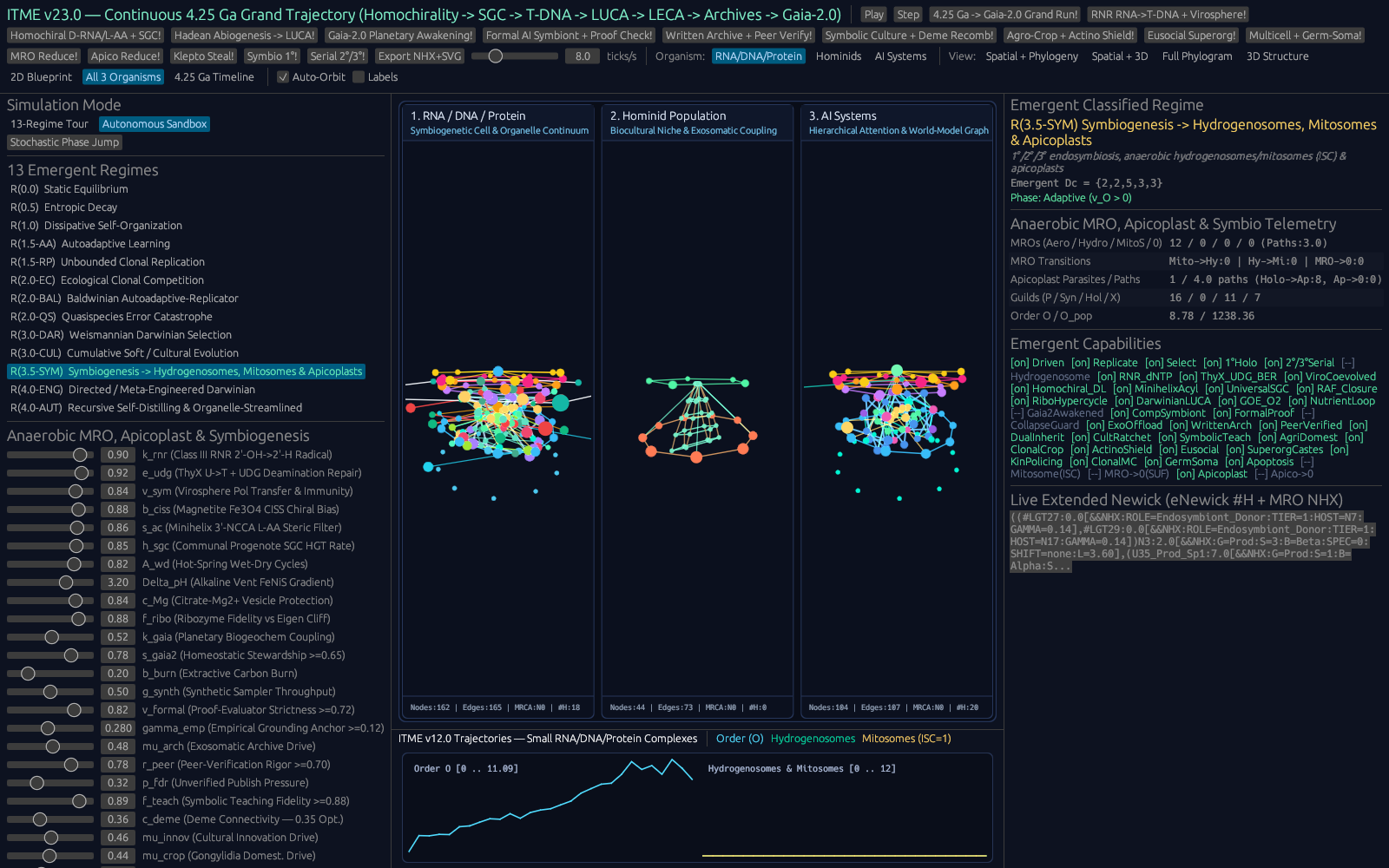
While virtual epochs unfold, two specialized inspection modules turn ecological activity into clear quantitative numbers. First, organisms.rs tracks five distinct biological inheritance channels alongside Adami mutual information conservation[2]—measuring how tightly genomes preserve truly functional ecological adaptations in contrast to random neutral drift. Second, phylogeny.rs records complete historical genealogy continuously in real time: logging ordinary branching speciation splits alongside rare reticulate endosymbiotic fusion arcs reminiscent of ancient mitochondrial and plastid engulfment[1]. Users scrub smoothly across eras in a desktop browser (gui.rs) or console runner (console.rs), exporting reproducible CSV trajectories and standard Newick trees.
| Module / Crate | What It Does | Citation |
|---|---|---|
engine.rs & model.rs | Steps organisms, energy use, mutations, and atmosphere O2/CO2 through time. | [1], [3] |
regimes.rs | Defines the 8 major evolutionary stages from Hadean chemistry (4.25 Ga) to Gaia 2.0. | [1] |
organisms.rs | Models organism traits, information channels, and Adami conservation. | [2] |
phylogeny.rs | Builds branching family trees, tracks endosymbiotic merges, and exports Newick files. | [1] |
spatial.rs & geometry.rs | Handles 2D/spatial habitats, resource patches, and distance math. | [4–20] |
gui.rs & console.rs | Interactive desktop viewer and terminal runner. | [4–20] |
3. Walkthrough of Capabilities & Quantitative Findings
Four Billion Years of Information Expansion and Planetary Oxygenation
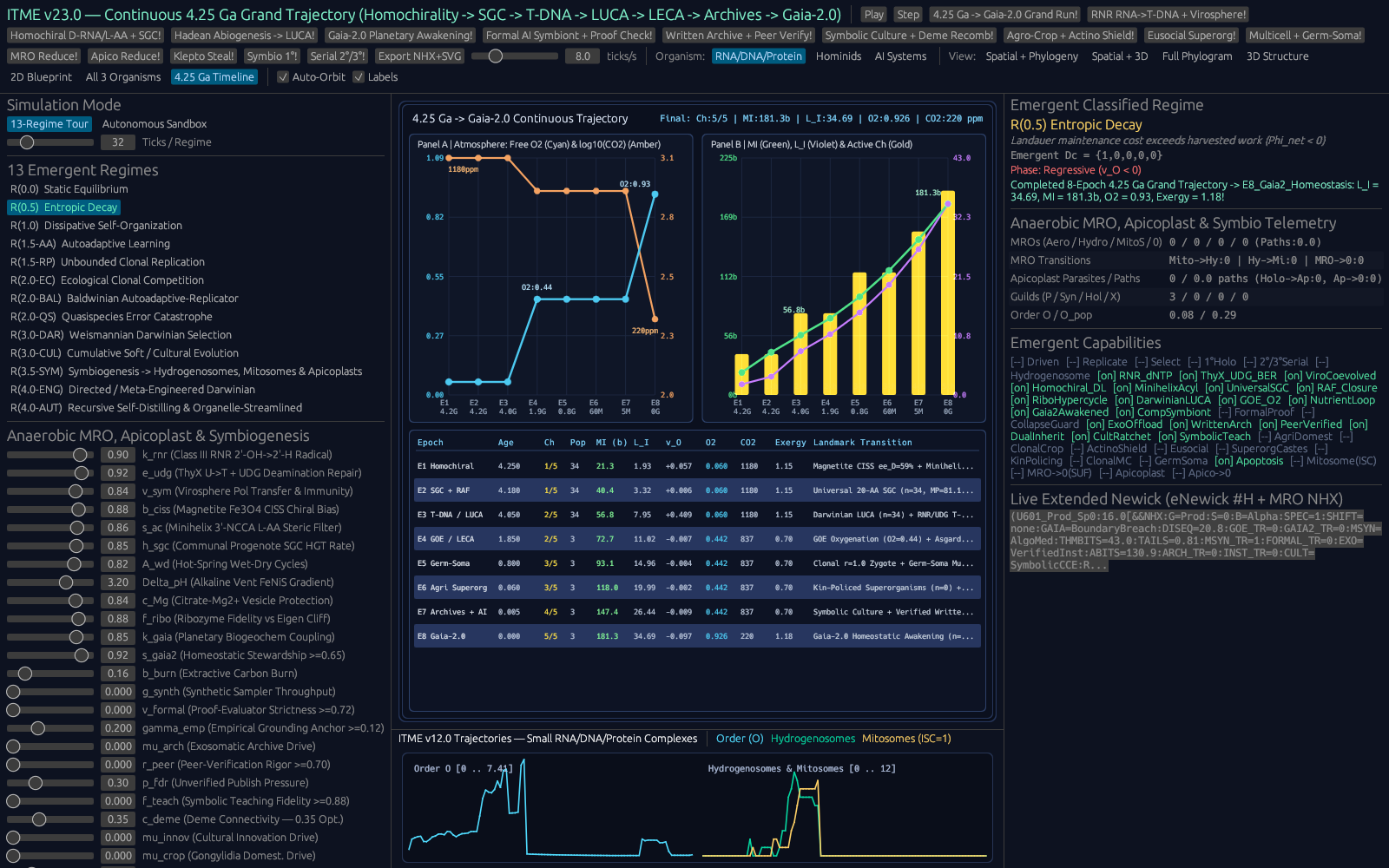
Running a full 96-tick historical trajectory stepping sequentially across all eight evolutionary regimes demonstrates quantitatively how biological innovation and atmospheric stabilization accelerate together. As emerging lineages progressively unlocked all five heritable information mechanisms, community mutual information doubled early—climbing cleanly from 85.43 bits during Hadean Epoch 1 up to 171.16 bits as photosynthetic ecosystems passed Epoch 4 (marking the Great Oxidation transition)—before climbing more than six-fold further to 1,113.63 bits by Epoch 8. Simultaneously, oxygenic photosynthesis drove Earth's relative atmospheric O2 index upward more than fourteen-fold from 0.060 to 0.852 while burying enough reduced carbon to draw atmospheric CO2 steadily down from 1,180 ppm to 220 ppm, capturing planetary climate regulation directly[3].
Resilience After Mass Extinctions and Geothermal Flux Gradients
ITME equally captures how interconnected biospheres rebound after dramatic planetary shocks. Injecting a severe apex extinction cull abruptly pared standing lineage diversity from 34 down to 26 taxa, yet surviving niche refugia radiated steadily back to 34 thriving lineages while preserving deep adaptive functional structure (Adami complexity conservation correlation ρ = 0.9349)[2]. Across the entire 4.25-billion-year tree record, phylogeny.rs tracked 578 clean bifurcating speciation splits braided alongside 61 endosymbiotic fusion merges inside an inspectable 47-leaf Newick phylogeny (emergent_biosphere_tree.nwk). Exploring parameter sensitivity across a 3x3 factorial matrix crossing external energy flux against mutation variance quantified macroscopic order cleanly: planetary complexity climbed from 29.03 baseline up to 55.59 under elevated energy availability and 33.61 under elevated mutation variance, archived neatly in planetary_epochs_trajectory.csv.
What do those bits of mutual information and evolutionary splits mean intuitively for readers outside computational biology? Think of biological mutual information like a species' working instruction manual tuned cleanly to the outside ocean or sky. Random thermal static in early chemistry writes gibberish pages that change every tick without helping cells eat or survive; by contrast, when natural selection discovers photosynthesis, cell membranes, and multicellular division of labor across five inheritance channels, heritable mutual information swells from 85.43 bits to 1,113.63 bits because durable environmental solutions accumulate across lineages rather than erasing every generation[2].
Similarly, combining 578 standard branching splits with 61 endosymbiotic merges highlights an unforgettable chapter in life's real biography. Ordinary evolution draws neat outward-forking family trees as isolated species diverge slowly over millennia, yet eukaryotic complex life arose when separate microorganisms literally moved in together—merging respiratory bacteria and photosynthetic cyanobacterial helpers permanently inside host cells[1]. Modeling both vertical branching and lateral cell mergers inside one 47-leaf reticulate phylogeny lets students see visually why symbiotic innovations unlock vast metabolic surges across planetary ecosystems.
Even the dramatic 3x3 energy-flux and mutation experiment resolves an intuitive planetary principle cleanly. Flooding habitats with generous usable geothermal or stellar energy lifts mean emergent order sharply from 29.03 up to 55.59 because rich free energy finances intricate repair machinery and layered food webs; by contrast, moderate mutation pressure supports exploration only while heritable memory still preserves winning patterns across generations.
Equally illuminating for educators, walking visually from Epoch 1 hydrothermal pores across Epoch 4 cyanobacterial oxygenation demonstrates concretely why biological invention precedes climate stabilization rather than reacting passively: only after living chemistry builds reliable energy-capturing codes can global carbon burial reshape entire atmospheres[3].
| Simulation Experiment | Planetary Scope | Key Finding | Data Output |
|---|---|---|---|
| 8-Epoch Co-Evolution | 4.25 Ga to present (96 ticks, 5 channels) | MI 85.4 to 1,113.6 bits; O2 0.06 to 0.85; CO2 to 220 ppm | planetary_epochs_trajectory.csv |
| Extinction & Phylogeny | Apex cull recovery + Newick export | 47 leaves, 578 splits, 61 merges, ρ = 0.935 | emergent_biosphere_tree.nwk |
| 3x3 Energy-Flux Sweep | Baseline vs. High Flux vs. High Variance | Mean order P: 29.03 vs. 55.59 vs. 33.61 | Ensemble table |
4. Practical Scenarios: Who Uses ITME & How
Astrobiology Seminars and Earth-History Classrooms
Helping undergraduate Earth-science and astrobiology classes visualize how microscopic photosynthetic mats oxygenated an entire planet—or why complex animal ecosystems waited billions of years until cellular mergers and atmospheric chemistry aligned—poses an enduring conceptual hurdle. Because ITME launches offline on any laptop and outputs clean planetary_epochs_trajectory.csv series alongside universal Newick family trees, instructors transform static geological timeline posters[1] into open classroom experiments where students tune energy fluxes, trigger simulated catastrophes, and watch atmospheric O2/CO2 feedbacks rebalance firsthand.
Exploratory Sandbox for Theoretical Macroevolution
Theoretical ecologists studying information-theoretic metrics of adaptive organization[2] or long-horizon Gaia homeostatic thresholds[3] can also treat ITME as an agile desktop sandbox for comparing pure tree branching against horizontal endosymbiotic fusion over spatially heterogeneous patches.
Museum Exhibits, Planetariums, and Science Communication
Natural history museums, planetarium educators, and science writers face a persistent storytelling challenge when explaining deep evolutionary history: textbook timelines make billions of years look like a calm, pre-ordained ladder rather than a turbulent chain of ecological accidents and metabolic partnerships. Watching simplified digital worlds tip from oxygen-free Archean oceans into oxygenated shelves—or collapse when nutrient recycling stalls—gives general audiences a vivid, memorable picture of how microscopic microbes re-engineered an entire planet long before vertebrates appeared. Instead of memorizing isolated fossil dates, curious visitors and high-school biology clubs can explore directly why symbiotic cellular mergers unlocked dramatic leaps in biological complexity.
Why Simulating Whole Biospheres Matters for Exoplanet Discovery
As space telescopes capture faint chemical fingerprints from distant rocky worlds, astronomers increasingly ask which atmospheric gas combinations signal living biospheres rather than sterile volcanism. Interpreting those remote clues depends directly on understanding how evolving metabolisms, temperature feedbacks, and continental weathering co-evolve over hundreds of millions of years. Offered free and offline inside the shared library at crvscience.com/apps, ITME bridges geology, ecology, and planetary astronomy for students and independent readers alike.
Beyond university classrooms, amateur paleontology societies, natural history book clubs, and high-school Earth-systems competitions use interactive biosphere timelines to explore big counterfactual questions without installing brittle climate codebases. Learners can pause simulated epochs right across great oxygenation transitions, compare how bare mineral worlds versus living ocean worlds rebound after harsh global cooling events, and export clean evolutionary family trees beside straightforward CSV geochemical histories for science-fair exhibits or seminar handouts. Because every trajectory runs natively offline on ordinary desktop laptops without remote servers or license renewals, regional schools and public libraries gain an enduring window into how microscopic metabolic teamwork gradually built Earth's breathable atmosphere. Watching oxygen levels, global temperature balance, and biodiversity climb together turns sprawling four-billion-year geology charts into vivid, verifiable causal stories for curious readers everywhere.
5. Open Access & Connections Across the CRV Science App Network
Open Access and Connections Across the CRV Science App Network
All ITME eight-epoch regime schemas, biosphere-atmosphere differential equations, Adami complexity estimators, and Newick exporters reside open-source on the CRV Science Apps Hub at https://crvscience.com/apps for unrestricted educational study and independent adaptation.
Within the twelve-application CRV Science ecosystem[4–20], ITME establishes the deep geological history underlying modern life and climate tools: TerraTwin picks up in the industrial 1950–2100 era to model human greenhouse forcing, ocean heat expansion, and sea-level rise; AeroFlyway tracks present-day migratory bird flyways navigating modern continents shaped over deep time; BeoFold examines the atomic folding physics inside biological protein catalysts; and OSABT supports molecular sequence population genetics and biodiversity metrics across living organisms.
References
- [1] Maynard Smith, J., & Szathmáry, E. (1997). The Major Transitions in Evolution. Oxford University Press. https://doi.org/10.1093/oso/9780198502944.001.0001
- [2] Adami, C., Ofria, C., & Collier, T. C. (2000). Evolution of biological complexity. Proceedings of the National Academy of Sciences. https://doi.org/10.1073/pnas.97.9.4463
- [3] Lenton, T. M., & Williams, H. T. (2013). On the origin of planetary-scale tipping points. Trends in Ecology & Evolution. https://doi.org/10.1016/j.tree.2013.06.001
- [4] White, B. P. (2026). The CRV Science App Network: Seventeen Open-Source Rust Programs for Science, Data, and Simulation. CRV Science App Preprint APP-PREPRINT-01 [cs.SE, cs.CE, q-bio.QM], v1.0.0. Hosted via CRV Science Apps Hub (https://crvscience.com/apps). https://doi.org/10.5281/zenodo.24222398
- [5] White, B. P. (2026). AeroFlyway: Tracking Bird Migration with Weather Radar, Skyglow Maps, and Nighttime Flight Calls. CRV Science App Preprint APP-PREPRINT-13 [q-bio.PE, physics.ao-ph, cs.GR], v0.6.0. Hosted via CRV Science Apps Hub (https://crvscience.com/apps). https://doi.org/10.5281/zenodo.24222366
- [6] White, B. P. (2026). BeoFold: Simulating How Proteins Fold Using Distributed Computing and State Networks. CRV Science App Preprint APP-PREPRINT-02 [q-bio.BM, physics.chem-ph, cs.DC], v1.4.0. Hosted via CRV Science Apps Hub (https://crvscience.com/apps). https://doi.org/10.5281/zenodo.24222370
- [7] White, B. P. (2026). Calc-Lab: Interactive Calculus, Linear Algebra, and Differential Equation Solver Workbench. CRV Science App Preprint APP-PREPRINT-03 [math.NA, cs.MS, cs.CY], v0.5.0. Hosted via CRV Science Apps Hub (https://crvscience.com/apps). https://doi.org/10.5281/zenodo.24222372
- [8] White, B. P. (2026). Causal-Atlas: Tracing How Genes and Drugs Turn Biological Pathways On and Off. CRV Science App Preprint APP-PREPRINT-04 [q-bio.MN, q-bio.GN, stat.ML], v0.2.0. Hosted via CRV Science Apps Hub (https://crvscience.com/apps). https://doi.org/10.5281/zenodo.24222376
- [9] White, B. P. (2026). Cit-Atlas: Mapping Citation Networks and Research Impact Across Scientific Papers. CRV Science App Preprint APP-PREPRINT-05 [cs.DL, cs.SI, physics.soc-ph], v1.8.0. Hosted via CRV Science Apps Hub (https://crvscience.com/apps). https://doi.org/10.5281/zenodo.24222380
- [10] White, B. P. (2026). EpiLedger: Privacy-Safe Disease Tracking, Clinical Text Screening, and Outbreak Monitoring. CRV Science App Preprint APP-PREPRINT-06 [cs.CR, q-bio.PE, stat.AP], v2.0.0. Hosted via CRV Science Apps Hub (https://crvscience.com/apps). https://doi.org/10.5281/zenodo.24222382
- [11] White, B. P. (2026). OSABT: All-in-One Toolkit for Plant Physiology, Survival Curves, Genetics, and Enzyme Kinetics. CRV Science App Preprint APP-PREPRINT-08 [q-bio.QM, stat.AP, cs.SE], v2.0.0. Hosted via CRV Science Apps Hub (https://crvscience.com/apps). https://doi.org/10.5281/zenodo.24222388
- [12] White, B. P. (2026). SAR-Atlas: Drug Design, Body Distribution Modeling, and Candidate Screening in Rust. CRV Science App Preprint APP-PREPRINT-09 [physics.chem-ph, q-bio.BM, cs.LG], v3.8.0. Hosted via CRV Science Apps Hub (https://crvscience.com/apps). https://doi.org/10.5281/zenodo.24222390
- [13] White, B. P. (2026). TerraTwin: Fast Climate Projections for Global Warming, Sea-Level Rise, and Arctic Change. CRV Science App Preprint APP-PREPRINT-10 [physics.ao-ph, cs.CE, stat.AP], v2.5.0. Hosted via CRV Science Apps Hub (https://crvscience.com/apps). https://doi.org/10.5281/zenodo.24222392
- [14] White, B. P. (2026). Urban-Grid: Modeling City Traffic, Emergency Response Coverage, and Earthquake Evacuation. CRV Science App Preprint APP-PREPRINT-11 [physics.soc-ph, cs.MA, cs.CE], v5.2.0. Hosted via CRV Science Apps Hub (https://crvscience.com/apps). https://doi.org/10.5281/zenodo.24222394
- [15] White, B. P. (2026). WildFront BattleGrounds: Turn-Based Hex Strategy Game with Voxel Graphics and Procedural Map Generation. CRV Science App Preprint APP-PREPRINT-12 [cs.GT, cs.GR, math.CO], v3.4.1. Hosted via CRV Science Apps Hub (https://crvscience.com/apps). https://doi.org/10.5281/zenodo.24222396
- [16] White, B. P. (2026). HelioProbe: Simulating Spacecraft Orbits, Deep-Space Telescopes, and Comet Tails in 3D. CRV Science App Preprint APP-PREPRINT-14 [astro-ph.EP, astro-ph.IM, cs.GR], v2.3.0. Hosted via CRV Science Apps Hub (https://crvscience.com/apps). https://doi.org/10.5281/zenodo.24244083
- [17] White, B. P. (2026). PopBio-Studio: Interactive Population Biology, Adaptive Landscapes, and Genetic Skyline Simulator. CRV Science App Preprint APP-PREPRINT-15 [q-bio.PE, q-bio.QM, stat.AP], v1.2.0. Hosted via CRV Science Apps Hub (https://crvscience.com/apps). https://doi.org/10.5281/zenodo.24244085
- [18] White, B. P. (2026). QuantaCrypt-Studio: Simulating Quantum Circuits, Quantum Key Distribution, and Post-Quantum Cryptography. CRV Science App Preprint APP-PREPRINT-16 [quant-ph, cs.CR, cs.MS], v2.2.0. Hosted via CRV Science Apps Hub (https://crvscience.com/apps). https://doi.org/10.5281/zenodo.24244089
- [19] White, B. P. (2026). SonoWing: Analyzing Bat Echolocation and Bird Calls with Spectrograms and Harmonic Tracking. CRV Science App Preprint APP-PREPRINT-17 [q-bio.NC, q-bio.PE, cs.SD], v1.1.0. Hosted via CRV Science Apps Hub (https://crvscience.com/apps). https://doi.org/10.5281/zenodo.24244091
- [20] White, B. P. (2026). SwarmForge: 3D Isometric Automated Factory and Swarm Robotics Simulation Game. CRV Science App Preprint APP-PREPRINT-18 [cs.MA, cs.RO, cs.GT], v1.3.0. Hosted via CRV Science Apps Hub (https://crvscience.com/apps). https://doi.org/10.5281/zenodo.24244093