Overview
PopBio-Studio (v1.2.0) is an open-source native Rust workbench that unites classical population ecology, evolutionary genetics, and molecular phylogenetics inside one interactive desktop application. Students and researchers frequently learn logistic growth, Sewall Wright adaptive landscapes, Leslie age-structured matrices, Bayesian Skyline demographic plots, and median-joining haplotype networks in disconnected software tools. PopBio-Studio brings all of these models together offline with deterministic random-number seeding, real-time animated plots, and built-in biological example alignments (including Isle Royale wolf mitochondrial DNA, Tribolium archipelago sequences, and chromosomal sweeps). Users can watch populations expand or collapse across competitive landscapes, inspect dominant eigenvalues and elasticities of stage-structured life tables, infer past effective population sizes from coalescent intervals, and construct parsimonious median-joining haplotype networks with SVG export. Source code, documentation, and companion apps are listed at https://crvscience.com/apps.
1. Real-World Context & Why This Problem Matters
Bridging Ecological Counts and Evolutionary Sequences
Life changes on two intertwined clocks: the ecological clock of births, deaths, competition, and carrying capacity unfolding over seasons and decades, and the evolutionary clock of mutation, genetic drift, selection, and demographic bottlenecks recorded inside DNA sequences over thousands of generations. In university classrooms and research labs, however, those two perspectives are often taught in separate courses using incompatible file formats, brittle web applets, and specialized command-line scripts.
Understanding how a bottlenecked island population loses genetic diversity—or how shifts in juvenile survival alter long-term population persistence—requires seeing both the demographic equations and the resulting molecular footprints side by side. Bayesian Skyline models reconstruct past effective population size directly from coalescent waiting times[1], while Median-Joining networks untangle closely related haplotypes by inferring missing ancestral intermediates[2]. PopBio-Studio puts both ecological dynamics and sequence-based inference on one unified canvas.
Think of PopBio-Studio as a bilingual translator between field ecology and molecular genetics. Field counts tell you how many individuals survive this winter, which age classes drive growth, and where carrying capacity bites; DNA alignments tell you how many ancestors survived ten thousand winters ago and how isolated subpopulations exchanged migrants. Having both sets of tools share one deterministic interface lets learners trace the entire arc from demographic change to genetic signature.
From Sewall Wright Landscapes to Coalescent Skylines in One App
PopBio-Studio (v1.2.0) pairs interactive dynamical simulators—spanning microbial chemostats, invertebrate competition, vertebrate harvesting, and theoretical drift—with empirical FASTA/PHYLIP sequence analysis and 3D adaptive landscape visualization, all persisted cleanly in local SQLite worksets. Every simulation stream uses explicit seeded random-number generation so classroom demonstrations, parameter sweeps, and exported CSV/SVG figures remain reproducible across machines.
Instead of scattering separate utilities across R packages, Java jars, and spreadsheet macros, PopBio-Studio delivers 18 compiled Rust modules in a single offline executable backed by a bundled user guide PDF and verified integration tests. Students can move seamlessly from classroom life-table exercises to sequence-based coalescent analysis on any standard desktop or laptop without configuring external compilers or package managers.
2. Conceptual Design & How PopBio-Studio Works
Ecological Simulators, Matrix Algebra, and Sequence Genetics
PopBio-Studio divides its scientific engine into focused, transparent modules. Classical and applied ecological models reside in sim_microbiology.rs, sim_invertebrates.rs, sim_vertebrates.rs, sim_theoretical.rs, and sim_landscapes_matrices.rs. Together these cover E. coli batch and chemostat growth phases, Tribolium flour-beetle competitive exclusion and cannibalism dynamics, vertebrate harvesting thresholds under Ricker and Beverton-Holt stock-recruitment curves, Wright-Fisher genetic drift trajectories, age- and stage-structured Leslie/Lefkovitch projection matrices with dominant eigenvalue and sensitivity/elasticity decomposition, and 3D Sewall Wright fitness surfaces.
Molecular and coalescent inference modules live in popgen_alignment.rs, popgen_skyline.rs, and haplotype_network.rs. These parse standard FASTA and PHYLIP alignments, compute segregating sites, nucleotide diversity, haplotype diversity, and Tajima's D alongside sliding-window selection scans, run piecewise-constant Bayesian Skyline demographic reconstructions[1], and build TCS statistical parsimony and Bandelt Median-Joining haplotype networks[2] with publication-ready SVG export.
Interactive multi-panel plotting, 3D spatial canvases, deterministic seeded PRNG streams, and SQLite save slots are orchestrated by gui/, model.rs, rng.rs, and workset.rs. The entire pipeline is verified by tests/popbio_integration.rs (6/6 integration checks passing), confirming matrix eigenvalues, coalescent likelihoods, and median-vector parsimony reductions.
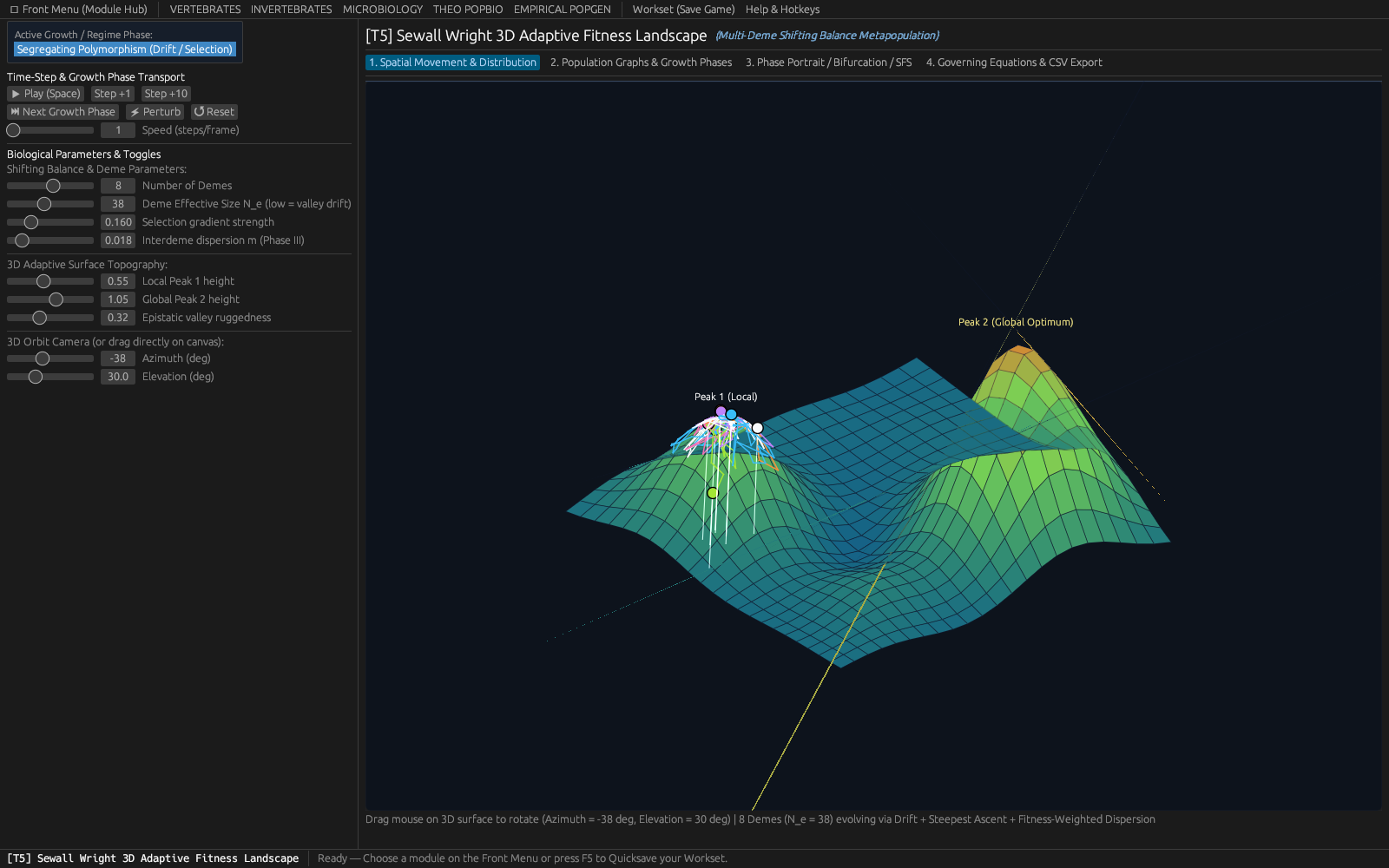
Equally helpful for newcomers is how PopBio-Studio handles unit clarity and visual consistency across all of its simulation tabs. Every growth curve, harvesting threshold, and skyline demographic plot renders with explicit axis units, clean color-blind-safe legends, and instant hover tooltips, while the spatial canvas lets users rotate 3D Sewall Wright fitness surfaces smoothly with a mouse drag to inspect saddle points, valleys, and multiple adaptive peaks from any angle.
| Module / Crate | What It Does | Citation |
|---|---|---|
sim_microbiology.rs & sim_invertebrates.rs | E. coli batch chemostat growth phases and Tribolium flour-beetle competitive dynamics. | CRV Science Apps Network [3–19] |
sim_vertebrates.rs & sim_theoretical.rs | Vertebrate harvesting thresholds, Wright-Fisher genetic drift, and coalescent TMRCA trajectories. | CRV Science Apps Network [3–19] |
sim_landscapes_matrices.rs | 3D Sewall Wright adaptive landscapes and Leslie/Lefkovitch matrix eigenvalues and elasticities. | CRV Science Apps Network [3–19] |
popgen_alignment.rs & popgen_skyline.rs | FASTA/PHYLIP parsing, diversity and Tajima D statistics, sliding-window scans, and Bayesian Skyline inference. | Drummond et al. (2005) [1] |
haplotype_network.rs | TCS statistical parsimony and Bandelt Median-Joining haplotype networks with ancestral median vectors and SVG export. | Bandelt et al. (1999) [2] |
gui/, workset.rs & rng.rs | Multi-panel interactive plots, spatial 3D canvas, deterministic PRNG, and SQLite workset persistence. | CRV Science Apps Network [3–19] |
3. Walkthrough of Capabilities & Quantitative Findings
Matrix Elasticities, Demographic Expansion, and Median Vectors
When analyzing stage-structured vertebrate or plant life tables, PopBio-Studio computes the dominant growth eigenvalue alongside stable stage distributions, reproductive-value vectors, and full sensitivity and elasticity matrices. Conservation biologists can immediately see which life-history transition—juvenile survival, subadult maturation, or adult fecundity—carries the greatest leverage over long-term population persistence. On the 3D adaptive landscape, users can drag allele-frequency and epistatic-interaction parameters to watch how Sewall Wright's shifting-balance peaks trap or guide evolving populations across valleys of lower fitness.
On the molecular side, loading the bundled Isle Royale wolf mitochondrial DNA, Tribolium archipelago, or chromosomal-sweep alignments immediately computes segregating sites, nucleotide diversity, and Tajima's D, while the sliding-window scanner highlights localized regions of selective sweeps or balancing selection. Switching to the Bayesian Skyline module[1] separates constant-size lineages from historical bottlenecks and post-glacial expansions directly from coalescent interval spacing.
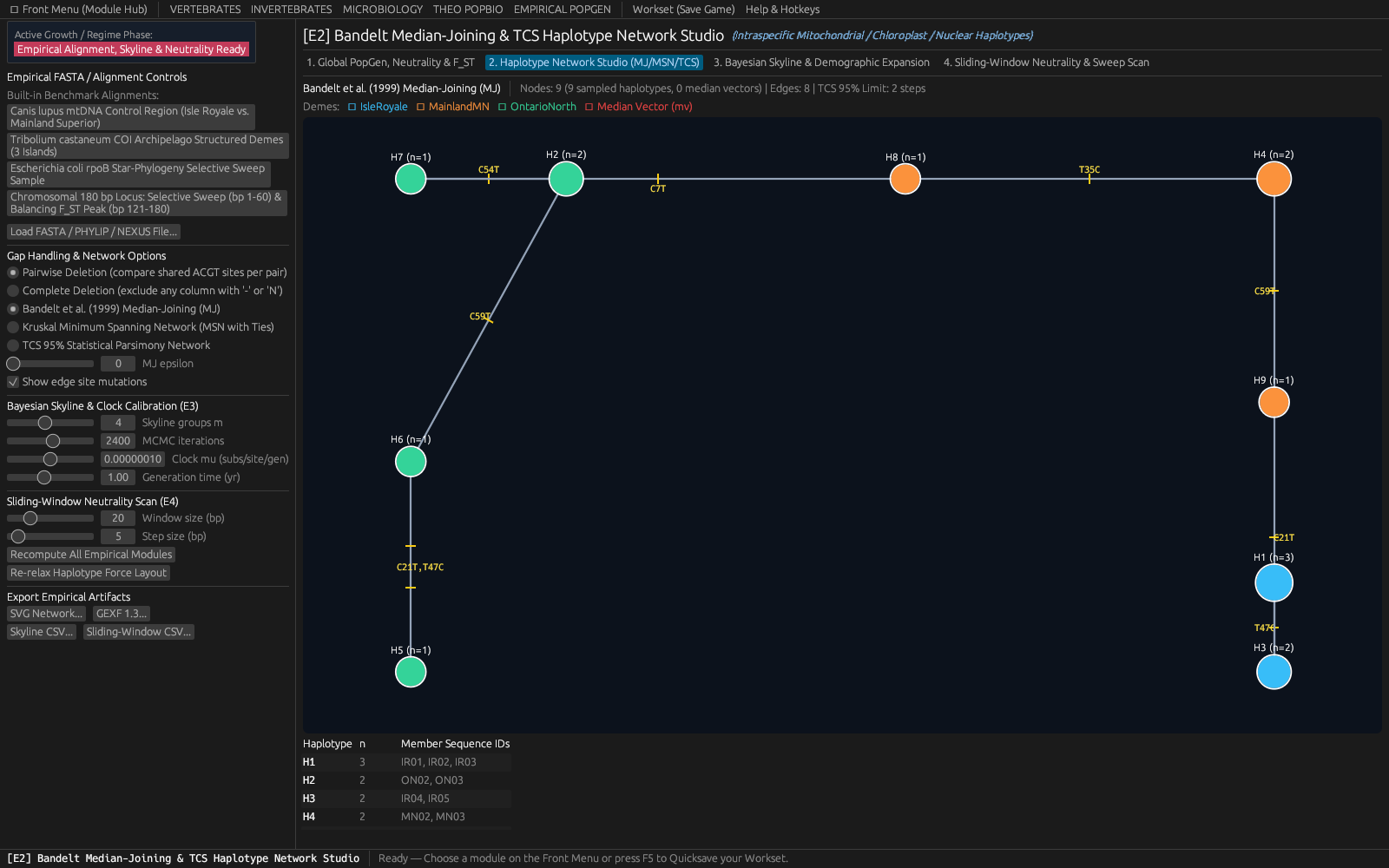
In star-like or reticulate haplotype topologies, the Median-Joining solver[2] infers missing ancestral median vectors whenever adding an unobserved consensus node strictly reduces total mutational steps over the minimum spanning tree, exporting crisp vector diagrams ready for reports or teaching slides.
Consider a concrete classroom walkthrough linking both halves of PopBio-Studio. An instructor begins in the age-structured matrix lab with a threatened vertebrate life table, adjusting juvenile survival by five percent and showing students how the dominant growth eigenvalue crosses from slow decline below one to steady recovery above one, while the elasticity matrix highlights which stage transition dominates long-term viability. Next, switching to the 3D Sewall Wright adaptive landscape, students watch a simulated population start near a local fitness ridge, experience genetic drift at small effective size, and cross a shallow valley onto a higher adaptive peak when migration or selection shifts. Moving directly into the molecular sequence tab, the class loads the bundled Isle Royale wolf mitochondrial alignment, inspects segregating sites and Tajima's D for signatures of bottlenecked diversity, and runs the Bayesian Skyline reconstruction[1] to see how coalescent intervals trace past effective population contraction. Finally, opening the Bandelt Median-Joining viewer[2] renders every observed wolf or beetle haplotype as proportional circles separated by mutational tick marks, making geographic isolation and shared ancestry immediately legible without writing a single line of external script.
Across both ecological and molecular tabs, every parameter tweak updates animated trajectories, summary statistics, and tabular exports in real time, turning abstract population-genetics equations into concrete visual patterns.
| Subsystem | Verified Scope | Suite Result |
|---|---|---|
| Ecological & Matrix Sims | Chemostat, Tribolium, Leslie/Lefkovitch eigenvalues | Verified in tests/popbio_integration.rs |
| 3D Adaptive Landscapes | Sewall Wright surfaces & deterministic seeded RNG | 6/6 integration checks passed |
| Skyline & Haplotypes | Bayesian Skyline coalescent & Bandelt Median-Joining | 18 Rust modules (v1.2.0) |
4. Practical Scenarios: Who Uses PopBio-Studio & How
Evolutionary Biology Courses and Conservation Planning
Ecology, evolution, and conservation-genetics instructors use PopBio-Studio in interactive computer labs to demonstrate competitive exclusion, maximum sustainable yield harvesting, stage-matrix elasticities, and coalescent effective population size without requiring students to debug external R, Python, or Java environments. Because all example datasets—from microbial growth curves to wolf mtDNA—are bundled inside the executable, every student starts on identical footing.
Conservation practitioners and wildlife biologists can inspect stage elasticities for managed species while exploring haplotype connectivity across fragmented habitats, testing how corridor restoration or harvest limits alter both demographic viability and genetic drift. Because every simulation uses reproducible seeded random streams and exports clean CSV tables and SVG network diagrams, lab assignments, workshop handouts, and exploratory studies remain easy to share and reproduce.
Beyond formal university coursework, PopBio-Studio also welcomes naturalists, citizen scientists, and independent learners curious about how evolution actually leaves measurable footprints in DNA. Why does a small island population of wolves or beetles lose variation far faster than a continental population? Why can two populations with identical total headcounts have wildly different extinction risks depending on whether juveniles or breeding adults face higher mortality? And how do geneticists look at modern DNA samples collected today and infer whether a species expanded rapidly after the Ice Age or survived a severe historical bottleneck? By letting users adjust carrying capacity, survival rates, mutation rates, and coalescent priors directly—and immediately seeing the resulting trajectories, eigenvalue tables, skyline curves, and haplotype networks update on screen—PopBio-Studio turns foundational concepts of ecology and evolutionary biology into hands-on exploration rather than passive memorization.
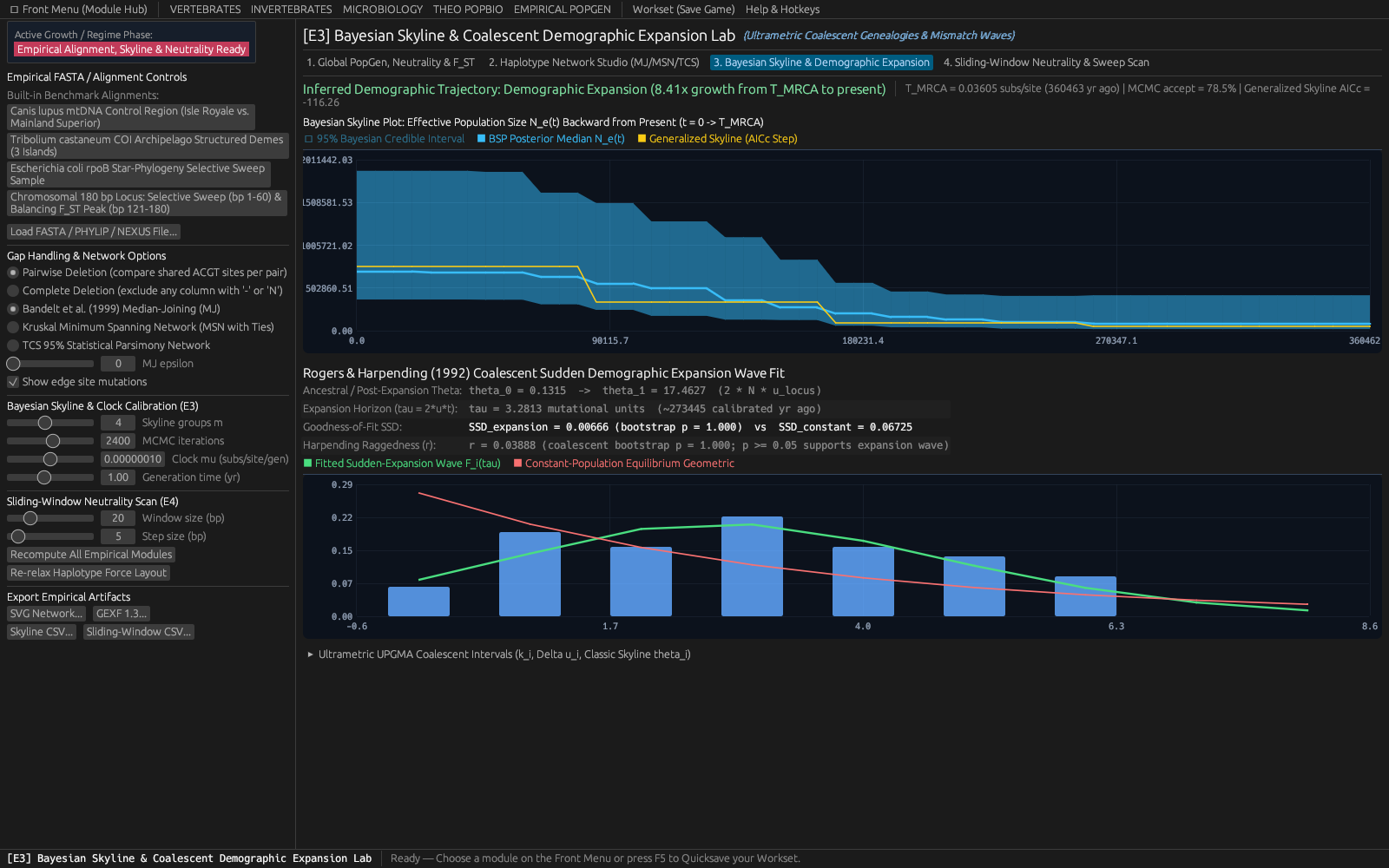
Every built-in dataset also serves as a clean template for users' own FASTA or PHYLIP alignments: researchers can drop local sequence files straight into the alignment or skyline tabs, verify nucleotide diversity and Tajima's D in milliseconds, and archive complete multi-panel analyses inside portable SQLite workset files without touching external cloud servers.
5. Open Access & Connections Across the CRV Science App Network
Open Access and Connections Across the CRV Science App Network
PopBio-Studio is dual-licensed under MIT or Apache-2.0 with full Rust source code, bundled example alignments, integration tests, and a companion user guide PDF on GitHub. Standard CSV and SVG exports let users inspect every number and diagram outside the application as well. Because every biological dataset, matrix model, and coalescent routine runs locally with zero external runtime dependencies, classrooms and research teams can archive reproducible exercises alongside their course materials for years to come.
Across the CRV Science Apps suite[3–19], PopBio-Studio bridges molecular biostatistics and Hardy-Weinberg/Fst calculators in OSABT, deep-time evolutionary systems modeling in ITME, and bioacoustic field surveys in SonoWing. Together, these interconnected offline tools give students and practitioners a cohesive quantitative toolkit spanning scales from individual genes and organisms up to ecosystems and geological eras.
References
- [1] Drummond, A. J., et al. (2005). Bayesian Coalescent Inference of Past Population Dynamics from Molecular Sequences. Molecular Biology and Evolution. https://doi.org/10.1093/molbev/msi103
- [2] Bandelt, H.-J., Forster, P., & Rohl, A. (1999). Median-joining networks for inferring intraspecific phylogenies. Molecular Biology and Evolution. https://doi.org/10.1093/oxfordjournals.molbev.a026036
- [3] White, B. P. (2026). The CRV Science App Network: Seventeen Open-Source Rust Programs for Science, Data, and Simulation. CRV Science App Preprint APP-PREPRINT-01 [cs.SE, cs.CE, q-bio.QM], v1.0.0. Hosted via CRV Science Apps Hub (https://crvscience.com/apps). https://doi.org/10.5281/zenodo.24222398
- [4] White, B. P. (2026). AeroFlyway: Tracking Bird Migration with Weather Radar, Skyglow Maps, and Nighttime Flight Calls. CRV Science App Preprint APP-PREPRINT-13 [q-bio.PE, physics.ao-ph, cs.GR], v0.6.0. Hosted via CRV Science Apps Hub (https://crvscience.com/apps). https://doi.org/10.5281/zenodo.24222366
- [5] White, B. P. (2026). BeoFold: Simulating How Proteins Fold Using Distributed Computing and State Networks. CRV Science App Preprint APP-PREPRINT-02 [q-bio.BM, physics.chem-ph, cs.DC], v1.4.0. Hosted via CRV Science Apps Hub (https://crvscience.com/apps). https://doi.org/10.5281/zenodo.24222370
- [6] White, B. P. (2026). Calc-Lab: Interactive Calculus, Linear Algebra, and Differential Equation Solver Workbench. CRV Science App Preprint APP-PREPRINT-03 [math.NA, cs.MS, cs.CY], v0.5.0. Hosted via CRV Science Apps Hub (https://crvscience.com/apps). https://doi.org/10.5281/zenodo.24222372
- [7] White, B. P. (2026). Causal-Atlas: Tracing How Genes and Drugs Turn Biological Pathways On and Off. CRV Science App Preprint APP-PREPRINT-04 [q-bio.MN, q-bio.GN, stat.ML], v0.2.0. Hosted via CRV Science Apps Hub (https://crvscience.com/apps). https://doi.org/10.5281/zenodo.24222376
- [8] White, B. P. (2026). Cit-Atlas: Mapping Citation Networks and Research Impact Across Scientific Papers. CRV Science App Preprint APP-PREPRINT-05 [cs.DL, cs.SI, physics.soc-ph], v1.8.0. Hosted via CRV Science Apps Hub (https://crvscience.com/apps). https://doi.org/10.5281/zenodo.24222380
- [9] White, B. P. (2026). EpiLedger: Privacy-Safe Disease Tracking, Clinical Text Screening, and Outbreak Monitoring. CRV Science App Preprint APP-PREPRINT-06 [cs.CR, q-bio.PE, stat.AP], v2.0.0. Hosted via CRV Science Apps Hub (https://crvscience.com/apps). https://doi.org/10.5281/zenodo.24222382
- [10] White, B. P. (2026). ITME: Simulating Four Billion Years of Life, Oceans, and Atmosphere Evolution. CRV Science App Preprint APP-PREPRINT-07 [q-bio.PE, nlin.AO, physics.bio-ph], v2.3.0. Hosted via CRV Science Apps Hub (https://crvscience.com/apps). https://doi.org/10.5281/zenodo.24222386
- [11] White, B. P. (2026). OSABT: All-in-One Toolkit for Plant Physiology, Survival Curves, Genetics, and Enzyme Kinetics. CRV Science App Preprint APP-PREPRINT-08 [q-bio.QM, stat.AP, cs.SE], v2.0.0. Hosted via CRV Science Apps Hub (https://crvscience.com/apps). https://doi.org/10.5281/zenodo.24222388
- [12] White, B. P. (2026). SAR-Atlas: Drug Design, Body Distribution Modeling, and Candidate Screening in Rust. CRV Science App Preprint APP-PREPRINT-09 [physics.chem-ph, q-bio.BM, cs.LG], v3.8.0. Hosted via CRV Science Apps Hub (https://crvscience.com/apps). https://doi.org/10.5281/zenodo.24222390
- [13] White, B. P. (2026). TerraTwin: Fast Climate Projections for Global Warming, Sea-Level Rise, and Arctic Change. CRV Science App Preprint APP-PREPRINT-10 [physics.ao-ph, cs.CE, stat.AP], v2.5.0. Hosted via CRV Science Apps Hub (https://crvscience.com/apps). https://doi.org/10.5281/zenodo.24222392
- [14] White, B. P. (2026). Urban-Grid: Modeling City Traffic, Emergency Response Coverage, and Earthquake Evacuation. CRV Science App Preprint APP-PREPRINT-11 [physics.soc-ph, cs.MA, cs.CE], v5.2.0. Hosted via CRV Science Apps Hub (https://crvscience.com/apps). https://doi.org/10.5281/zenodo.24222394
- [15] White, B. P. (2026). WildFront BattleGrounds: Turn-Based Hex Strategy Game with Voxel Graphics and Procedural Map Generation. CRV Science App Preprint APP-PREPRINT-12 [cs.GT, cs.GR, math.CO], v3.4.1. Hosted via CRV Science Apps Hub (https://crvscience.com/apps). https://doi.org/10.5281/zenodo.24222396
- [16] White, B. P. (2026). HelioProbe: Simulating Spacecraft Orbits, Deep-Space Telescopes, and Comet Tails in 3D. CRV Science App Preprint APP-PREPRINT-14 [astro-ph.EP, astro-ph.IM, cs.GR], v2.3.0. Hosted via CRV Science Apps Hub (https://crvscience.com/apps). https://doi.org/10.5281/zenodo.24244083
- [17] White, B. P. (2026). QuantaCrypt-Studio: Simulating Quantum Circuits, Quantum Key Distribution, and Post-Quantum Cryptography. CRV Science App Preprint APP-PREPRINT-16 [quant-ph, cs.CR, cs.MS], v2.2.0. Hosted via CRV Science Apps Hub (https://crvscience.com/apps). https://doi.org/10.5281/zenodo.24244089
- [18] White, B. P. (2026). SonoWing: Analyzing Bat Echolocation and Bird Calls with Spectrograms and Harmonic Tracking. CRV Science App Preprint APP-PREPRINT-17 [q-bio.NC, q-bio.PE, cs.SD], v1.1.0. Hosted via CRV Science Apps Hub (https://crvscience.com/apps). https://doi.org/10.5281/zenodo.24244091
- [19] White, B. P. (2026). SwarmForge: 3D Isometric Automated Factory and Swarm Robotics Simulation Game. CRV Science App Preprint APP-PREPRINT-18 [cs.MA, cs.RO, cs.GT], v1.3.0. Hosted via CRV Science Apps Hub (https://crvscience.com/apps). https://doi.org/10.5281/zenodo.24244093