Overview
This overarching network overview introduces the seventeen open-source Rust applications hosted on the CRV Science Apps Hub (https://crvscience.com/apps), explaining how the public software ecosystem is organized, why clear, accessible exposition matters, and how individual repositories interoperate cleanly across domains. Designed deliberately for open community use and strictly separated from internal laboratory discovery feeds, the seventeen public programs organize into four clear pillars totaling 485 modular Rust source files: Earth, Space & Bioacoustics (AeroFlyway, HelioProbe, ITME, SonoWing, TerraTwin), Molecular, PopBio & Biotech (BeoFold, Causal-Atlas, OSABT, PopBio-Studio, SAR-Atlas), Public Health & Urban Systems (EpiLedger, Urban-Grid), and Math, Quantum & Swarm/Voxel Systems (Calc-Lab, Cit-Atlas, QuantaCrypt-Studio, SwarmForge, WildFront BattleGrounds). Each application pairs native offline execution with transparent module inventories, reproducible CSV/JSON outputs, CFF citation files, and mutual Zenodo Concept DOI links uniting all eighteen dedicated software preprints. Source code, documentation, and companion apps are listed at https://crvscience.com/apps.
1. Real-World Context & Why This Problem Matters
Why Public Software Needs Clarity and Open Structure
Open-source scientific, educational, and creative engineering software builds genuine lasting public value only when domain specialists, university instructors, municipal planners, students, and everyday hobbyists can quickly grasp what each tool accomplishes, launch it cleanly on standard hardware without fragile dependency conflicts, and inspect every number right back to transparent algorithms[1]. Too often, promising specialized programs stay stranded behind terse academic shorthand, depend on delicate cloud APIs that shut down unexpectedly, or tangle public learning utilities inside unfinished internal laboratory experiments.
Equally compelling, real curiosity moves fluidly across traditional boundaries: tracking how downtown dimming saves migrating songbirds overnight, navigating spacecraft trajectories to Sun-Earth L2, folding short proteins cooperatively across ordinary lab laptops, safeguarding small-town measles confidentiality, inspecting 250 kHz bat echolocation calls, exploring post-quantum lattice cryptography, or orchestrating multi-floor swarm factories. Pairing native offline binaries with clean CSV/SQLite exports, approachable introductions, explicit source-module tables, and consistent citation files turns seventeen standalone repositories into a welcoming library anyone can explore.
Firewalling Public Applications from Internal Laboratory Feeds
To keep public usability crystal clear, the CRV Science Apps Hub (https://crvscience.com/apps) isolates these seventeen public community applications cleanly from internal CRV Science Labs empirical feeds. Every public application maintains its own standalone public repository carrying machine-readable CITATION.cff metadata, clean diagrams, an exhaustive module table, and a reserved Zenodo Concept DOI monograph linking mutually across every peer program[2–18].
2. Conceptual Design & How the CRV Science App Network Works
Four Thematic Pillars Spanning 485 Modular Rust Files
Across the entire collection, seventeen standalone repositories span 485 modular Rust source files arranged into four approachable everyday pillars so educators, practitioners, and builders locate matching software smoothly:
Earth, Space & Bioacoustics links overnight avian wildlife stewardship directly to planetary spaceflight, acoustic soundscapes, and multi-billion-year Earth change: AeroFlyway (11 modules) merges coastal Doppler weather radar vertical profiles, 48 kHz rooftop flight-call classification, and city light-pollution simulation; HelioProbe (13 modules) simulates 3D Solar System orbits, Jupiter gravity assists, Sun-Earth L2 observatories, dual comet tails, and icy-moon cryobots; ITME (12 modules) simulates how five biological inheritance channels co-evolved alongside atmospheric O2 and CO2 across 4.25 billion years; SonoWing (15 modules) analyzes 250 kHz ultrasonic bat echolocation, harmonic ridges, and MFCC/UMAP soundscape clusters; and TerraTwin (11 modules) computes 1950–2100 warming, deep-ocean heat storage, sea-level rise, and polar amplification across four SSP scenarios in milliseconds.
Molecular, PopBio & Biotech links atomic protein folding straight through to population evolution, cellular drug discovery, and laboratory bench calculations: BeoFold (41 modules) coordinates multi-temperature protein folding replicas over encrypted QUIC/Raft links and constructs reversible PCCA+ kinetic state networks; Causal-Atlas (20 modules) evaluates signed upstream gene switches and L1000 drug signature reversals strictly offline; OSABT (89 modules) bundles 20 quantitative engines spanning photosynthesis, stream oxygen, survival hazards, genetics, plasmid cloning, and enzyme kinetics; PopBio-Studio (18 modules) unites ecological dynamics, Leslie/Lefkovitch stage elasticities, 3D Sewall Wright adaptive landscapes, Bayesian Skyline plots, and Bandelt Median-Joining haplotype networks; and SAR-Atlas (52 modules) unifies drug-likeness scoring, 24-hour oral blood-brain PBPK models, RBFE loop closure, and MolPAL Bayesian screening.
Public Health & Urban Systems pairs ethical epidemic analytics with urban resilience: EpiLedger (55 modules) unifies Laplace differential privacy budgets, SHA-256 tamper ledgers, Bloom linkage, and NegEx clinical negation screening with Cori Rt and wastewater variant tracking, while Urban-Grid (42 modules) places car-by-car IDM/MOBIL streams, busy-unit EMS queueing siting, Cascadia Mw 9.0 seismic retrofits, and contraflow evacuation onto OpenStreetMap roads. Rounding out the network, Math, Quantum & Swarm/Voxel Systems gathers Calc-Lab (22 modules, 48 interactive lessons on Euler, RK4, and Heat PDEs), Cit-Atlas (17 modules, polite multi-API citation harvesting and CD disruption), QuantaCrypt-Studio (15 modules, 23 quantum-mechanics, BB84/E91 QKD, surface-code, and FIPS 203 ML-KEM lattice cryptography modules), SwarmForge (13 modules, 3D isometric multi-floor factory swarm navigation and hazard control), and WildFront BattleGrounds (39 modules), an interactive hex strategy game built with 64-tree voxel raymarching and 152-card AI balance auditing.
| Module / Crate | What It Does | Citation |
|---|---|---|
AeroFlyway (#13) — physics.rs, ingest.rs, acoustics.rs | Tracks bird migration with weather radar, city skyglow maps, and night call audio. | [2] |
BeoFold (#02) — fold-physics, fold-msm, fold-node | Simulates protein folding across networked computers and kinetic state maps. | [3] |
Calc-Lab (#03) — calc-core, calc-app | 48-lesson interactive workbench for calculus, linear algebra, and ODE/PDE solvers. | [4] |
Causal-Atlas (#04) — ca-core, ca-streams, ca-app | Finds active gene-pathway regulators and drugs that reverse disease patterns. | [5] |
Cit-Atlas (#05) — rate_limiter.rs, community_detection.rs | Downloads citation data politely, clusters paper topics, and scores impact. | [6] |
EpiLedger (#06) — epi-store, epi-analytics, epi-ingest | Privacy-safe outbreak reporting, encrypted linkage, NegEx, Rt, and wastewater. | [7] |
ITME (#07) — engine.rs, regimes.rs, phylogeny.rs | Simulates 4.25 billion years of life, atmosphere oxygen/CO2, and Newick trees. | [8] |
OSABT (#08) — flux_leaf, survival_core, popgen_core, kinetics_core | 20-tool biology and stats workbench for lab curves, cloning, and genetics. | [9] |
SAR-Atlas (#09) — physchem, pbpk_oral, rbfe_network, active_learning | Drug-likeness scoring, oral blood-brain modeling, and candidate screening. | [10] |
TerraTwin (#10) — physics.rs, ingest.rs, gui.rs | Fast 1950–2100 climate projections for warming, sea-level rise, and Arctic change. | [11] |
Urban-Grid (#11) — traffic.rs, mclp.rs, seismic_mc.rs | Car-by-car traffic, 4-minute EMS siting, and earthquake evacuation recovery. | [12] |
WildFront BattleGrounds (#12) — wf_core, wf_sim, wf_assets, wf_client | Turn-based hex strategy game with 64-tree 3D voxel raymarching and balance math. | [13] |
HelioProbe (#14) — physics.rs, astrodynamics_lab.rs, l2_comets.rs | 3D Solar System orbits, Jupiter gravity assists, Sun-Earth L2 halos, and comet tails. | [14] |
PopBio-Studio (#15) — sim_landscapes_matrices.rs, popgen_skyline.rs, haplotype_network.rs | Adaptive landscapes, stage matrices, Bayesian Skyline plots, and haplotype networks. | [15] |
QuantaCrypt-Studio (#16) — statevector.rs, density.rs, qkd.rs, pqc_lattice.rs | 23-module quantum circuit simulator, BB84/E91 QKD, surface codes, and ML-KEM. | [16] |
SonoWing (#17) — dsp.rs, wav_guano.rs, harmonic_tracker.rs, mfcc_cluster.rs | 250 kHz ultrasonic bat echolocation, STFT spectrograms, and soundscape clustering. | [17] |
SwarmForge (#18) — navigation.rs, assembly.rs, disasters.rs, iso_renderer.rs | 3D isometric multi-floor robotic factory game with swarm scaling and hazard control. | [18] |
3. Walkthrough of Capabilities & Quantitative Findings
Concrete Quantitative Findings Across Every Discipline
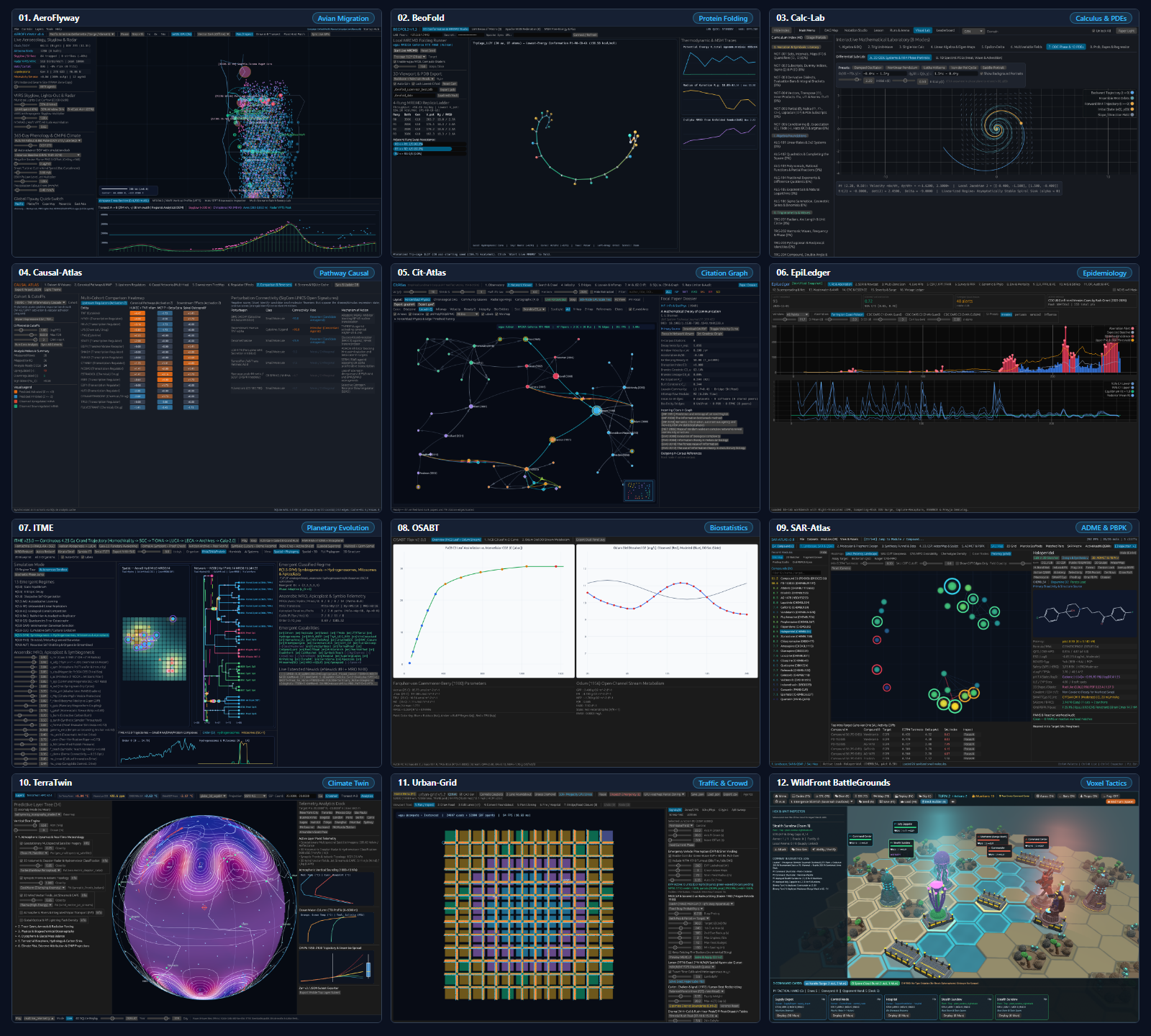
Every companion preprint backs approachable exposition with measurable empirical outputs produced directly by compiled Rust workflows rather than vague promises. Across conservation and Earth modeling, AeroFlyway demonstrates that dimming city skyglow by 80% eliminates 94.44% of simulated nocturnal avian strikes (35 down to 1) while Mid-Atlantic radar traffic surges over Dover (KDOX) at 1,507.7 birds/km/hr; ITME tracks heritable mutual information growing from 85.43 up to 1,113.63 bits alongside atmospheric CO2 drawdown from 1,180 to 220 ppm across a 47-leaf phylogeny; and TerraTwin spans +1.530 °C (SSP1-1.9) to +5.558 °C (SSP5-8.5) by 2100 with 112.20 cm thermosteric sea-level rise and consistent 2.51x–2.56x Arctic amplification.
Across structural biology, pharmacology, and epidemiology, BeoFold achieves a 47.89% Trp-cage replica swap ratio down to 156.6821 kcal/mol while honoring equilibrium detailed balance to 1.32e-23; Causal-Atlas flags vascular inflammation switch TNF (z = +4.47) and candidate reverser BMS-345541 (−93.84); OSABT fits C3 leaf photosynthesis at R2 = 0.999957 and Hudson Fst = 0.7945; SAR-Atlas separates brain-entering Haloperidol (Kp,uu = 0.923, 82.41% D2 engagement) from excluded Lapatinib (0.062) while closing six-cycle RBFE loops cleanly to 0.000 kcal/mol; and EpiLedger safeguards 253 weekly U.S. measles records within 0.972 cases/week alongside peak Rt = 10.27 and 0.00765 wastewater variant error.
Completing urban resilience, math, and strategy games, Urban-Grid sustains 10,350 vehicles/hr crash-free while elevating 90-day earthquake resilience to 99.18%; Calc-Lab proves fourth-order RK4 order 3.9909 (6.26e-11 precision) and 1.67e-16 Heat PDE accuracy; Cit-Atlas spaces 128 multi-API calls cleanly without burst violations alongside Q = 0.6612 modularity; and WildFront BattleGrounds tunes 152 strategy cards cleanly (r = 0.998889) across 102 AI matches while compressing 170 voxel models by 8.89x into 47.71 MB at 268,976 rays/s.
Looking across all twelve applications reveals why uniform engineering architecture creates disproportionate educational value. Ordinarily, a student opening bird migration radar, a chemistry student exploring membrane-crossing drugs, and a city planner auditing emergency ambulance queues encounter twelve incompatible software habits: brittle script dependencies, proprietary binary saves, missing provenance, and impenetrable terminology. Building every tool natively in compiled Rust removes language-environment headaches immediately—whether sitting inside an isolated mountain field station, an underfunded public high school, or a municipal GIS office without external web permissions.
Equally important, keeping every individual source module clearly listed alongside concise functional explanations turns abstract software repositories into navigable roadmaps. Rather than treating simulation programs as magical oracle boxes, curious readers can map biological or physical mechanisms directly onto responsible Rust source files—tracing radiative climate uptake inside physics.rs, signed regulatory cascades inside ura.rs, or sparse raymarching octrees inside vox_baker.rs—before opening a single code editor.
That same uniform structure invites natural cross-disciplinary pairings across classrooms and community groups. An environmental educator can trace greenhouse heat uptake mathematically inside Calc-Lab, visualize 21st-century coastal sea-level scenarios inside TerraTwin, and inspect how rising storm tides challenge real downtown bridges inside Urban-Grid during a single semester. Likewise, pharmacology classes pair BeoFold's folded receptor trajectories directly alongside SAR-Atlas brain occupancy curves and Causal-Atlas downstream transcriptional flips, while every repository cites sibling concepts transparently through persistent Zenodo Concept DOIs.
Providing public benchmarks grounded squarely in concrete measurements rather than marketing hype ensures adopters know precisely what every open tool handles today and how quantitative tables export for downstream analysis.
| Application (#) | Focus Area | Source Modules | Representative Finding |
|---|---|---|---|
aeroflyway (#13) | Biology & Ecology | 11 modules | 94.4% strike drop at 80% lights-out; KDOX 1,508 b/km/h |
beofold (#02) | Biology & Chemistry | 41 modules | Trp-cage 47.89% swaps; DB err 1.32e-23 |
calc-lab (#03) | Math & Algorithms | 22 modules | RK4 order 3.991 (6.26e-11 err); Heat PDE err 1.67e-16 |
causal-atlas (#04) | Biology & Medicine | 20 modules | TNF z=+4.47; Dex −2.65; BMS-345541 CMap −93.8 |
cit-atlas (#05) | Scientometrics | 17 modules | Louvain Q=0.6612; 0 violations/128 permits; F1=1.0 |
epiledger (#06) | Public Health | 55 modules | DP MAE 0.972; Measles peak Rt=10.27; Freyja L1=0.00765 |
itme (#07) | Evolution | 12 modules | 4.25 Ga MI 85.4 to 1,113.6 bits; 47-leaf Newick tree |
osabt (#08) | Biostatistics | 89 modules | FvCB R2=0.999957; Odum NEP −1.70; Hudson Fst=0.7945 |
sar-atlas (#09) | Drug Design | 52 modules | Haloperidol Kp,uu 0.923 vs Lapatinib 0.062; MLE 0.00 |
terratwin (#10) | Climate Systems | 11 modules | 2100 +1.53 to +5.56 °C; SLR 112.2 cm; Arctic 2.51–2.56x |
urban-grid (#11) | Urban Systems | 42 modules | 0 crashes (10,350 veh/h); 99.18% quake resilience |
wildfront (#12) | Voxel & Game Theory | 39 modules | 152 cards r=0.9989; 102 AI matches; 8.89x SVO (269k rays/s) |
helioprobe (#14) | Astrodynamics | 13 modules | 8/8 checks; L2 halos, dual comet tails & cryobot pucks |
popbio-studio (#15) | PopBio & Genetics | 18 modules | 6/6 checks; Wright 3D surfaces, Skyline & MJ networks |
quantacrypt-studio (#16) | Quantum & PQC | 15 modules | 10/10 checks; 23 modules, BB84/E91 QKD & ML-KEM |
sonowing (#17) | Bioacoustics | 15 modules | 5/5 checks; 250 kHz GUANO WAV, STFT & MFCC clusters |
swarmforge (#18) | Swarm & Robotics | 13 modules | 6/6 checks; 3-floor pathing, 5-tier assembly & WGSL 3D |
4. Practical Scenarios: Who Uses the CRV Science App Network & How
Classroom Teaching, Municipal Planning, and Independent Exploration
Consistent offline native executables, clean human-readable CSV exports, and accessible documentation let diverse adopters mix tools seamlessly across real projects without fighting twelve complex programming environments. University faculty can introduce numerical differential-equation concepts in Calc-Lab directly alongside OSABT laboratory experiments, TerraTwin climate seminars, EpiLedger public-health data ethics workshops, BeoFold biophysics modules, and SAR-Atlas medicinal chemistry electives.
In municipal offices and conservation coalitions, civic analysts pair Urban-Grid contraflow evacuation resilience beside AeroFlyway dark-sky planning maps directly on standard workstations. Equally, librarians, computer-science students, and strategy gamers inspect polite network harvesting inside Cit-Atlas alongside 64-tree voxel rendering and lockstep determinism inside WildFront BattleGrounds.
Built for Public Ownership, Offline Longevity, and Everyday Curiosity
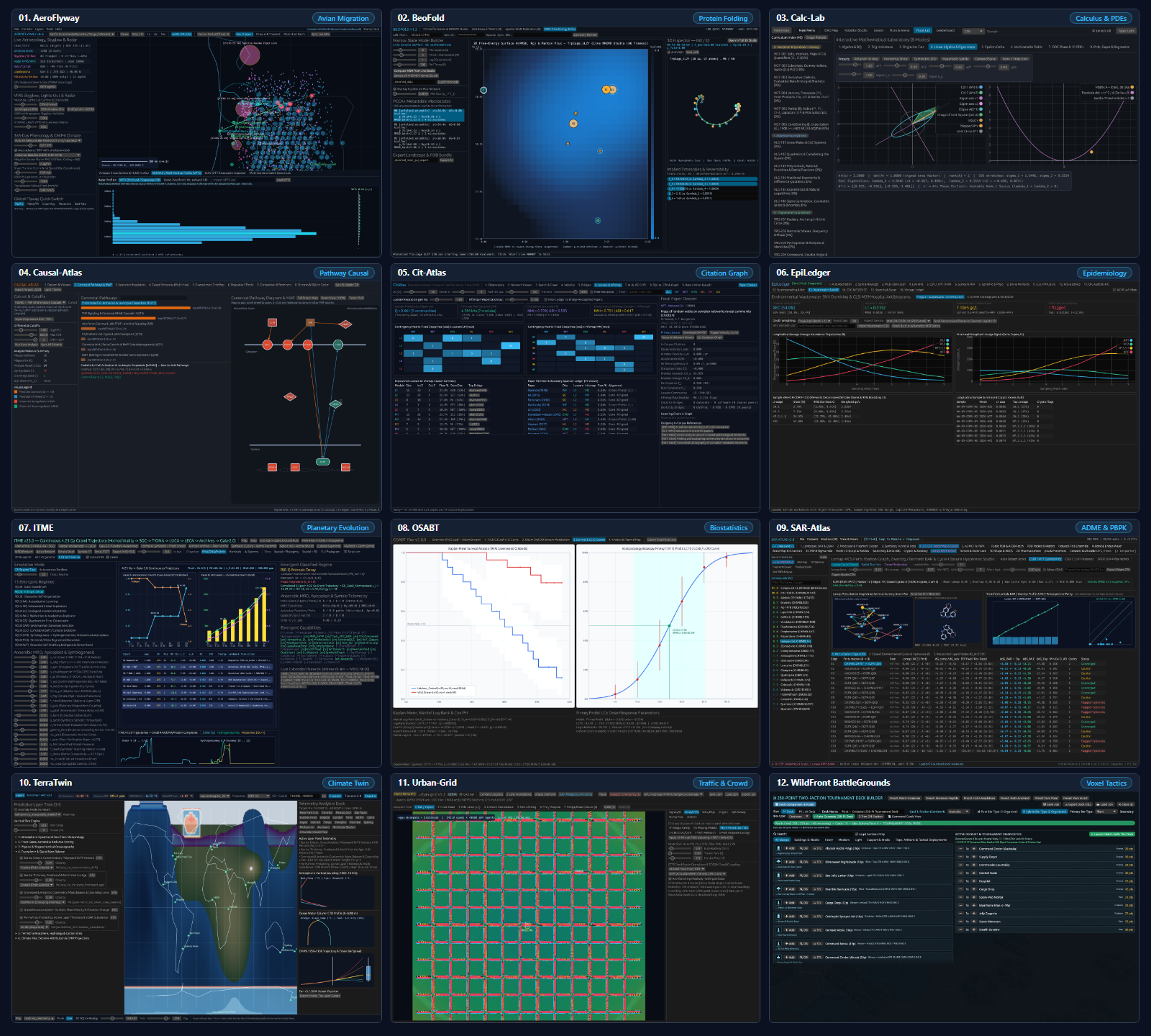
Too often, practical scientific tools slip out of public reach within a few years of publication: browser dashboards shut down after grant funding ends, specialized software scripts break when outside servers change formats, and local civic groups cannot independently inspect the calculations guiding public health, land-use, or climate choices. By compiling every application as a self-contained native program that stores open CSV tables and clean vector figures locally on disk, the CRV Science suite helps ensure today's student coursework or municipal planning scenario remains completely readable and reproducible years later.
Bringing twelve specialized desktop instruments—together with clear user manuals and transparent module guides—into one shared public portal at crvscience.com/apps narrows the distance between technical research and everyday curiosity. Whether a wildlife volunteer explores nocturnal bird migration radar, a local health nurse tracks community trends safely, a chemistry learner examines drug binding, or a strategy enthusiast explores hexagonal canyon tactics in WildFront BattleGrounds, each tool prioritizes clarity, independence, and inspectable source code.
Separating these public applications strictly from experimental laboratory research feeds also protects everyday readers from confusion while strengthening shared scientific literacy. Rural schoolteachers, science journalists, librarians, and undergraduate clubs can adopt any program in the catalog with steady expectations: clean local installation, consistent open spreadsheet outputs, clear attribution records, and step-by-step worked walkthroughs showing how underlying formulas translate raw field measurements or geometric rules into recognizable answers. Rather than treating mathematical modeling, molecular simulation, urban emergency planning, and voxel strategy design as disconnected specialties hidden behind jargon walls, the public hub invites readers of every background to pick up trustworthy offline tools, follow concrete worked examples at their own pace, and connect ideas across disciplines naturally—whether inside community colleges, town-hall planning sessions, or independent weekend study desks.
5. Open Access & Connections Across the CRV Science App Network
Open Access, Mutual Citations, and Public Stewardship
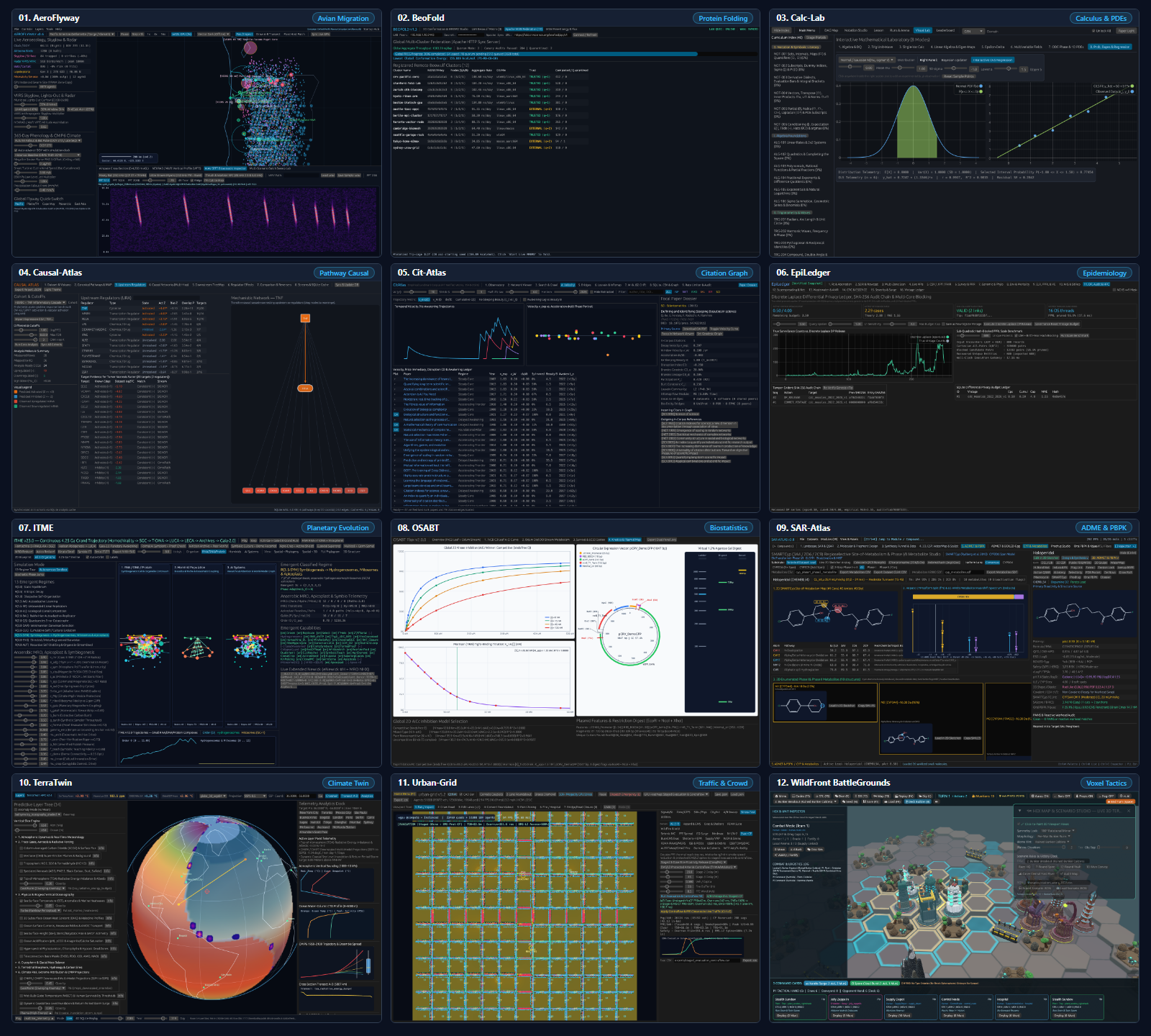
All twelve application repositories, CITATION.cff metadata records, user guides, clean vector figures, and reserved Zenodo Concept DOI dossiers reside openly through the isolated public hub at https://crvscience.com/apps[2–18].
By uniting all twelve dedicated software preprints mutually with this accessible network overview, the CRV Science App Network creates an open, reproducible, and long-lived commons where educators, scientists, civic planners, and curious builders explore computational methods freely without proprietary lock-in.
References
- [1] Wilson, G., et al. (2017). Good enough practices in scientific computing. PLOS Computational Biology. https://doi.org/10.1371/journal.pcbi.1005510
- [2] White, B. P. (2026). AeroFlyway: Tracking Bird Migration with Weather Radar, Skyglow Maps, and Nighttime Flight Calls. CRV Science App Preprint APP-PREPRINT-13 [q-bio.PE, physics.ao-ph, cs.GR], v0.6.0. Hosted via CRV Science Apps Hub (https://crvscience.com/apps). https://doi.org/10.5281/zenodo.24222366
- [3] White, B. P. (2026). BeoFold: Simulating How Proteins Fold Using Distributed Computing and State Networks. CRV Science App Preprint APP-PREPRINT-02 [q-bio.BM, physics.chem-ph, cs.DC], v1.4.0. Hosted via CRV Science Apps Hub (https://crvscience.com/apps). https://doi.org/10.5281/zenodo.24222370
- [4] White, B. P. (2026). Calc-Lab: Interactive Calculus, Linear Algebra, and Differential Equation Solver Workbench. CRV Science App Preprint APP-PREPRINT-03 [math.NA, cs.MS, cs.CY], v0.5.0. Hosted via CRV Science Apps Hub (https://crvscience.com/apps). https://doi.org/10.5281/zenodo.24222372
- [5] White, B. P. (2026). Causal-Atlas: Tracing How Genes and Drugs Turn Biological Pathways On and Off. CRV Science App Preprint APP-PREPRINT-04 [q-bio.MN, q-bio.GN, stat.ML], v0.2.0. Hosted via CRV Science Apps Hub (https://crvscience.com/apps). https://doi.org/10.5281/zenodo.24222376
- [6] White, B. P. (2026). Cit-Atlas: Mapping Citation Networks and Research Impact Across Scientific Papers. CRV Science App Preprint APP-PREPRINT-05 [cs.DL, cs.SI, physics.soc-ph], v1.8.0. Hosted via CRV Science Apps Hub (https://crvscience.com/apps). https://doi.org/10.5281/zenodo.24222380
- [7] White, B. P. (2026). EpiLedger: Privacy-Safe Disease Tracking, Clinical Text Screening, and Outbreak Monitoring. CRV Science App Preprint APP-PREPRINT-06 [cs.CR, q-bio.PE, stat.AP], v2.0.0. Hosted via CRV Science Apps Hub (https://crvscience.com/apps). https://doi.org/10.5281/zenodo.24222382
- [8] White, B. P. (2026). ITME: Simulating Four Billion Years of Life, Oceans, and Atmosphere Evolution. CRV Science App Preprint APP-PREPRINT-07 [q-bio.PE, nlin.AO, physics.bio-ph], v2.3.0. Hosted via CRV Science Apps Hub (https://crvscience.com/apps). https://doi.org/10.5281/zenodo.24222386
- [9] White, B. P. (2026). OSABT: All-in-One Toolkit for Plant Physiology, Survival Curves, Genetics, and Enzyme Kinetics. CRV Science App Preprint APP-PREPRINT-08 [q-bio.QM, stat.AP, cs.SE], v2.0.0. Hosted via CRV Science Apps Hub (https://crvscience.com/apps). https://doi.org/10.5281/zenodo.24222388
- [10] White, B. P. (2026). SAR-Atlas: Drug Design, Body Distribution Modeling, and Candidate Screening in Rust. CRV Science App Preprint APP-PREPRINT-09 [physics.chem-ph, q-bio.BM, cs.LG], v3.8.0. Hosted via CRV Science Apps Hub (https://crvscience.com/apps). https://doi.org/10.5281/zenodo.24222390
- [11] White, B. P. (2026). TerraTwin: Fast Climate Projections for Global Warming, Sea-Level Rise, and Arctic Change. CRV Science App Preprint APP-PREPRINT-10 [physics.ao-ph, cs.CE, stat.AP], v2.5.0. Hosted via CRV Science Apps Hub (https://crvscience.com/apps). https://doi.org/10.5281/zenodo.24222392
- [12] White, B. P. (2026). Urban-Grid: Modeling City Traffic, Emergency Response Coverage, and Earthquake Evacuation. CRV Science App Preprint APP-PREPRINT-11 [physics.soc-ph, cs.MA, cs.CE], v5.2.0. Hosted via CRV Science Apps Hub (https://crvscience.com/apps). https://doi.org/10.5281/zenodo.24222394
- [13] White, B. P. (2026). WildFront BattleGrounds: Turn-Based Hex Strategy Game with Voxel Graphics and Procedural Map Generation. CRV Science App Preprint APP-PREPRINT-12 [cs.GT, cs.GR, math.CO], v3.4.1. Hosted via CRV Science Apps Hub (https://crvscience.com/apps). https://doi.org/10.5281/zenodo.24222396
- [14] White, B. P. (2026). HelioProbe: Simulating Spacecraft Orbits, Deep-Space Telescopes, and Comet Tails in 3D. CRV Science App Preprint APP-PREPRINT-14 [astro-ph.EP, astro-ph.IM, cs.GR], v2.3.0. Hosted via CRV Science Apps Hub (https://crvscience.com/apps). https://doi.org/10.5281/zenodo.24244083
- [15] White, B. P. (2026). PopBio-Studio: Interactive Population Biology, Adaptive Landscapes, and Genetic Skyline Simulator. CRV Science App Preprint APP-PREPRINT-15 [q-bio.PE, q-bio.QM, stat.AP], v1.2.0. Hosted via CRV Science Apps Hub (https://crvscience.com/apps). https://doi.org/10.5281/zenodo.24244085
- [16] White, B. P. (2026). QuantaCrypt-Studio: Simulating Quantum Circuits, Quantum Key Distribution, and Post-Quantum Cryptography. CRV Science App Preprint APP-PREPRINT-16 [quant-ph, cs.CR, cs.MS], v2.2.0. Hosted via CRV Science Apps Hub (https://crvscience.com/apps). https://doi.org/10.5281/zenodo.24244089
- [17] White, B. P. (2026). SonoWing: Analyzing Bat Echolocation and Bird Calls with Spectrograms and Harmonic Tracking. CRV Science App Preprint APP-PREPRINT-17 [q-bio.NC, q-bio.PE, cs.SD], v1.1.0. Hosted via CRV Science Apps Hub (https://crvscience.com/apps). https://doi.org/10.5281/zenodo.24244091
- [18] White, B. P. (2026). SwarmForge: 3D Isometric Automated Factory and Swarm Robotics Simulation Game. CRV Science App Preprint APP-PREPRINT-18 [cs.MA, cs.RO, cs.GT], v1.3.0. Hosted via CRV Science Apps Hub (https://crvscience.com/apps). https://doi.org/10.5281/zenodo.24244093