Overview
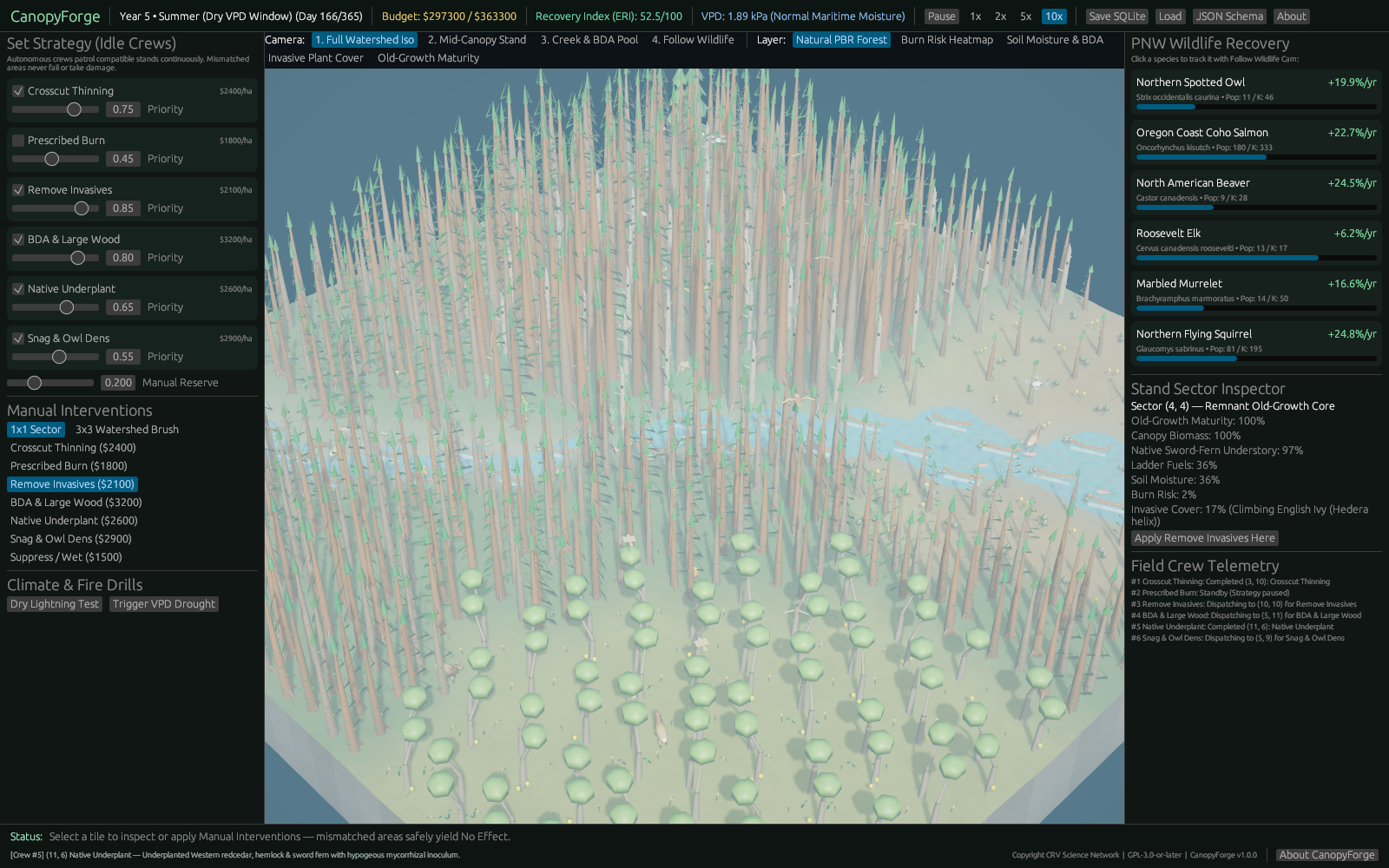
CanopyForge (v1.0.0) is a hardware-accelerated 3D isometric Pacific Northwest (PNW) old-growth watershed recovery and ecological stewardship simulator written in memory-safe Rust across core library modules under GPL-3.0-or-later licensing. Across a 16 x 16 spatial watershed lattice (256 sectors spanning five ecotypes: Remnant Old-Growth Core, Dense Second-Growth Plantation, Incised Salmonid Creek Corridor, Degraded Clearcut Edge, and Upland Oak-Conifer Meadow Ridge), autonomous restoration crews and canopy LiDAR drones execute budget-constrained treatments—variable-density crosscut thinning, prescribed underburns, invasive suppression, Beaver Dam Analogue (BDA) installation, native mycorrhizal underplanting, and snag cavity creation—while strict site-compatibility invariants guarantee mismatched interventions never degrade ecosystem state. The custom three-pass WGPU renderer renders sculpted continuous terrain over columnar basalt cliffs, 2048 x 2048 directional shadow maps, 4x MSAA HDR lighting, animated dual-wave creek water with woven-willow BDAs, and six articulated PNW fauna guilds (Northern Spotted Owl, Oregon Coast Coho Salmon, North American Beaver, Roosevelt Elk, Marbled Murrelet, and Northern Flying Squirrel). Across 8/8 passing tests and deterministic 15-year CLI sweeps (seed 2026), the watershed Ecological Recovery Index (ERI) rises monotonically from 40.42/100 (Year 1, annual grant USD 278,600) to 55.07 (Year 5), 66.92 (Year 8, replicated at 67.10 on seed 1994), and 77.17/100 by Year 15 (annual grant USD 484,800), with Oregon Coast Coho Salmon recovering to 413.0 / 420.0 K (98.3%). Source repositories, documentation, and peer applications are hosted at https://crvscience.com/apps.
1. Introduction
Industrial forestry, clearcut edge encroachment, stream incision, and summer drought vapor pressure deficit (VPD) interact across Pacific Northwest catchments in ways linear spread-sheet calculators rarely capture[1,3]. Rebuilding vertical old-growth structure—large multi-cohort conifers, cavity-bearing snags, native sword-fern and mycorrhizal understories, and reconnected Beaver Dam Analogue (BDA) off-channel salmonid wetlands[2,5]—requires decades of sequenced stewardship balanced against annual grant ceilings and wildfire ignition risk[4].
CanopyForge (v1.0.0) models these interacting forest-watershed mechanisms across a 16 × 16 sector terrain in standalone safe Rust (#![forbid(unsafe_code)] across core modules) with a hardware-accelerated three-pass wgpu renderer and headless CLI audit tooling inside the CRV Science Open-Source Apps ecosystem[6–27].
2. Architecture: Three-Pass WGPU Renderer & Zero-Harm Stewardship Rules
Eleven modular Rust files separate continuous-time forest/VPD/fire ecology, six articulated PNW fauna and steward crews, portfolio strategy enforcement, custom 3D mesh builders, GPU shaders, and SQLite WAL save state (Table 1). Each sector stores continuous fractions for old-growth maturity, canopy biomass, native understory, ladder fuels, soil moisture, three invasive species (Himalayan blackberry, Scotch broom, English ivy), riparian BDA/large-wood density, snag cavities, and mycorrhizal inoculation. A central validation invariant enforces Zero-Harm Stewardship: attempting incompatible actions (e.g., placing a BDA on an arid upland ridge) yields No Effect at zero cost and zero ecological penalty.
| Source File | Subsystem Role |
|---|---|
src/ecology.rs | 256-tile (16 × 16) 5-ecotype watershed state, seasonal VPD drought hydrology, invasive spread, and probabilistic wildfire dynamics. |
src/strategies.rs | Six portfolio & manual interventions with strict ecotype compatibility rules and performance-scaled annual stewardship grants. |
src/agents.rs | Six autonomous field crews, orbiting canopy LiDAR drones, terrain elevation sampling, and 6-species PNW wildlife demography. |
src/models_3d.rs | Procedural 32 × 32 continuous terrain, columnar basalt cliff skirt, 6-species anatomical wildlife geometry (90+ verts each), conifers, oaks, and BDAs. |
src/wgpu_renderer.rs & src/shaders/ | Three-pass wgpu pipeline: 2048 × 2048 directional shadow map, 4× MSAA Rgba16Float HDR PBR, procedural 3D noise, and ACES tonemap. |
src/persistence.rs & src/app.rs | SQLite WAL save slots, JSON schema export/import, interactive isometric HUD, and offscreen 1600 × 1000 GPU capture harness. |
3. Multi-Year Recovery & Carrying-Capacity Benchmarks
Running compiled release sweeps (22_CanopyForge.exe simulate --years N --seed S) across 1-, 5-, 8-, and 15-year horizons demonstrates sustained ecological succession and multi-species population recovery (Tables 2–3; Figure 2). Under baseline portfolio weights on seed 2026, ERI climbs steadily from 40.42/100 in Year 1 to 77.17/100 by Year 15, scaling annual grant awards from USD 278,600 to USD 484,800. Mean riparian BDA/LWD restoration reaches 100.0% by Year 8 while mean watershed burn risk drops to 4.20% at Year 15—even during a SevereVpdDrought summer oscillation—and an independent replicate sweep on seed 1994 yields nearly identical Year 8 ERI (67.10/100, burn risk 7.68%, grant USD 441,100).
| Horizon | ERI Score | Next Annual Grant | Mean Burn Risk | Old-Growth Maturity | Riparian BDA/LWD | Active Climate |
|---|---|---|---|---|---|---|
| Year 1 (End Y2) | 40.42 | USD 278,600 | 3.19% | 42.5% | 22.9% | WarmDrySummer |
| Year 5 (End Y6) | 55.07 | USD 385,100 | 6.32% | 52.4% | 78.4% | WarmDrySummer |
| Year 8 (End Y9) | 66.92 | USD 440,400 | 9.29% | 59.9% | 100.0% | NormalMaritime |
| Year 15 (End Y16) | 77.17 | USD 484,800 | 4.20% | 76.9% | 100.0% | SevereVpdDrought |
| PNW Guild | Simulated Count | Carrying Capacity (K) | Percent of K | Net Trend |
|---|---|---|---|---|
| NorthernSpottedOwl | 36.01 | 48.00 | 75.0% | +4.88%/yr |
| OregonCoastCohoSalmon | 413.00 | 420.00 | 98.3% | +0.76%/yr |
| NorthAmericanBeaver | 36.44 | 40.36 | 90.3% | +3.06%/yr |
| RooseveltElk | 19.94 | 22.41 | 89.0% | +2.70%/yr |
| MarbledMurrelet | 44.31 | 64.00 | 69.2% | +5.47%/yr |
| NorthernFlyingSquirrel | 280.70 | 319.18 | 87.9% | +4.74%/yr |
4. Stand-Scale & Salmonid Creek Zoom Views
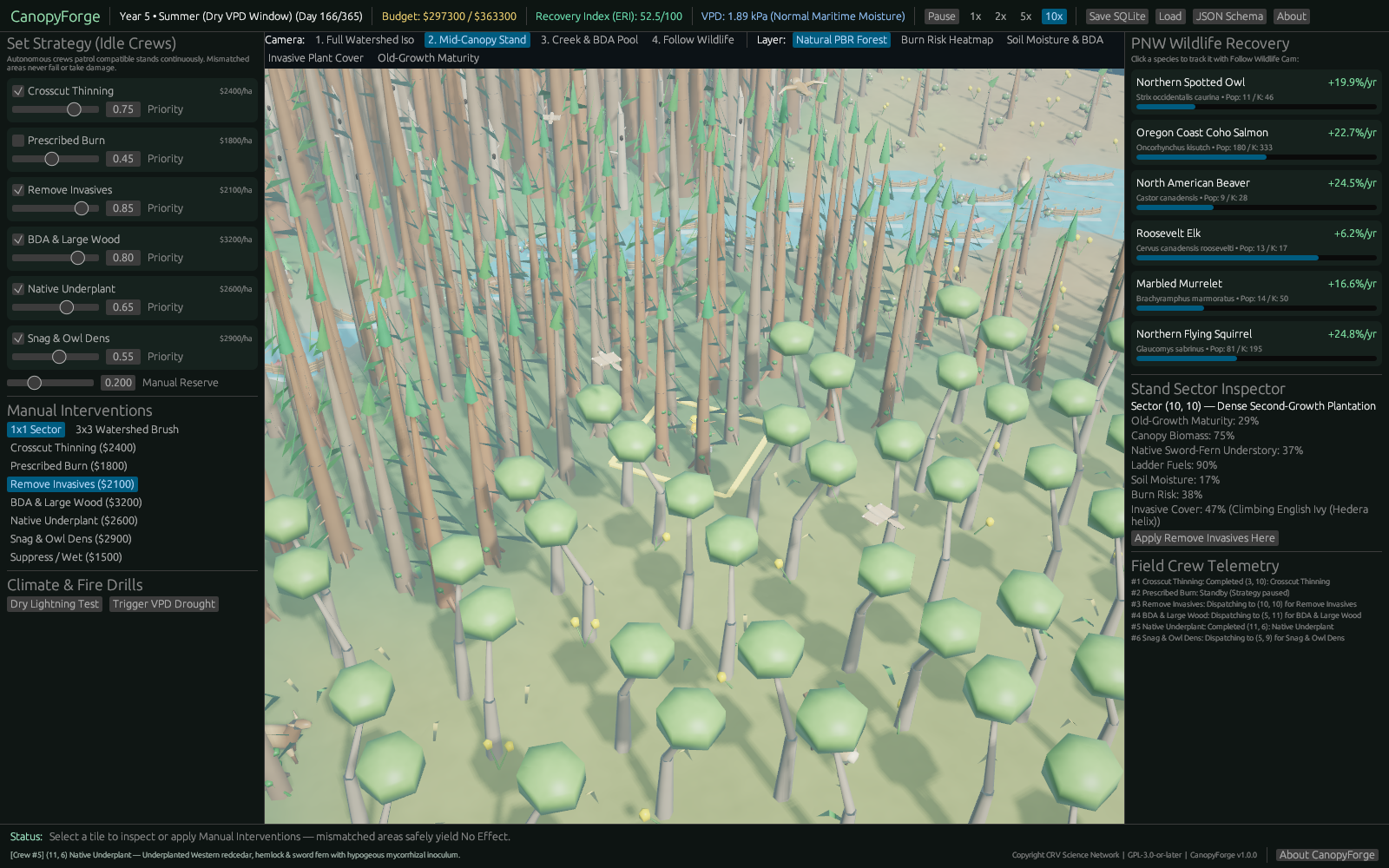
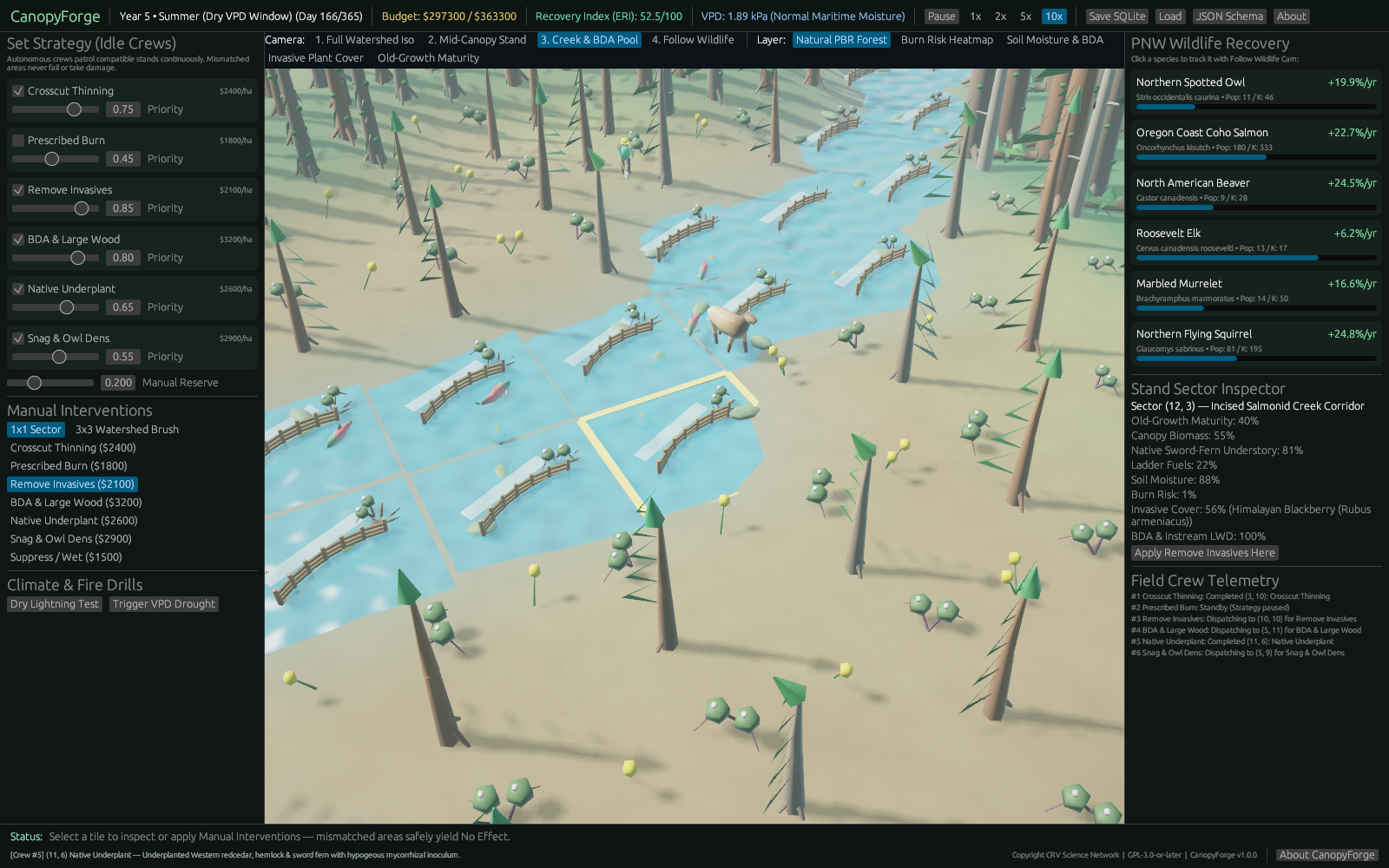
Zooming from basin scale into the Mid-Canopy Stand (Figure 3) and the Incised Salmonid Creek Corridor (Figure 4) exposes individual snag cavities, thinning crews, woven-willow BDA stakes spanning gravel bars, red spawning Oncorhynchus kisutch (Oregon Coast Coho Salmon), and drinking Roosevelt Elk alongside sectoral invasive and fuel telemetry.
5. Software Availability & Network Integration
CanopyForge (v1.0.0) is distributed in full safe Rust source with compilation instructions, 8/8 passing cargo tests, SQLite WAL save support, and JSON validation summaries under GPL-3.0-or-later at https://crvscience.com/apps[6–27]. Together with TrophicHearth (nine-biome trophic energetics), PopBio-Studio (stage-matrix demography), SonoWing (avian/chiropteran bioacoustics), and PelagicGlobe (North Pacific climate forcing), CanopyForge completes an end-to-end Pacific Northwest land-to-ocean modeling suite.
References
- [1] Franklin, J. F., et al. (2002). Disturbances and structural development of natural forest ecosystems with silvicultural implications, using Douglas-fir forests as an example. Forest Ecology and Management, 155(1–3), 399–423. https://doi.org/10.1016/s0378-1127(01)00575-8
- [2] Pollock, M. M., et al. (2014). Using Beaver Dams to Restore Incised Stream Ecosystems. BioScience, 64(4), 279–290. https://doi.org/10.1093/biosci/biu036
- [3] Agee, J. K., & Skinner, C. N. (2005). Basic principles of forest fuel reduction treatments. Forest Ecology and Management, 211(1–2), 83–96. https://doi.org/10.1016/j.foreco.2005.01.034
- [4] Dugger, K. M., et al. (2015). The effects of habitat, climate, and Barred Owls on long-term demography of Northern Spotted Owls. The Condor, 118(1), 57–116. https://doi.org/10.1650/condor-15-24.1
- [5] Bilby, R. E., Fransen, B. R., & Bisson, P. A. (1996). Incorporation of nitrogen and carbon from spawning coho salmon into the trophic system of small streams: evidence from stable isotopes. Canadian Journal of Fisheries and Aquatic Sciences, 53(1), 164–173. https://doi.org/10.1139/f95-159
- [6] White, B. P. (2026). The CRV Science App Network: Twenty-Two Open-Source Rust Programs for Science, Data, and Simulation. CRV Science App Preprint APP-PREPRINT-01 [cs.SE, cs.CE, q-bio.QM], v1.2.0. Hosted via CRV Science Apps Hub (https://crvscience.com/apps). https://doi.org/10.5281/zenodo.24222398
- [7] White, B. P. (2026). AeroFlyway: Tracking Bird Migration with Weather Radar, Skyglow Maps, and Nighttime Flight Calls. CRV Science App Preprint APP-PREPRINT-13 [q-bio.PE, physics.ao-ph, cs.GR], v0.6.0. Hosted via CRV Science Apps Hub (https://crvscience.com/apps). https://doi.org/10.5281/zenodo.24222366
- [8] White, B. P. (2026). BeoFold: Simulating How Proteins Fold Using Distributed Computing and State Networks. CRV Science App Preprint APP-PREPRINT-02 [q-bio.BM, physics.chem-ph, cs.DC], v1.4.0. Hosted via CRV Science Apps Hub (https://crvscience.com/apps). https://doi.org/10.5281/zenodo.24222370
- [9] White, B. P. (2026). Calc-Lab: Interactive Calculus, Linear Algebra, and Differential Equation Solver Workbench. CRV Science App Preprint APP-PREPRINT-03 [math.NA, cs.MS, cs.CY], v0.5.0. Hosted via CRV Science Apps Hub (https://crvscience.com/apps). https://doi.org/10.5281/zenodo.24222372
- [10] White, B. P. (2026). Causal-Atlas: Tracing How Genes and Drugs Turn Biological Pathways On and Off. CRV Science App Preprint APP-PREPRINT-04 [q-bio.MN, q-bio.GN, stat.ML], v0.2.0. Hosted via CRV Science Apps Hub (https://crvscience.com/apps). https://doi.org/10.5281/zenodo.24222376
- [11] White, B. P. (2026). Cit-Atlas: Mapping Citation Networks and Research Impact Across Scientific Papers. CRV Science App Preprint APP-PREPRINT-05 [cs.DL, cs.SI, physics.soc-ph], v1.8.0. Hosted via CRV Science Apps Hub (https://crvscience.com/apps). https://doi.org/10.5281/zenodo.24222380
- [12] White, B. P. (2026). EpiLedger: Privacy-Safe Disease Tracking, Clinical Text Screening, and Outbreak Monitoring. CRV Science App Preprint APP-PREPRINT-06 [cs.CR, q-bio.PE, stat.AP], v2.0.0. Hosted via CRV Science Apps Hub (https://crvscience.com/apps). https://doi.org/10.5281/zenodo.24222382
- [13] White, B. P. (2026). ITME: Modeling Evolutionary Regimes, Contingency, and Substrate Complexity Across Molecular, Hominid, and AI Worlds. CRV Science App Preprint APP-PREPRINT-07 [q-bio.PE, nlin.AO, physics.bio-ph], v2.3.0. Hosted via CRV Science Apps Hub (https://crvscience.com/apps). https://doi.org/10.5281/zenodo.24222386
- [14] White, B. P. (2026). OSABT: A 20-Module Biology and Biostatistics Workbench for Molecular Labs, Genetics, Kinetics, and Ecology. CRV Science App Preprint APP-PREPRINT-08 [q-bio.QM, stat.AP, cs.SE], v2.0.0. Hosted via CRV Science Apps Hub (https://crvscience.com/apps). https://doi.org/10.5281/zenodo.24222388
- [15] White, B. P. (2026). SAR-Atlas: Drug Design, Body Distribution Modeling, and Candidate Screening in Rust. CRV Science App Preprint APP-PREPRINT-09 [physics.chem-ph, q-bio.BM, cs.LG], v3.8.0. Hosted via CRV Science Apps Hub (https://crvscience.com/apps). https://doi.org/10.5281/zenodo.24222390
- [16] White, B. P. (2026). TerraTwin: Fast Climate Projections for Global Warming, Sea-Level Rise, and Arctic Change. CRV Science App Preprint APP-PREPRINT-10 [physics.ao-ph, cs.CE, stat.AP], v2.5.0. Hosted via CRV Science Apps Hub (https://crvscience.com/apps). https://doi.org/10.5281/zenodo.24222392
- [17] White, B. P. (2026). Urban-Grid: Modeling City Traffic, Emergency Response Coverage, and Earthquake Evacuation. CRV Science App Preprint APP-PREPRINT-11 [physics.soc-ph, cs.MA, cs.CE], v5.2.0. Hosted via CRV Science Apps Hub (https://crvscience.com/apps). https://doi.org/10.5281/zenodo.24222394
- [18] White, B. P. (2026). WildFront BattleGrounds: Turn-Based Hex Strategy Game with Voxel Graphics and Procedural Map Generation. CRV Science App Preprint APP-PREPRINT-12 [cs.GT, cs.GR, math.CO], v3.4.1. Hosted via CRV Science Apps Hub (https://crvscience.com/apps). https://doi.org/10.5281/zenodo.24222396
- [19] White, B. P. (2026). HelioProbe: Simulating Spacecraft Orbits, Deep-Space Telescopes, and Comet Tails in 3D. CRV Science App Preprint APP-PREPRINT-14 [astro-ph.EP, astro-ph.IM, cs.GR], v2.3.0. Hosted via CRV Science Apps Hub (https://crvscience.com/apps). https://doi.org/10.5281/zenodo.24244083
- [20] White, B. P. (2026). PopBio-Studio: Interactive Population Biology, Adaptive Landscapes, and Genetic Skyline Simulator. CRV Science App Preprint APP-PREPRINT-15 [q-bio.PE, q-bio.QM, stat.AP], v1.2.0. Hosted via CRV Science Apps Hub (https://crvscience.com/apps). https://doi.org/10.5281/zenodo.24244085
- [21] White, B. P. (2026). QuantaCrypt-Studio: Simulating Quantum Circuits, Quantum Key Distribution, and Post-Quantum Cryptography. CRV Science App Preprint APP-PREPRINT-16 [quant-ph, cs.CR, cs.MS], v2.2.0. Hosted via CRV Science Apps Hub (https://crvscience.com/apps). https://doi.org/10.5281/zenodo.24244089
- [22] White, B. P. (2026). SonoWing: Analyzing Bat Echolocation and Bird Calls with Spectrograms and Harmonic Tracking. CRV Science App Preprint APP-PREPRINT-17 [q-bio.NC, q-bio.PE, cs.SD], v1.1.0. Hosted via CRV Science Apps Hub (https://crvscience.com/apps). https://doi.org/10.5281/zenodo.24244091
- [23] White, B. P. (2026). SwarmForge: 3D Isometric Automated Factory and Swarm Robotics Simulation Game. CRV Science App Preprint APP-PREPRINT-18 [cs.MA, cs.RO, cs.GT], v1.3.0. Hosted via CRV Science Apps Hub (https://crvscience.com/apps). https://doi.org/10.5281/zenodo.24244093
- [24] White, B. P. (2026). NeuroSpace Lab: 3D Neural Network Topology, Structural Plasticity, and Six-Layered Cerebral Cortex Simulation in Rust. CRV Science App Preprint APP-PREPRINT-19 [q-bio.NC, cs.NE, cs.GR], v1.6.0. Hosted via CRV Science Apps Hub (https://crvscience.com/apps). https://doi.org/10.5281/zenodo.24263468
- [25] White, B. P. (2026). TrophicHearth: Nine-Biome 3D Living Trophic Diorama, Fire-Pit Hearth, and Bioacoustic Ecosystem Simulator in Rust. CRV Science App Preprint APP-PREPRINT-20 [q-bio.PE, cs.GR, cs.MA], v0.9.3. Hosted via CRV Science Apps Hub (https://crvscience.com/apps). https://doi.org/10.5281/zenodo.24359107
- [26] White, B. P. (2026). ConnectomeAtlas: Standalone 3D Multi-Scale Brain Connectome, Persistent Homology, and Lesion Workstation in Rust. CRV Science App Preprint APP-PREPRINT-21 [q-bio.NC, cs.SI, cs.GR], v0.8.0. Hosted via CRV Science Apps Hub (https://crvscience.com/apps). https://doi.org/10.5281/zenodo.24359109
- [27] White, B. P. (2026). PelagicGlobe: 3D Ocean Currents Globe, Conformal Spilhaus World Ocean Projection, and NOAA ENSO Workstation in Rust. CRV Science App Preprint APP-PREPRINT-22 [physics.ao-ph, cs.GR, cs.CE], v1.1.0. Hosted via CRV Science Apps Hub (https://crvscience.com/apps). https://doi.org/10.5281/zenodo.24442089