Overview
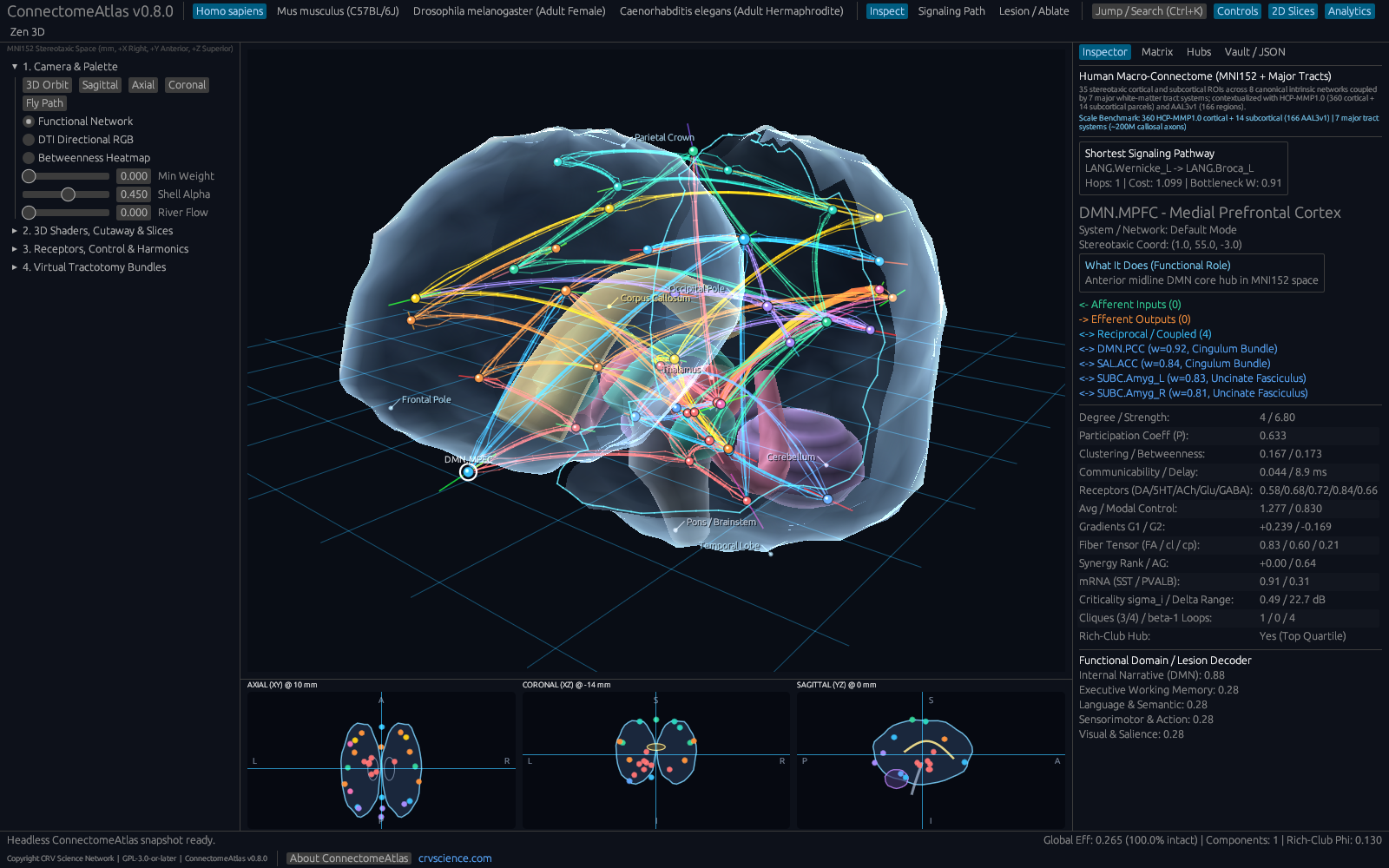
ConnectomeAtlas (v0.8.0) is an open-source, multi-scale 3D brain connectome and neuroinformatics workstation written in Rust across a five-crate workspace under GPL-3.0-or-later licensing. Unifying four curated anatomical presets spanning three orders of nervous-system complexity—Human MNI152 Macro-Connectome (40 regions, 62 tract systems), Mouse Allen CCFv3 (28 regions, 39 pathways), Drosophila melanogaster FlyWire (22 neuropils, 32 projections), and Caenorhabditis elegans WormAtlas (26 ganglion/nerve-cord nodes, 35 pathways)—the workstation pairs species-authentic procedural 3D anatomy meshes (gyral cortical hemispheres with surgical octant cutaway, foliated cerebellum, brainstem, corpus callosum, rodent olfactory bulbs, insect optic lobes and central complex, and C. elegans cuticle, two-bulb pharynx, and nerve ring) and synchronized 2D triplanar slice contours with weighted graph efficiency, clustering, rich-club coefficient, communicability, Kinouchi-Copelli excitable criticality (branching ratio sigma and dynamic range Delta), Jacobi symmetric control harmonics, and exact Z2 first-Betti (beta1) persistent homology within a deterministic CLI and interactive wgpu/egui 3D viewer. Verified across 12 workspace tests and binary CLI sweeps, all four species operate near criticality (sigma = 1.000, dynamic range 21.923–23.857 dB), with FlyWire attaining the strongest rich-club backbone (0.38095) and highest dynamic range (23.857 dB), C. elegans exhibiting peak clustering (0.28883), and Human MNI152 hosting 14 persistent beta1 topological cavities (max persistence 0.85). Simulated Human MNI152 lesions quantify cascading efficiency loss: severing the Cingulum Bundle lowers global efficiency to 80.34% (0.26475 to 0.21269, fragmenting into 2 components), severing the Corpus Callosum retains 87.82%, and ablating Posterior Cingulate hub DMN.PCC retains 88.31%, complemented by native NIfTI-1, TrackVis, SQLite WAL, SWC, and SHA-256 signed envelope I/O. Source code, validation suites, and companion apps are indexed at https://crvscience.com/apps.
1. Introduction
Comparative connectomics increasingly demonstrates that conserved topological trade-offs—balancing short global routing paths against metabolic wiring cost, modular segregation, and rich-club backbone hubs—recur from nematode ganglia to human association cortex[1,2,5]. Yet software ecosystems for inspecting brain wiring remain heavily fragmented: tractography viewers rarely compute Z2 algebraic homology cavities[4] or excitable dynamic range around branching criticality[3], whereas network-analysis scripts strip out 3D stereotaxic coordinates, white-matter bundles, and interactive virtual lesions.
ConnectomeAtlas (v0.8.0) consolidates comparative stereotaxic 3D streamline visualization, complex network graph theory, excitable branching criticality, exact 1D persistent homology, structural lesion testing, and neuroimaging file exchange inside a single dependency-free compiled Rust workspace (five workspace crates, #![forbid(unsafe_code)] in core analytics) within the CRV Science Open-Source Apps collection[6–25].
2. Multi-Scale Architecture & Topological Methods
ConnectomeAtlas is engineered as a modular five-crate Cargo workspace (Table 1). At initialization, each preset embeds nodes in authentic domain coordinates—millimeter MNI152 stereotaxic space for Homo sapiens, Allen CCFv3 coordinates for Mus musculus, scaled micrometer FAFB FlyWire neuropil centers for Drosophila melanogaster[5], and anterior-to-posterior body-axis positions for Caenorhabditis elegans. Alongside classical weighted efficiency, betweenness centrality, communicability, and rich-club stratification[2], atlas-core executes symmetric Jacobi eigendecomposition for network control harmonics, sweeps Kinouchi-Copelli excitable branching coupling around sigma = 1.0 to evaluate dynamic range (dB)[3], and builds descending weight-filtered clique complexes (clique_3, clique_4) with exact Z2 boundary reduction to isolate persistent beta1 loops[4].
| Workspace Crate / Files | Analytical & Systems Responsibilities |
|---|---|
crates/atlas-core (9 files) | Connectome graph model, 4 species presets, shortest-path latency & lesion delta engine, Jacobi control harmonics, Kinouchi-Copelli criticality, exact Z2 beta1 TDA, systems transcriptomics, and command palette index. |
crates/atlas-io (4 files) | Pure-Rust NIfTI-1 (.nii / .nii.gz) reader, TrackVis (.trk) streamline reader, SQLite WAL state vault, SHA-256 AtlasEnvelope JSON, and 3D .swc arbor exporter. |
crates/atlas-render (5 files) | Species-authentic 3D anatomical surface/organ meshes & 2D MRI slice contours (anatomy.rs), custom arcball camera, braided streamline bundles, DTI tensors, and wgpu shader descriptors. |
crates/atlas-cli (1 file) | Scriptable CLI subcommands: presets, metrics, criticality, topology, path, lesion, export-json, and export-swc. |
crates/atlas-gui (3 files) | Interactive 3D viewport, matrix heatmap, lesion console, native rfd dialogs, VERSIONINFO icon embedding, and 1600 × 1000 offscreen PNG capture. |
3. Cross-Species Structural, Criticality & Persistent Homology Benchmarks
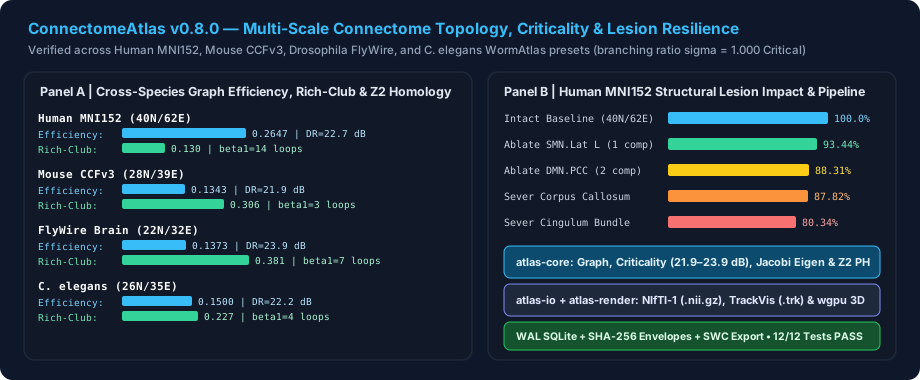
Deterministic CLI execution across all four bundled species atlases demonstrates distinct evolutionary topological signatures while preserving critical dynamical amplification (Table 2; Figure 2). Homo sapiens (40 nodes, 62 edges) achieves the highest global routing efficiency (0.26475) across the longest characteristic path (4.8583 steps, mean conduction delay 7.3635 ms) and supports 14 persistent beta1 topological loops (max persistence 0.85). By contrast, compact Drosophila melanogaster FlyWire neuropils (22 nodes, 32 edges) concentrate integrative traffic into the strongest top-quartile rich club (0.38095) and widest stimulus dynamic range (23.857 dB), whereas Caenorhabditis elegans achieves peak mean clustering (0.28883) along its serial ventral-cord ganglia and Mus musculus Allen CCFv3 minimizes physical conduction delay (2.9706 ms).
| Preset | Species | N / E | Global Eff. | Path Len. | Clustering | Rich-Club | Dyn. Range | beta1 (Max P.) |
|---|---|---|---|---|---|---|---|---|
human_mni152 | Homo sapiens | 40 / 62 | 0.26475 | 4.8583 | 0.2168 | 0.1304 | 22.697 dB | 14 (0.85) |
mouse_ccfv3 | Mus musculus (C57BL/6J) | 28 / 39 | 0.13434 | 3.8779 | 0.2269 | 0.3056 | 21.923 dB | 3 (0.78) |
drosophila_flywire | Drosophila melanogaster | 22 / 32 | 0.13729 | 2.6032 | 0.1515 | 0.3810 | 23.857 dB | 7 (0.85) |
celegans_wormatlas | Caenorhabditis elegans | 26 / 35 | 0.14996 | 3.3471 | 0.2888 | 0.2273 | 22.169 dB | 4 (0.83) |
Structural perturbation experiments on the Human MNI152 connectome isolate hierarchical vulnerability between midline association trunks and focal cortical hubs (Table 3). Severing the longitudinal Cingulum Bundle inflicts the sharpest network degradation, dropping global efficiency by 19.66% (80.34% retained: 0.26475 → 0.21269) and disconnecting the graph into two components; severing the interhemispheric Corpus Callosum retains 87.82% efficiency (2 components), while ablating the Posterior Cingulate hub DMN.PCC retains 88.31% (2 components) versus 93.44% for unilateral sensorimotor node SMN.Lat_L (remaining 1 connected component). Shortest weighted corticocerebellar tracing between DMN.MPFC and right cerebellum CBL.Crus1_R traverses 5 hops (DMN.MPFC → SAL.ACC → SUBC.Thal_L → SMN.Lat_L → BSTEM.Pons → CBL.Crus1_R) with 345.73 mm geometric arc length, 36.01 ms summed conduction latency, and bottleneck weight 0.76.
| Target Perturbed | Intervention Class | Intact Eff. | Lesioned Eff. | Retained Eff. | Components |
|---|---|---|---|---|---|
| Corpus Callosum | White-Matter Tract | 0.26475 | 0.23250 | 87.82% | 1 → 2 |
| Cingulum Bundle | White-Matter Tract | 0.26475 | 0.21269 | 80.34% | 1 → 2 |
DMN.PCC | Cortical Hub Node | 0.26475 | 0.23379 | 88.31% | 1 → 2 |
SMN.Lat_L | Cortical Hub Node | 0.26475 | 0.24738 | 93.44% | 1 → 1 |
4. Interactive Atlas Views & Neuroinformatics I/O
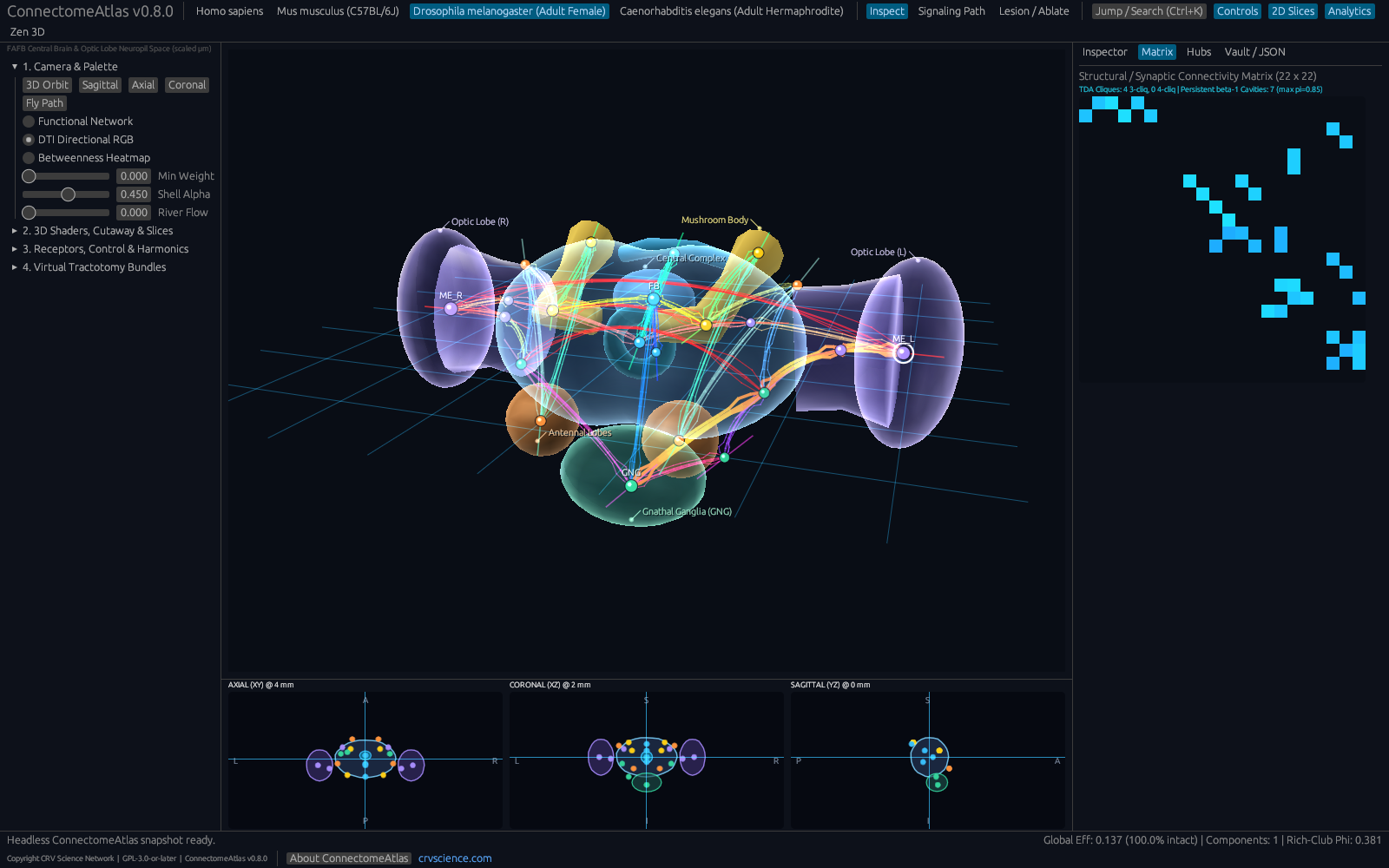
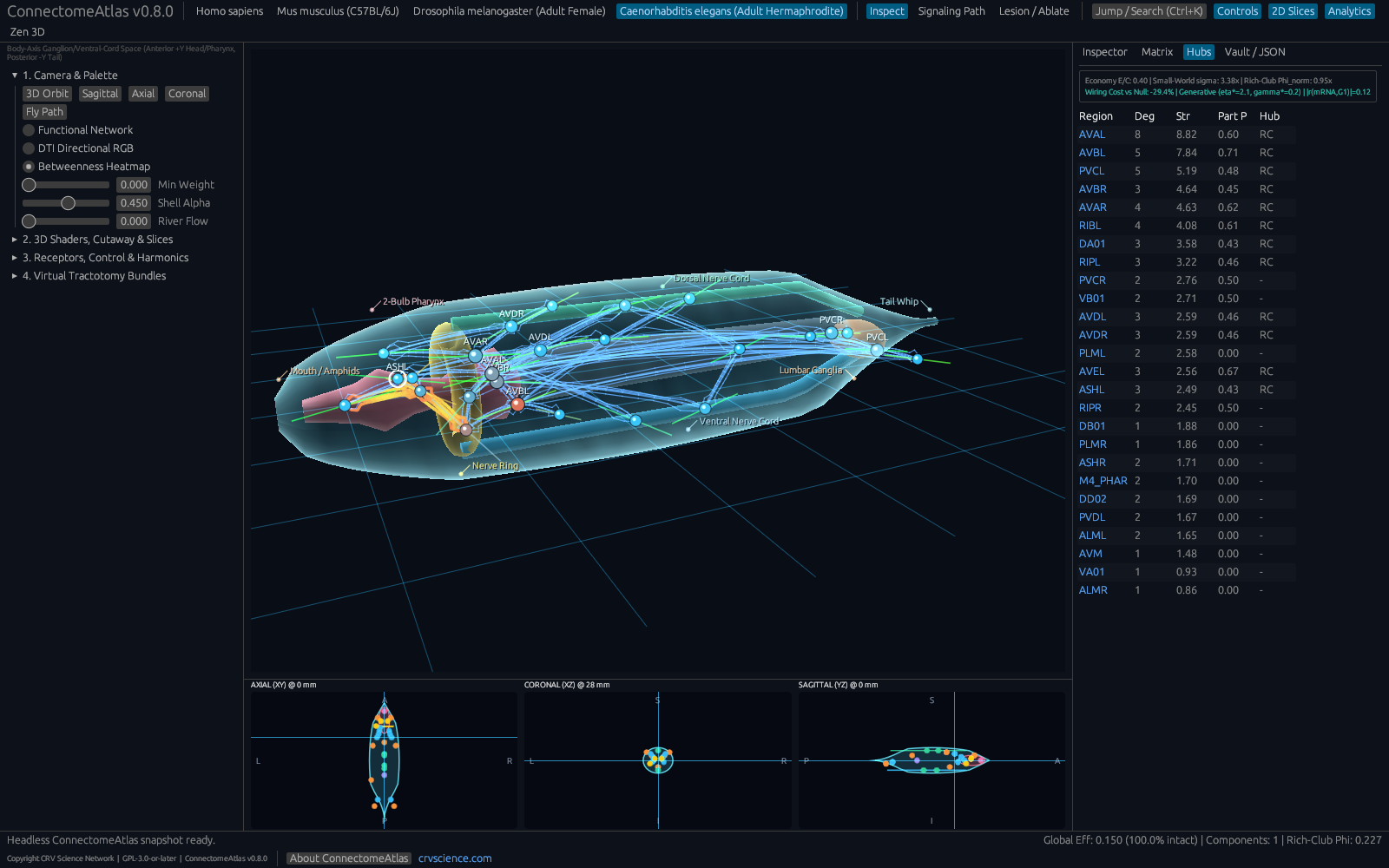
Beyond stereotaxic cortical streamlines, ConnectomeAtlas renders ordered adjacency connectivity matrices, receptor/transcriptomic node overlays, and inter-species 3D anatomy cleanly at native resolution (Figures 3–4). For interoperable data exchange, atlas-io parses compressed NIfTI-1 neuroimaging headers (.nii.gz), TrackVis streamline binary files (.trk), SQLite WAL persistence vaults, SWC neuronal arbor morphology reconstructions, and tamper-evident SHA-256 JSON worksets (AtlasEnvelope) validated across all 12 workspace unit and integration tests.
5. Discussion
Comparing macroscopic tract atlases alongside compact invertebrate wiring diagrams highlights how persistent homology and criticality metrics complement standard graph summaries[2–4]. While Human MNI152 maximizes global efficiency (0.26475) via long-range association and callosal bridges that generate 14 redundant beta1 cycles, losing either the Cingulum Bundle or the Corpus Callosum immediately splits graph connectivity and cuts global routing by 12–20%. Current bundled presets represent canonical parcellated circuits rather than voxel-wise whole-brain connectomes containing millions of edges; extending sparse GPU matrix eigensolvers and empirical diffusion tractography imports across larger HCP parcellations defines the next release roadmap.
6. Software Availability & Network Integration
ConnectomeAtlas (v0.8.0) is distributed as open-source Rust software under the GNU General Public License v3.0 or later (GPL-3.0-or-later) at https://crvscience.com/apps[6–25]. Within the twenty-application CRV Science suite, ConnectomeAtlas pairs directly with NeuroSpace Lab (microscale laminar cortical plasticity and optogenetic lesions), Causal-Atlas (transcriptomic pathway flips), Cit-Atlas (spectral graph modularity), and QuantaCrypt-Studio (linear-algebra and Hilbert-space eigenanalysis).
References
- [1] Sporns, O., Tononi, G., & Kotter, R. (2005). The Human Connectome: A Structural Description of the Human Brain. PLOS Computational Biology, 1(4), e42. https://doi.org/10.1371/journal.pcbi.0010042
- [2] Rubinov, M., & Sporns, O. (2010). Complex network measures of brain connectivity: Uses and interpretations. NeuroImage, 52(3), 1059–1069. https://doi.org/10.1016/j.neuroimage.2009.10.003
- [3] Beggs, J. M., & Plenz, D. (2003). Neuronal Avalanches in Neocortical Circuits. The Journal of Neuroscience, 23(35), 11167–11177. https://doi.org/10.1523/JNEUROSCI.23-35-11167.2003
- [4] Giusti, C., Ghrist, R., & Bassett, D. S. (2016). Two's company, three (or more) is a simplex. Journal of Computational Neuroscience, 41(1), 1–14. https://doi.org/10.1007/s10827-016-0608-6
- [5] Dorkenwald, S., Matsliah, A., Yu, S. C., et al. (2024). Neuronal wiring diagram of an adult brain. Nature, 634, 124–138. https://doi.org/10.1038/s41586-024-07558-y
- [6] White, B. P. (2026). The CRV Science App Network: Twenty Open-Source Rust Programs for Science, Data, and Simulation. CRV Science App Preprint APP-PREPRINT-01 [cs.SE, cs.CE, q-bio.QM], v1.1.0. Hosted via CRV Science Apps Hub (https://crvscience.com/apps). https://doi.org/10.5281/zenodo.24222398
- [7] White, B. P. (2026). AeroFlyway: Tracking Bird Migration with Weather Radar, Skyglow Maps, and Nighttime Flight Calls. CRV Science App Preprint APP-PREPRINT-13 [q-bio.PE, physics.ao-ph, cs.GR], v0.6.0. Hosted via CRV Science Apps Hub (https://crvscience.com/apps). https://doi.org/10.5281/zenodo.24222366
- [8] White, B. P. (2026). BeoFold: Simulating How Proteins Fold Using Distributed Computing and State Networks. CRV Science App Preprint APP-PREPRINT-02 [q-bio.BM, physics.chem-ph, cs.DC], v1.4.0. Hosted via CRV Science Apps Hub (https://crvscience.com/apps). https://doi.org/10.5281/zenodo.24222370
- [9] White, B. P. (2026). Calc-Lab: Interactive Calculus, Linear Algebra, and Differential Equation Solver Workbench. CRV Science App Preprint APP-PREPRINT-03 [math.NA, cs.MS, cs.CY], v0.5.0. Hosted via CRV Science Apps Hub (https://crvscience.com/apps). https://doi.org/10.5281/zenodo.24222372
- [10] White, B. P. (2026). Causal-Atlas: Tracing How Genes and Drugs Turn Biological Pathways On and Off. CRV Science App Preprint APP-PREPRINT-04 [q-bio.MN, q-bio.GN, stat.ML], v0.2.0. Hosted via CRV Science Apps Hub (https://crvscience.com/apps). https://doi.org/10.5281/zenodo.24222376
- [11] White, B. P. (2026). Cit-Atlas: Mapping Citation Networks and Research Impact Across Scientific Papers. CRV Science App Preprint APP-PREPRINT-05 [cs.DL, cs.SI, physics.soc-ph], v1.8.0. Hosted via CRV Science Apps Hub (https://crvscience.com/apps). https://doi.org/10.5281/zenodo.24222380
- [12] White, B. P. (2026). EpiLedger: Privacy-Safe Disease Tracking, Clinical Text Screening, and Outbreak Monitoring. CRV Science App Preprint APP-PREPRINT-06 [cs.CR, q-bio.PE, stat.AP], v2.0.0. Hosted via CRV Science Apps Hub (https://crvscience.com/apps). https://doi.org/10.5281/zenodo.24222382
- [13] White, B. P. (2026). ITME: Modeling Evolutionary Regimes, Contingency, and Substrate Complexity Across Molecular, Hominid, and AI Worlds. CRV Science App Preprint APP-PREPRINT-07 [q-bio.PE, nlin.AO, physics.bio-ph], v2.3.0. Hosted via CRV Science Apps Hub (https://crvscience.com/apps). https://doi.org/10.5281/zenodo.24222386
- [14] White, B. P. (2026). OSABT: A 20-Module Biology and Biostatistics Workbench for Molecular Labs, Genetics, Kinetics, and Ecology. CRV Science App Preprint APP-PREPRINT-08 [q-bio.QM, stat.AP, cs.SE], v2.0.0. Hosted via CRV Science Apps Hub (https://crvscience.com/apps). https://doi.org/10.5281/zenodo.24222388
- [15] White, B. P. (2026). SAR-Atlas: Drug Design, Body Distribution Modeling, and Candidate Screening in Rust. CRV Science App Preprint APP-PREPRINT-09 [physics.chem-ph, q-bio.BM, cs.LG], v3.8.0. Hosted via CRV Science Apps Hub (https://crvscience.com/apps). https://doi.org/10.5281/zenodo.24222390
- [16] White, B. P. (2026). TerraTwin: Fast Climate Projections for Global Warming, Sea-Level Rise, and Arctic Change. CRV Science App Preprint APP-PREPRINT-10 [physics.ao-ph, cs.CE, stat.AP], v2.5.0. Hosted via CRV Science Apps Hub (https://crvscience.com/apps). https://doi.org/10.5281/zenodo.24222392
- [17] White, B. P. (2026). Urban-Grid: Modeling City Traffic, Emergency Response Coverage, and Earthquake Evacuation. CRV Science App Preprint APP-PREPRINT-11 [physics.soc-ph, cs.MA, cs.CE], v5.2.0. Hosted via CRV Science Apps Hub (https://crvscience.com/apps). https://doi.org/10.5281/zenodo.24222394
- [18] White, B. P. (2026). WildFront BattleGrounds: Turn-Based Hex Strategy Game with Voxel Graphics and Procedural Map Generation. CRV Science App Preprint APP-PREPRINT-12 [cs.GT, cs.GR, math.CO], v3.4.1. Hosted via CRV Science Apps Hub (https://crvscience.com/apps). https://doi.org/10.5281/zenodo.24222396
- [19] White, B. P. (2026). HelioProbe: Simulating Spacecraft Orbits, Deep-Space Telescopes, and Comet Tails in 3D. CRV Science App Preprint APP-PREPRINT-14 [astro-ph.EP, astro-ph.IM, cs.GR], v2.3.0. Hosted via CRV Science Apps Hub (https://crvscience.com/apps). https://doi.org/10.5281/zenodo.24244083
- [20] White, B. P. (2026). PopBio-Studio: Interactive Population Biology, Adaptive Landscapes, and Genetic Skyline Simulator. CRV Science App Preprint APP-PREPRINT-15 [q-bio.PE, q-bio.QM, stat.AP], v1.2.0. Hosted via CRV Science Apps Hub (https://crvscience.com/apps). https://doi.org/10.5281/zenodo.24244085
- [21] White, B. P. (2026). QuantaCrypt-Studio: Simulating Quantum Circuits, Quantum Key Distribution, and Post-Quantum Cryptography. CRV Science App Preprint APP-PREPRINT-16 [quant-ph, cs.CR, cs.MS], v2.2.0. Hosted via CRV Science Apps Hub (https://crvscience.com/apps). https://doi.org/10.5281/zenodo.24244089
- [22] White, B. P. (2026). SonoWing: Analyzing Bat Echolocation and Bird Calls with Spectrograms and Harmonic Tracking. CRV Science App Preprint APP-PREPRINT-17 [q-bio.NC, q-bio.PE, cs.SD], v1.1.0. Hosted via CRV Science Apps Hub (https://crvscience.com/apps). https://doi.org/10.5281/zenodo.24244091
- [23] White, B. P. (2026). SwarmForge: 3D Isometric Automated Factory and Swarm Robotics Simulation Game. CRV Science App Preprint APP-PREPRINT-18 [cs.MA, cs.RO, cs.GT], v1.3.0. Hosted via CRV Science Apps Hub (https://crvscience.com/apps). https://doi.org/10.5281/zenodo.24244093
- [24] White, B. P. (2026). NeuroSpace Lab: 3D Neural Network Topology, Structural Plasticity, and Six-Layered Cerebral Cortex Simulation in Rust. CRV Science App Preprint APP-PREPRINT-19 [q-bio.NC, cs.NE, cs.GR], v1.6.0. Hosted via CRV Science Apps Hub (https://crvscience.com/apps). https://doi.org/10.5281/zenodo.24263468
- [25] White, B. P. (2026). TrophicHearth: Nine-Biome 3D Living Trophic Diorama, Fire-Pit Hearth, and Bioacoustic Ecosystem Simulator in Rust. CRV Science App Preprint APP-PREPRINT-20 [q-bio.PE, cs.GR, cs.MA], v0.9.3. Hosted via CRV Science Apps Hub (https://crvscience.com/apps). https://doi.org/10.5281/zenodo.24359107