Overview
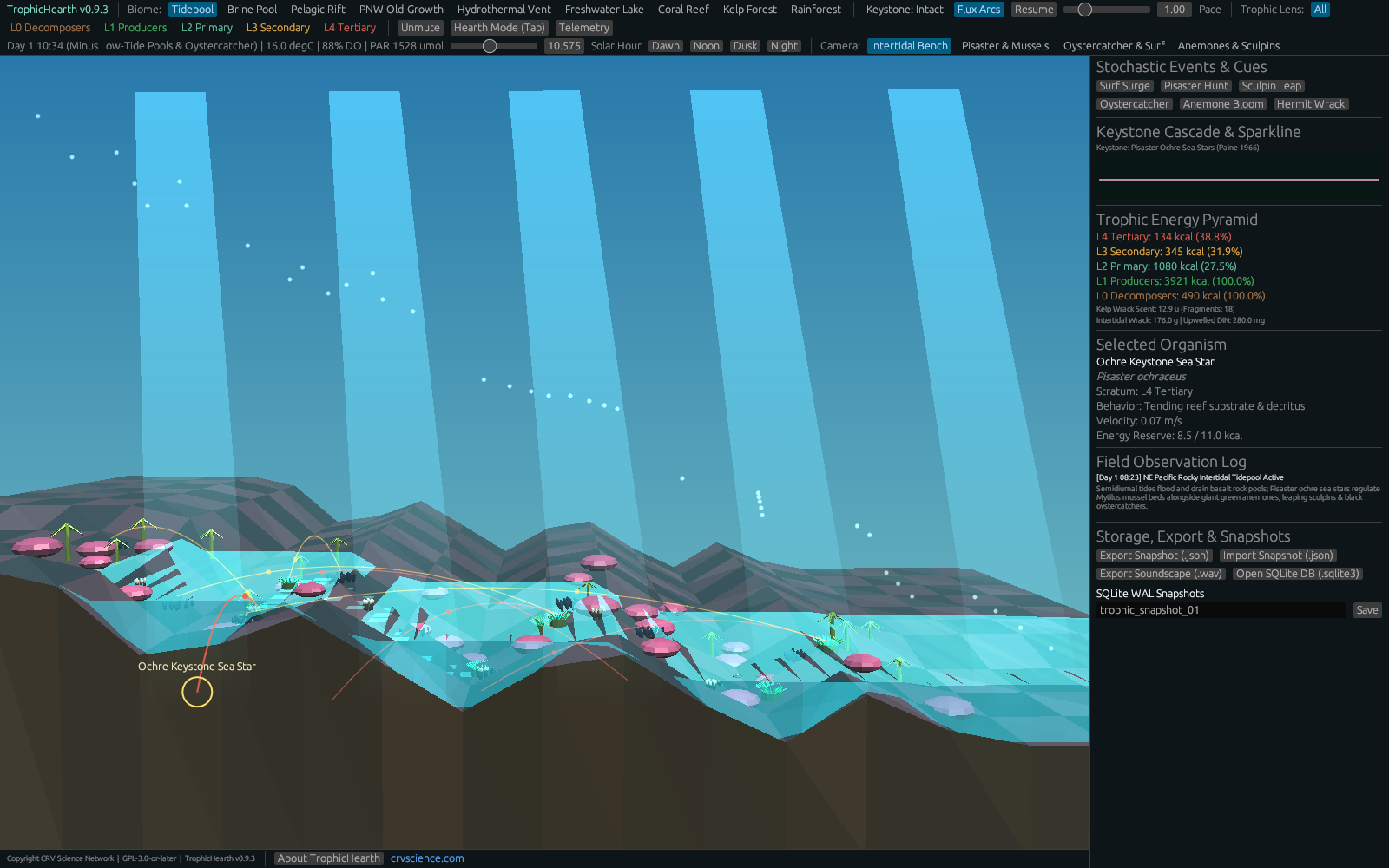
TrophicHearth (v0.9.3) is an open-source, GPU-accelerated 3D ecological diorama and trophic energy simulator implemented in safe Rust under GPL-3.0-or-later licensing. Spanning nine marine, benthic, freshwater, and terrestrial biomes—Rocky Intertidal Tidepool, Cold-Seep Brine Pool, Midwater Pelagic Rift, Pacific Northwest Salmon Creek, Deep-Sea Hydrothermal Vent, Temperate Freshwater Lake, Indo-Pacific Coral Reef, Pacific Giant Kelp Forest, and Neotropical Rainforest—the application couples continuous-time autonomous foraging, predator-prey encounters, and benthic/terrestrial decomposition directly to a Lindeman five-tier energetic ledger (L0 autotrophs through L4 decomposers) and diurnal solar or hydrothermal hearth forcing. A 2D diffusing pheromone substrate, 44.1 kHz stereo procedural bioacoustic soundscape engine, SQLite WAL state snapshots, and deterministic CLI sweeps enable reproducible multi-biome experiments without external cloud dependencies. Across 24-hour seeded CLI simulations (dt = 0.05 s, seed = 20261116, 2,880 steps per biome), Deep-Sea Hydrothermal Vent sustained the highest cumulative primary production at 653.46 kcal GPP through continuous chemosynthetic hearth flux, compared against 411.85 kcal in Giant Kelp Forest and 383.09 kcal in Coral Reef, while standing total trophic biomass ranged from 5,970.04 kcal (Tidepool) to 8,110.67 kcal (Salmon Creek) with 6,213.31 to 6,821.60 mg of closed-loop nutrient mineralization and 14/14 integration checks passing. Source repositories, documentation, and peer applications are hosted at https://crvscience.com/apps.
1. Introduction
Conceptual ecology courses frequently present ecosystem energetics through static triangular pyramids, hiding the continuous physical mechanisms that govern real biological communities: diurnal solar angle, tidal surge and thermal plume gradients, olfactory chemical trails, predator-prey search energetics, and microbial detrital remineralization[1,3]. Conversely, real-time 3D graphics engines rarely enforce thermodynamic accounting—organisms move across decorative scenery without tracking kilocalories assimilated, basal respiration lost, or elemental nutrients recycled to autotrophs[2,4].
TrophicHearth (v0.9.3) bridges spatial simulation and quantitative ecosystem modeling inside a single cross-sectional "living hearth" cut-away observatory implemented in safe Rust (#![forbid(unsafe_code)]). Designed for offline classroom exploration, evolutionary ecology demonstrations, and reproducible CLI sweeps, TrophicHearth integrates nine contrasting biomes under the CRV Science Open-Source Apps ecosystem[6–25].
2. Architecture & Trophic-Hearth Physics
Every biome occupies an aquarium-style or terrestrial cross-section containing stratified physical substrates (canopy or euphotic water column, benthic or forest floor, sediment/soil porewater, and a central campfire or black-smoker hydrothermal hearth), paired with deterministic organism kinematics and stereo bioacoustic synthesis[5] (Table 1). Across the Lindeman hierarchy, autotrophic primary producers (L0) fix solar photosynthetically active radiation (PAR) in diurnal biomes or hydrogen sulfide / methane vent enthalpy in abyssal biomes. Primary herbivores and filter-feeders (L1) graze L0 stocks and detrital snow, supporting mesopredators (L2) and apex consumers (L3), while detritivores and fungi (L4) remineralize organic detritus back into bioavailable inorganic nutrients.
| Source File | Subsystem Role |
|---|---|
src/trophic.rs | Nine BiomeKind definitions, keystone guilds, five-tier (L0–L4) energy ledger, GPP/respiration & nutrient budgets. |
src/organisms.rs | Species life-history catalog across terrestrial canopy, kelp, reef, lake, tidepool, brine seep, and abyssal vents. |
src/world.rs | Fixed-step ecological integration loop, foraging decisions, predation, keystone removal scenarios, and event stream. |
src/pheromone.rs | 2D spatially diffused alarm, courtship, grazing, and detrital chemotaxis gradient fields on the habitat floor. |
src/physics.rs | Diurnal solar irradiance, precipitation/foliage wetness, tidal surge, plume updrafts, and vegetated habitat geometry. |
src/audio.rs | 44.1 kHz stereo procedural bioacoustic soundscape synthesis and stereo WAV export synchronized to ecological events. |
src/models_3d.rs & src/renderer.rs | Procedural anatomical 3D mesh builders and native wgpu HDR/offscreen framebuffer renderer (1600 × 1000 PNG capture). |
src/persistence.rs & src/main.rs | Bundled SQLite WAL checkpoint slots, JSON simulation snapshots, and headless CLI simulate harness. |
3. Multi-Biome 24-Hour Validation Benchmarks
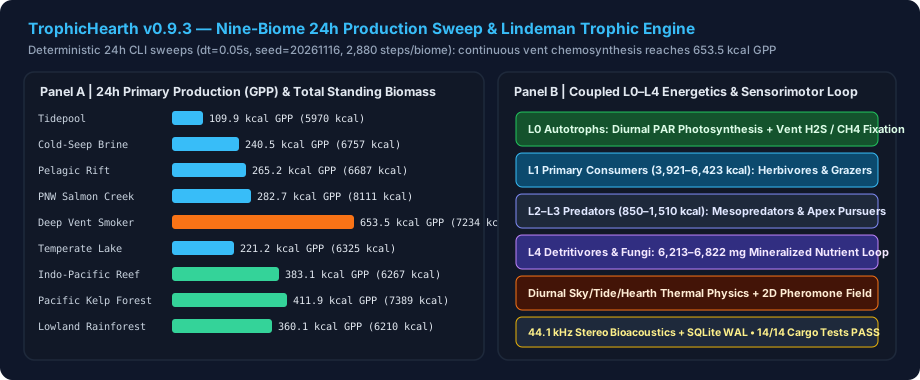
Running compiled release CLI sweeps (19_Trophic-Hearth.exe simulate --hours 24 --dt 0.05 --seed 20261116, 2,880 integration steps per biome) quantifies divergent production regimes across aquatic, intertidal, deep-sea, and forested ecosystems (Table 2; Figure 2). Continuous chemosynthetic oxidation at the 2,600 m black smoker vent sustained 653.46 kcal cumulative GPP over 24 hours without nocturnal photosynthetic shutoff, surpassing Giant Kelp Forest (411.85 kcal), Indo-Pacific Coral Reef (383.09 kcal), and Neotropical Rainforest (360.12 kcal). Closed-loop microbial and invertebrate decomposition mineralized 6,213.31 mg to 6,821.60 mg of inorganic nutrients per 24-hour cycle, supporting total standing community energy budgets between 5,970.04 kcal (Tidepool, 46 organisms) and 8,110.67 kcal (PNW Salmon Creek, 30 organisms).
| CLI Biome | Ecosystem | Orgs / Spp | L0 (kcal) | L1 (kcal) | L2+L3 (kcal) | Total Biomass (kcal) | Cum. GPP (kcal) | Mineralized (mg) |
|---|---|---|---|---|---|---|---|---|
tidepool | Rocky Intertidal Tidepool | 46 / 8 | 490 | 3921.0 | 1425 | 5970.04 | 109.87 | 6213.31 |
brine | Cold-Seep Brine Pool (1,050 m) | 49 / 8 | 640 | 4620.9 | 1370 | 6756.90 | 240.54 | 6213.31 |
rift | Midwater Pelagic Rift | 48 / 10 | 540 | 4480.9 | 1510 | 6686.86 | 265.21 | 6213.31 |
pnw | PNW Old-Growth Salmon Creek | 30 / 10 | 580 | 6422.7 | 1000 | 8110.67 | 282.73 | 6432.90 |
vent | Deep-Sea Hydrothermal Vent | 45 / 10 | 620 | 5182.4 | 1300 | 7234.45 | 653.46 | 6382.93 |
lake | Temperate Freshwater Lake | 40 / 14 | 440 | 4682.1 | 1085 | 6325.09 | 221.20 | 6449.64 |
coral | Indo-Pacific Coral Reef | 45 / 14 | 460 | 4383.7 | 1275 | 6266.66 | 383.09 | 6821.60 |
kelp | Pacific Giant Kelp Forest | 50 / 13 | 510 | 5624.0 | 1130 | 7388.98 | 411.85 | 6478.82 |
rainforest | Neotropical Lowland Rainforest | 42 / 13 | 420 | 4852.1 | 850 | 6210.12 | 360.12 | 6701.21 |
4. Interactive Biome Gallery & Bioacoustic Synthesis
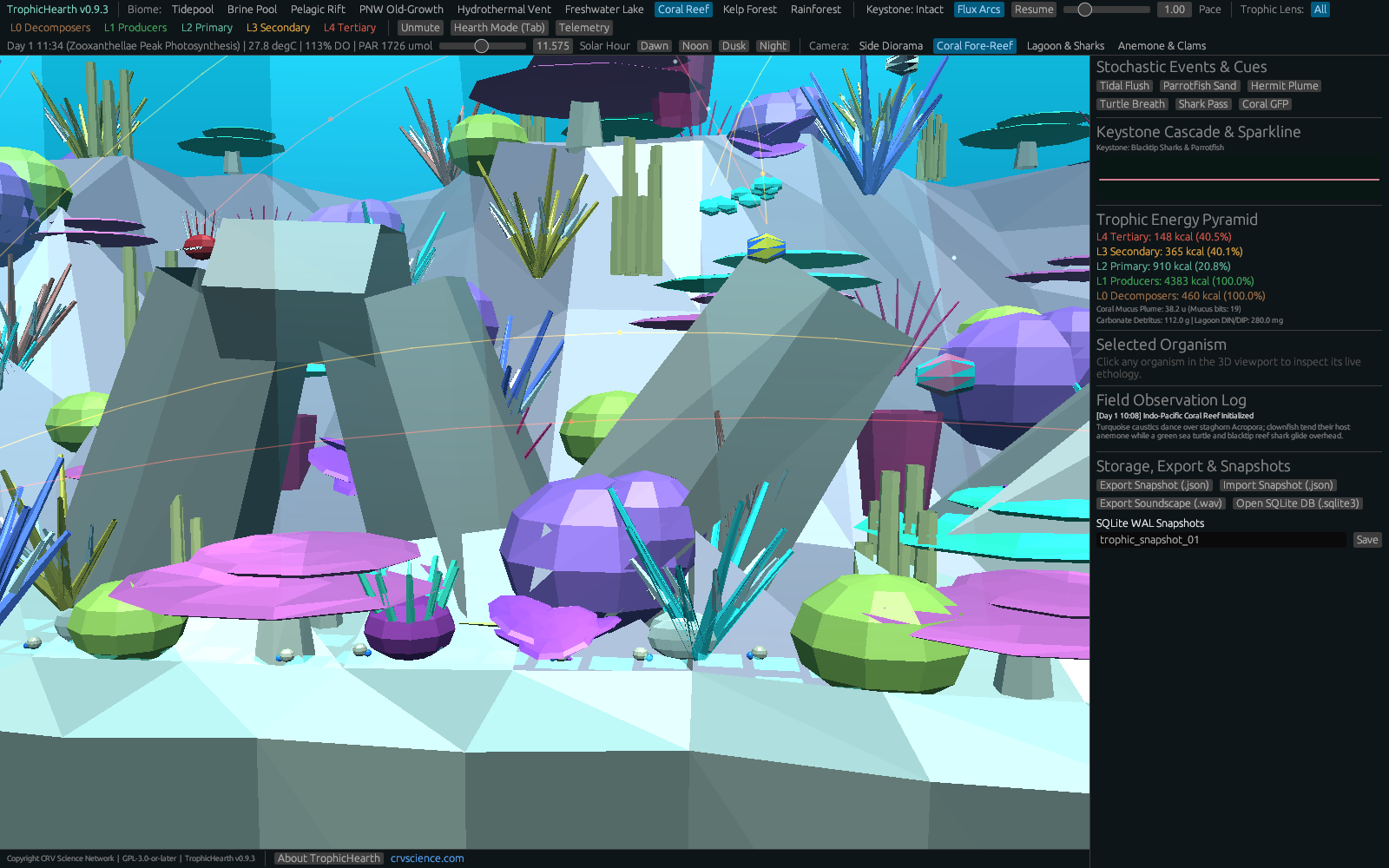
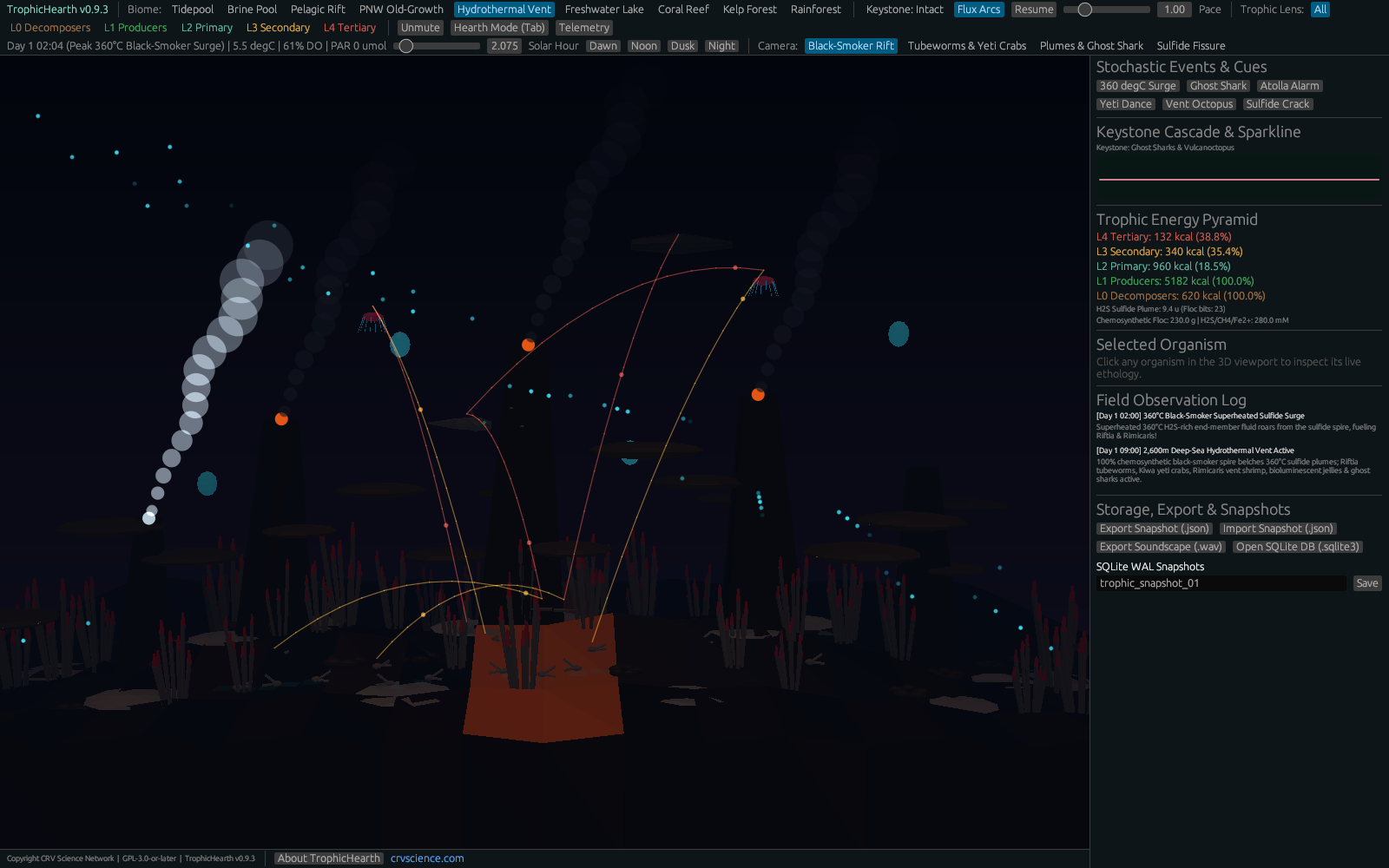
Two additional 1600 × 1000 headless GPU captures illustrate geometric and metabolic diversity across euphotic reefs and abyssal vents (Figures 3–4). In sunlit shallow lagoons (Indo-Pacific Coral Reef), GFP-fluorescent scleractinian heads anchor multi-guild herbivorous scraping by parrotfish alongside apex blacktip reef sharks, whereas 2,600 m black-smoker chimneys drive hydrothermal shrimp grazing, tube-worm mutualisms, and benthic chimaera patrols powered entirely by hearth geochemistry.
5. Discussion
Unifying 3D behavioral animation with strict kilocalorie conservation exposes trophic constraints often obscured in qualitative diagrams: in every simulated biome, herbivore and detritivore biomass (L1: 3,921.04–6,422.67 kcal) exceeds combined predator biomass (L2+L3: 850–1,510 kcal), while steady detrital remineralization stabilizes nutrient pools against premature washout[1,4]. All 14 integration tests in tests/simulation_tests.rs confirm deterministic state transitions, SQLite checkpoint serialization, WAV bioacoustic generation, and keystone-predator perturbation bookkeeping. Current parameterizations intentionally use compartmental guild pools rather than spatial reaction-diffusion biogeochemistry or multi-year life-history demography—domains explored dynamically alongside seasonal population fluctuations in companion CRV Science tools.
6. Software Availability & Network Integration
TrophicHearth (v0.9.3) is released in full safe Rust source under the GNU General Public License v3.0 or later (GPL-3.0-or-later) through the isolated CRV Science Open-Source Apps hub at https://crvscience.com/apps[6–25]. Within the twenty-application Rust network, TrophicHearth pairs naturally with PopBio-Studio for population elasticity and adaptive landscapes, SonoWing for spectrogram bioacoustics, OSABT for ecophysiology, AeroFlyway for nocturnal aeroecology, and ITME for deep-time macroevolutionary transitions.
References
- [1] Lindeman, R. L. (1942). The Trophic-Dynamic Aspect of Ecology. Ecology, 23(4), 399–417. https://doi.org/10.2307/1930126
- [2] Paine, R. T. (1966). Food Web Complexity and Species Diversity. The American Naturalist, 100(910), 65–75. https://doi.org/10.1086/282400
- [3] Odum, E. P. (1969). The Strategy of Ecosystem Development. Science, 164(3877), 262–270. https://doi.org/10.1126/science.164.3877.262
- [4] Polis, G. A., & Strong, D. R. (1996). Food Web Complexity and Community Dynamics. The American Naturalist, 147(5), 813–846. https://doi.org/10.1086/285880
- [5] Sueur, J., Farina, A., Gasc, A., Pieretti, N., & Pavoine, S. (2014). Acoustic Indices for Biodiversity Assessment and Landscape Investigation. Acta Acustica united with Acustica, 100(4), 772–781. https://doi.org/10.3813/aaa.918757
- [6] White, B. P. (2026). The CRV Science App Network: Twenty Open-Source Rust Programs for Science, Data, and Simulation. CRV Science App Preprint APP-PREPRINT-01 [cs.SE, cs.CE, q-bio.QM], v1.1.0. Hosted via CRV Science Apps Hub (https://crvscience.com/apps). https://doi.org/10.5281/zenodo.24222398
- [7] White, B. P. (2026). AeroFlyway: Tracking Bird Migration with Weather Radar, Skyglow Maps, and Nighttime Flight Calls. CRV Science App Preprint APP-PREPRINT-13 [q-bio.PE, physics.ao-ph, cs.GR], v0.6.0. Hosted via CRV Science Apps Hub (https://crvscience.com/apps). https://doi.org/10.5281/zenodo.24222366
- [8] White, B. P. (2026). BeoFold: Simulating How Proteins Fold Using Distributed Computing and State Networks. CRV Science App Preprint APP-PREPRINT-02 [q-bio.BM, physics.chem-ph, cs.DC], v1.4.0. Hosted via CRV Science Apps Hub (https://crvscience.com/apps). https://doi.org/10.5281/zenodo.24222370
- [9] White, B. P. (2026). Calc-Lab: Interactive Calculus, Linear Algebra, and Differential Equation Solver Workbench. CRV Science App Preprint APP-PREPRINT-03 [math.NA, cs.MS, cs.CY], v0.5.0. Hosted via CRV Science Apps Hub (https://crvscience.com/apps). https://doi.org/10.5281/zenodo.24222372
- [10] White, B. P. (2026). Causal-Atlas: Tracing How Genes and Drugs Turn Biological Pathways On and Off. CRV Science App Preprint APP-PREPRINT-04 [q-bio.MN, q-bio.GN, stat.ML], v0.2.0. Hosted via CRV Science Apps Hub (https://crvscience.com/apps). https://doi.org/10.5281/zenodo.24222376
- [11] White, B. P. (2026). Cit-Atlas: Mapping Citation Networks and Research Impact Across Scientific Papers. CRV Science App Preprint APP-PREPRINT-05 [cs.DL, cs.SI, physics.soc-ph], v1.8.0. Hosted via CRV Science Apps Hub (https://crvscience.com/apps). https://doi.org/10.5281/zenodo.24222380
- [12] White, B. P. (2026). EpiLedger: Privacy-Safe Disease Tracking, Clinical Text Screening, and Outbreak Monitoring. CRV Science App Preprint APP-PREPRINT-06 [cs.CR, q-bio.PE, stat.AP], v2.0.0. Hosted via CRV Science Apps Hub (https://crvscience.com/apps). https://doi.org/10.5281/zenodo.24222382
- [13] White, B. P. (2026). ITME: Modeling Evolutionary Regimes, Contingency, and Substrate Complexity Across Molecular, Hominid, and AI Worlds. CRV Science App Preprint APP-PREPRINT-07 [q-bio.PE, nlin.AO, physics.bio-ph], v2.3.0. Hosted via CRV Science Apps Hub (https://crvscience.com/apps). https://doi.org/10.5281/zenodo.24222386
- [14] White, B. P. (2026). OSABT: A 20-Module Biology and Biostatistics Workbench for Molecular Labs, Genetics, Kinetics, and Ecology. CRV Science App Preprint APP-PREPRINT-08 [q-bio.QM, stat.AP, cs.SE], v2.0.0. Hosted via CRV Science Apps Hub (https://crvscience.com/apps). https://doi.org/10.5281/zenodo.24222388
- [15] White, B. P. (2026). SAR-Atlas: Drug Design, Body Distribution Modeling, and Candidate Screening in Rust. CRV Science App Preprint APP-PREPRINT-09 [physics.chem-ph, q-bio.BM, cs.LG], v3.8.0. Hosted via CRV Science Apps Hub (https://crvscience.com/apps). https://doi.org/10.5281/zenodo.24222390
- [16] White, B. P. (2026). TerraTwin: Fast Climate Projections for Global Warming, Sea-Level Rise, and Arctic Change. CRV Science App Preprint APP-PREPRINT-10 [physics.ao-ph, cs.CE, stat.AP], v2.5.0. Hosted via CRV Science Apps Hub (https://crvscience.com/apps). https://doi.org/10.5281/zenodo.24222392
- [17] White, B. P. (2026). Urban-Grid: Modeling City Traffic, Emergency Response Coverage, and Earthquake Evacuation. CRV Science App Preprint APP-PREPRINT-11 [physics.soc-ph, cs.MA, cs.CE], v5.2.0. Hosted via CRV Science Apps Hub (https://crvscience.com/apps). https://doi.org/10.5281/zenodo.24222394
- [18] White, B. P. (2026). WildFront BattleGrounds: Turn-Based Hex Strategy Game with Voxel Graphics and Procedural Map Generation. CRV Science App Preprint APP-PREPRINT-12 [cs.GT, cs.GR, math.CO], v3.4.1. Hosted via CRV Science Apps Hub (https://crvscience.com/apps). https://doi.org/10.5281/zenodo.24222396
- [19] White, B. P. (2026). HelioProbe: Simulating Spacecraft Orbits, Deep-Space Telescopes, and Comet Tails in 3D. CRV Science App Preprint APP-PREPRINT-14 [astro-ph.EP, astro-ph.IM, cs.GR], v2.3.0. Hosted via CRV Science Apps Hub (https://crvscience.com/apps). https://doi.org/10.5281/zenodo.24244083
- [20] White, B. P. (2026). PopBio-Studio: Interactive Population Biology, Adaptive Landscapes, and Genetic Skyline Simulator. CRV Science App Preprint APP-PREPRINT-15 [q-bio.PE, q-bio.QM, stat.AP], v1.2.0. Hosted via CRV Science Apps Hub (https://crvscience.com/apps). https://doi.org/10.5281/zenodo.24244085
- [21] White, B. P. (2026). QuantaCrypt-Studio: Simulating Quantum Circuits, Quantum Key Distribution, and Post-Quantum Cryptography. CRV Science App Preprint APP-PREPRINT-16 [quant-ph, cs.CR, cs.MS], v2.2.0. Hosted via CRV Science Apps Hub (https://crvscience.com/apps). https://doi.org/10.5281/zenodo.24244089
- [22] White, B. P. (2026). SonoWing: Analyzing Bat Echolocation and Bird Calls with Spectrograms and Harmonic Tracking. CRV Science App Preprint APP-PREPRINT-17 [q-bio.NC, q-bio.PE, cs.SD], v1.1.0. Hosted via CRV Science Apps Hub (https://crvscience.com/apps). https://doi.org/10.5281/zenodo.24244091
- [23] White, B. P. (2026). SwarmForge: 3D Isometric Automated Factory and Swarm Robotics Simulation Game. CRV Science App Preprint APP-PREPRINT-18 [cs.MA, cs.RO, cs.GT], v1.3.0. Hosted via CRV Science Apps Hub (https://crvscience.com/apps). https://doi.org/10.5281/zenodo.24244093
- [24] White, B. P. (2026). NeuroSpace Lab: 3D Neural Network Topology, Structural Plasticity, and Six-Layered Cerebral Cortex Simulation in Rust. CRV Science App Preprint APP-PREPRINT-19 [q-bio.NC, cs.NE, cs.GR], v1.6.0. Hosted via CRV Science Apps Hub (https://crvscience.com/apps). https://doi.org/10.5281/zenodo.24263468
- [25] White, B. P. (2026). ConnectomeAtlas: Standalone 3D Multi-Scale Brain Connectome, Persistent Homology, and Lesion Workstation in Rust. CRV Science App Preprint APP-PREPRINT-21 [q-bio.NC, cs.SI, cs.GR], v0.8.0. Hosted via CRV Science Apps Hub (https://crvscience.com/apps). https://doi.org/10.5281/zenodo.24359109