Amborella
Amborella trichopoda is a shrub found only in the rainforests of New Caledonia, and the single living species of a lineage that branched off first from all other flowering plants. Its genome offers a glimpse of what the ancestor of flowering plants was like.
Amborella trichopoda is a shrub found only in the rainforests of New Caledonia, and the single living species of a lineage that branched off first from all other flowering plants. Its genome offers a glimpse of what the ancestor of flowering plants was like.
🧬 Field Guide Specimen: Open Amborella in the CRV Science Field Guide to log the specimen, see its place among the Diaphoretickes lineages in the Cladogram Explorer, and test your recall in the Red List conservation game.
The Sister of All Flowering Plants: What Does That Mean?
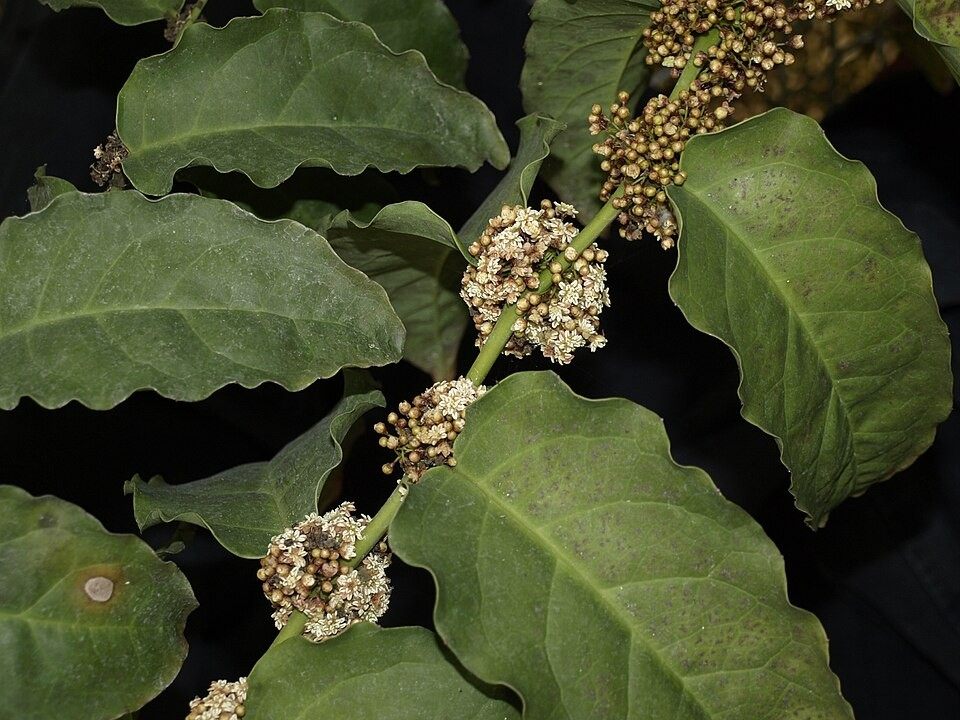
Molecular phylogenies place Amborella as the sister to all other living angiosperms. It does not mean that Amborella is primitive, but its mix of ancestral features helps reconstruct early flower evolution. The plant has small cream-colored flowers with spirally arranged parts and wood without vessels.
The Amborella Genome
Published in 2013, it showed that the plant has not undergone the whole-genome duplication that occurred in the ancestor of most flowering plants. This is a baseline for studying how duplications contributed to the diversity of flowers. See Genome.
Dioecious and Restricted
Individual plants are either male or female. It grows in the understory of cloud forest in New Caledonia, where mining and clearing threaten habitat.
Amborella at a Glance
| Property | Value |
|---|---|
| Scientific name | Amborella trichopoda |
| Kingdom | Plantae |
| Phylum | Tracheophyta |
| Class | Magnoliopsida |
| Order | Amborellales |
| Family | Amborellaceae |
| Field Guide group | Diaphoretickes: Plants & Algae |
| Diagnostic feature (Field Guide) | New Caledonian shrub forming the sister lineage to all other members of its group; xylem lacking vessel elements; tiny cream blossoms on separate male and female plants. |
| IUCN Red List status | Least Concern (LC), assessed 2020 |
| Distribution | New Caledonia (endemic) |
| Genome published | 2013 |