Aardvark
The aardvark (Orycteropus afer) is a nocturnal, burrowing mammal of sub-Saharan Africa that digs into termite mounds.
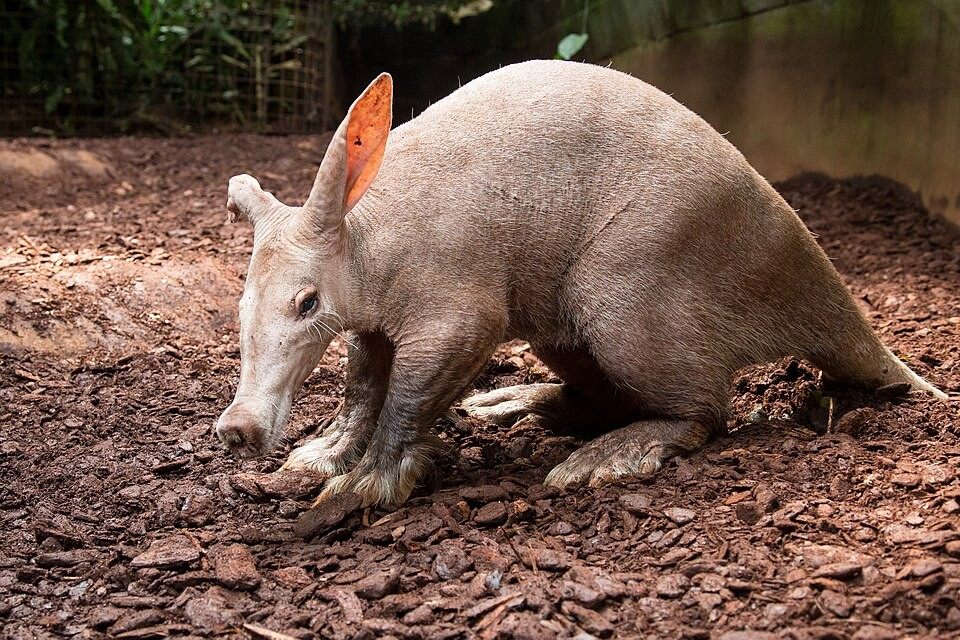
The aardvark (Orycteropus afer) is a nocturnal, burrowing mammal of sub-Saharan Africa that digs into termite mounds. Its name is Afrikaans for "earth pig", but it is not related to pigs or anteaters: it is the only living member of its own order, Tubulidentata.
🧬 Field Guide Specimen: Open Aardvark in the CRV Science Field Guide to log the specimen, see its place among the Mammals lineages in the Cladogram Explorer, and test your recall in the Red List conservation game.
Aardvark at a Glance
| Property | Value |
|---|---|
| Scientific name | Orycteropus afer |
| Kingdom | Animalia |
| Phylum | Chordata |
| Class | Mammalia |
| Order | Tubulidentata |
| Family | Orycteropodidae |
| Field Guide group | Mammals: Eutheria (Placentals) |
| Diagnostic feature (Field Guide) | Tubular pig-like snout, long rabbit-like ears, robust spade-like digging claws, rootless columnar dentine teeth. |
| IUCN Red List status | Least Concern (LC), assessed 2015 |
| Order | Tubulidentata |
| Clade | Afrotheria |
Taxonomy, Phylogenetics, and Evolutionary History
The aardvark (Orycteropus afer) is the sole extant representative of the family Orycteropodidae and the order Tubulidentata. Early anatomical classifications grouped the aardvark with South American xenarthrans (anteaters, sloths, and armadillos) and Old World pangolins under the polyphyletic taxon Edentata on the basis of convergent myrmecophagous traits. Molecular phylogenetics and retroposon insertion analyses overturned that arrangement, placing Tubulidentata firmly within the superorder Afrotheria—an ancient radiation of placental mammals that evolved in geographic isolation on the African continent during the Late Cretaceous and Paleogene. Within Afrotheria, Tubulidentata is nested in the clade Afroinsectiphilia alongside golden moles (Chrysochloridae), tenrecs (Tenrecidae), and elephant shrews (Macroscelidea), forming the sister group to Paenungulata, which encompasses proboscideans (Asian Elephant), sirenians, and hyraxes (Rock Hyrax).
Fossil Record and Cytogenetics
Fossil tubulidentates first appear in the early Miocene of East Africa with Myorycteropus africanus, a smaller, more gracile form that already possessed specialized fossorial forelimbs and tubular dentition. During the middle and late Miocene, the lineage dispersed into Eurasia and Madagascar, represented by genera such as Amphiorycteropus in Greece, Turkey, and Pakistan, and the cursorial genus Leptorycteropus in Kenya. Cytogenetically, Orycteropus afer has a diploid chromosome number of 2n = 20, one of the lowest karyotypes among placental mammals. Comparative chromosome painting indicates that the ancestral afrotherian karyotype (2n = 46) underwent extensive Robertsonian fusions along the tubulidentate stem while retaining conserved syntenic blocks shared with elephants and elephant shrews.
Comparative Anatomy, Dentition, and Fossorial Biomechanics
The ordinal name Tubulidentata refers to the histological architecture of the cheek teeth. Adult aardvarks lack incisors and canines; although rudimentary milk incisors and canines form in the fetus, they are resorbed before or shortly after birth. The functional dentition comprises two premolars and three molars in each jaw quadrant (totaling 20 cheek teeth), which are rootless, hypselodont (ever-growing), and completely devoid of an enamel cap in maturity. Instead, each flat-crowned tooth consists of up to 1,500 tightly packed hexagonal prisms of vasodentine surrounding longitudinal central pulp canals, bound together by an exterior layer of cementum. Because these teeth grow continuously against abrasive soil particles ingested with subterranean prey, occlusal wear constantly exposes fresh dentine tubules.
Cranial Olfaction and Limb Osteology
To locate subterranean nests of termites and ants at night, Orycteropus afer relies on a hypertrophied olfactory apparatus. The elongated nasal cavity houses nine endoturbinals—more than in any other extant placental mammal—providing an expansive surface area of olfactory epithelium innervated by massive olfactory bulbs. During excavation, dense rings of stiff hairs around the valvular nostrils and a fleshy nasal septum seal the airways against dust, while the long, tubular pinnae fold backward to close the external auditory meatus. The forelimbs possess four digits (lacking the pollex) armed with thick, dorsoventrally flattened ungual phalanges intermediate in morphology between claws and hooves. The humerus bears a broad deltopectoral crest and wide epicondyles, and the ulna exhibits an elongated olecranon process that provides a high mechanical advantage for the triceps brachii muscle during scratch-digging. As the forefeet loosen compacted soil, the five-toed, plantigrade hindfeet and muscular tail brace the pelvis and fling excavated earth backward.
| Anatomical Structure | Morphological Specialization | Functional Role in Fossorial Myrmecophagy |
|---|---|---|
| Cheek dentition | Rootless, enamel-free columns of hexagonal vasodentine prisms bound by cementum | Resists continuous abrasion from ingested quartz sand and silicate-rich soil |
| Nasal turbinals | 9 endoturbinals and 10–11 ectoturbinals with dense septal vibrissae | Detects volatile pheromones of subterranean Macrotermes and Anplolepis colonies |
| Lingual apparatus | Vermiform tongue (25–30 cm) coated by glycoprotein-rich submandibular saliva | Penetrates galleries and adheres up to 50,000 insects per foraging bout |
| Pyloric stomach | Muscular gizzard-like muscularis externa (~3–4 cm thick) | Mechanically triturates chitinous exoskeletons alongside swallowed sand grains |
| Forelimb skeleton | Tetradactyl manus with spoon-shaped unguals; olecranon-to-ulna ratio > 0.35 | Generates high out-force to breach sun-baked laterite and termitaria walls |
Trophic Ecology, Ecosystem Engineering, and Conservation
Aardvarks are obligate myrmecophages that forage solitarily over nocturnal home ranges of 2 to 5 km2, traversing 2 to 5 km per night. Their diet shifts seasonally between formicine and doryline ants (such as Anplolepis custodiens and Dorylus driver ants) during the wet season and fungus-growing or harvester termites (Macrotermes, Odontotermes, and Trinervitermes) during the dry season. Once a mound is breached, the thick corium of the skin protects the animal from soldier bites and formic acid sprays while the muscular, gizzard-like pyloric stomach grinds the ingested insects. A notable mutualistic exception to its strict insectivory is its relationship with the aardvark cucumber (Cucumis humifructus), the only geocarpic cucurbit in southern Africa. The plant buries its water-rich fruits 15 to 30 cm underground; aardvarks excavate the fruits for moisture during arid months and bury their feces, dispersing the viable seeds into loosened, nutrient-enriched soil.
Keystone Burrow Engineering and Thermal Vulnerability
Across savannas, woodlands, and bushveld south of the Sahara, Orycteropus afer functions as a physical ecosystem engineer. An individual constructs three distinct classes of excavations: shallow foraging trenches, temporary refuge burrows (1–3 m long) used for a few days, and deep permanent natal complexes extending up to 13 m in length with multiple entrances and a terminal sleeping chamber. Because interior burrow temperatures remain buffered between 20 and 26 °C with high relative humidity year-round, abandoned aardvark burrows serve as thermal and anti-predator refugia for more than 25 vertebrate species, including common warthogs (Phacochoerus africanus), African wild dogs (Lycaon pictus), spotted hyenas (Crocuta crocuta), ground pangolins (Smutsia temminckii), and African rock pythons (Python sebae). Although listed as Least Concern on the IUCN Red List, the aardvark is heterothermic and lowers its core body temperature to 34–35 °C during normothermic rest. In regions experiencing prolonged multi-year droughts, declining termite biomass forces aardvarks to forage diurnally, resulting in metabolic starvation and elevated winter hypothermia mortality.
Frequently Asked Questions
Why is the aardvark no longer classified with South American anteaters?
Early taxonomists grouped aardvarks, giant anteaters, sloths, armadillos, and pangolins into the order Edentata because all possess reduced or absent teeth, elongated snouts, vermiform tongues, and robust digging claws. Molecular sequencing of nuclear and mitochondrial genes proved that these shared traits arose independently through convergent evolution driven by an ant- and termite-eating diet. Aardvarks belong to Afrotheria and are more closely related to elephants and hyraxes than to xenarthran anteaters.
How do aardvark teeth differ from the teeth of other mammals?
Unlike typical mammalian teeth, which have a single central pulp cavity surrounded by dentine and capped with crystalline hydroxyapatite enamel, adult aardvark cheek teeth lack enamel and roots altogether. Each tooth is composed of hundreds of parallel, hexagonal columns of vasodentine, each housing its own slender tubular pulp canal, cemented together into a single continuously growing cylinder that wears flat during mastication.
Why is the aardvark considered a keystone species in African savannas?
By excavating dozens of deep subterranean burrows across its home range, the aardvark creates microclimatic shelters that buffer extreme daytime heat, seasonal bushfires, and predation. Secondary cavity users such as warthogs, bat-eared foxes, civets, porcupines, and burrowing owls cannot excavate hard lateritic soils themselves and depend on abandoned aardvark burrows for thermoregulation and raising offspring.
References
- Lehmann, T. (2009). Phylogeny and evolutionary history of salivary and dental adaptations in Tubulidentata (Mammalia, Afrotheria). Zoological Journal of the Linnean Society, 155(3), 649–702. https://doi.org/10.1111/j.1096-3642.2008.00460.x
- Taylor, W. A., & Skinner, J. D. (2004). Adaptations of the aardvark (Orycteropus afer) for survival in the arid Karoo, South Africa. Transactions of the Royal Society of South Africa, 59(2), 105–108. https://doi.org/10.1080/00359190409519169
- Rey, B., Fuller, A., Mitchell, D., Meyer, L. C. R., & Hetem, R. S. (2017). Drought-induced starvation of aardvarks in the Kalahari: an indirect effect of climate change. Biology Letters, 13(7), 20170301. https://doi.org/10.1098/rsbl.2017.0301
- Whittington-Jones, G. M., Bernard, R. T. F., & Parker, D. M. (2011). Aardvark burrows: a potential resource for vertebrates in arid and semi-arid environments. African Zoology, 46(2), 362–370. https://doi.org/10.3377/004.046.0215