Arabidopsis thaliana
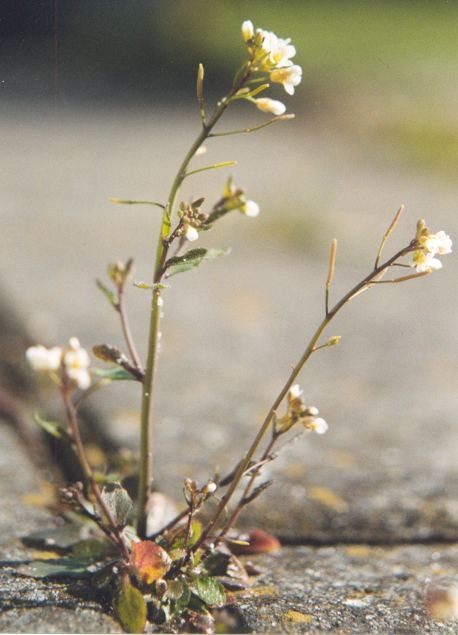
Arabidopsis thaliana, thale cress, is a small weed of the mustard family and the most widely used model plant in biology. In 2000 it became the first plant to have its genome sequenced.
Arabidopsis thaliana, thale cress, is a small weed of the mustard family and the most widely used model plant in biology. In 2000 it became the first plant to have its genome sequenced.
🧬 Field Guide Specimen: Open Thale Cress in the CRV Science Field Guide to log the specimen, see its place among the Diaphoretickes lineages in the Cladogram Explorer, and test your recall in the Red List conservation game.
Arabidopsis thaliana at a Glance
| Property | Value |
|---|---|
| Scientific name | Arabidopsis thaliana |
| Kingdom | Plantae |
| Phylum | Tracheophyta |
| Class | Magnoliopsida |
| Order | Brassicales |
| Family | Brassicaceae |
| Field Guide group | Diaphoretickes: Plants & Algae |
| Diagnostic feature (Field Guide) | Small brassicaceous rosette weed with tiny white 4-petaled blossoms and slender seed pods; rapid 6-week life cycle; first plant genome sequenced. |
| Genome sequenced | 2000 |
| Chromosomes | Five |
Taxonomy, Phylogenetics, and Genomic Architecture
Arabidopsis thaliana (thale cress or mouse-ear cress) is a diminutive annual herbaceous dicot in the family Brassicaceae (Cruciferae), order Brassicales, within the malvid clade of Rosids. Described by Johannes Thal in 1577 and assigned the binomial Arabis thaliana by Carl Linnaeus in 1753 before Gustav Heynhold transferred it to Arabidopsis in 1842, the species diverged from its outcrossing perennial congeners—such as Arabidopsis lyrata and Arabidopsis halleri (both 2n = 16)—approximately 5 to 6 million years ago during the Late Miocene. Following divergence, the A. thaliana lineage underwent descending dysploidy via chromosomal fusions and reciprocal translocations, reducing its karyotype to 2n = 10 (n = 5 chromosomes) and losing self-incompatibility alleles at the S-locus (SRK and SCR) to become a predominantly self-fertilizing (>98% selfing) annual.
The 135-Mbp Reference Genome and Agrobacterium Transformation
Championed for laboratory mutation Genetics in the 20th century, A. thaliana became the first plant species to have its nuclear genome sequenced in December 2000 by the Arabidopsis Genome Initiative (ecotype Col-0). Spanning ~135 Mbp (~119 Mbp euchromatin; ~15% repetitive sequence), the five chromosomes encode ~27,600 protein-coding genes alongside plastid (154.5 kbp) and mitochondrial (367.8 kbp) genomes. Synteny comparisons show three paleo-polyploid whole-genome duplications (γ, β, and α). Combined with its 6-week generation time, 15 to 30 cm stature, fecundity of 5,000 to 10,000 seeds per plant inside two-valved siliques, and the "floral dip" method for Genetic engineering—dipping floral buds into a sucrose-surfactant suspension of Agrobacterium tumefaciens to transform ovules—A. thaliana enabled genome-wide T-DNA mutant collections.
Developmental Biology, Photobiology, and Molecular Physiology
The ABCDE Model of Floral Organ Identity
Wild-type A. thaliana flowers exhibit four concentric whorls: 4 green sepals in whorl 1, 4 white cruciform petals in whorl 2, 6 tetradynamous stamens in whorl 3, and 2 fused carpels in whorl 4. In 1991, Enrico Coen and Elliot Meyerowitz formulated the combinatorial ABC model of flower development, later expanded to the ABCDE floral quartet model of Gene expression: Whorl 1 (sepals) is specified by Class A (APETALA1 [AP1], APETALA2 [AP2]) and Class E (SEPALLATA1–4 [SEP]) genes; Whorl 2 (petals) by Class A + Class B (APETALA3 [AP3], PISTILLATA [PI]) + Class E; Whorl 3 (stamens) by Class B + Class C (AGAMOUS [AG]) + Class E; and Whorl 4 (carpels) by Class C (AG) + Class E (SEP), while ovules require Class D (SEEDSTICK [STK]). Class A and Class C factors mutually antagonize one another across whorls 2 and 3, and except for AP2, all ABCDE factors encode MADS-box proteins forming tetrameric complexes.
Photoreceptors, Vernalization, and Phytohormone Receptors
Arabidopsis thaliana served as the experimental system in which the molecular receptors for plant light perception, circadian rhythms, and phytohormones were identified. Five red/far-red absorbing phytochromes (PHYA–PHYE), two blue/UV-A flavoprotein cryptochromes (CRY1, CRY2), and phototropins (PHOT1, PHOT2) regulate germination, shade avoidance, phototropism, and photoperiodic induction of the mobile florigen protein FT (FLOWERING LOCUS T). Similarly, the canonical receptors for auxin (TIR1), gibberellins (GID1), jasmonic acid (COI1), abscisic acid (PYR/PYL/RCAR), ethylene (ETR1), and brassinosteroids (BRI1) were isolated through Arabidopsis mutant screens, alongside the innate immune flagellin receptor FLS2.
| Molecular or Genetic System | Key Arabidopsis Genes or Proteins | Quantitative or Structural Parameter | Biological Process Regulated |
|---|---|---|---|
| Nuclear Genome Architecture | 5 chromosomes (Chr 1–5); Col-0 reference assembly | ~135 Mbp total (~119 Mbp euchromatin); ~27,600 protein genes | Compact model template for angiosperm functional genomics |
| ABCDE Floral Quartet Model | AP1, AP2 (A); AP3, PI (B); AG (C); STK (D); SEP1–4 (E) | Tetrameric MADS-box complexes across 4 concentric whorls | Homeotic specification of sepals, petals, stamens, and carpels |
| Vernalization Epigenetics | FLOWERING LOCUS C (FLC) and FRIGIDA (FRI) | Polycomb H3K27me3 histone methylation during prolonged 4 °C cold | Epigenetic memory of winter preventing premature autumn bolting |
| Auxin & Abscisic Acid Signaling | TIR1/AFB SCFTIR1 ubiquitin ligase; PYR/PYL–PP2C–SnRK2 | C3 photosynthesis; stomatal aperture regulation | Root gravitropism, apical dominance, and drought guard-cell closure |
Natural Variation, Ecogeography, and the 1001 Genomes Project
Native across Europe, Central Asia, North Africa, and East African mountains up to 4,200 m, A. thaliana colonizes disturbed sandy soils, rocky outcrops, and agricultural margins. The 1001 Genomes Project, which resequenced over 1,135 natural inbred accessions (ecotypes), revealed how allelic variation adapts the species to diverse climates. Northern Scandinavian accessions behave as winter annuals that germinate in autumn, overwinter as vegetative rosettes, and require 8 to 12 weeks of cold (vernalization) to epigenetically silence the floral repressor gene FLOWERING LOCUS C (FLC) via Polycomb Repressive Complex 2 (PRC2) tri-methylation of histone H3 lysine 27 (H3K27me3) before bolting in spring. Conversely, temperate ruderal accessions carrying loss-of-function mutations in FRIGIDA (FRI) or weak FLC alleles (such as Col-0) behave as rapid-cycling summer annuals that flower within 3 to 4 weeks without cold exposure.
Frequently Asked Questions
Why did biologists choose a small weed with no agricultural value as the primary model plant?
Crop plants such as wheat and maize have large genomes (2,500 to 16,000 Mbp) and take months to mature. Arabidopsis thaliana has a compact 135-Mbp genome on five chromosomes, matures in six weeks inside a small pot, self-pollinates to produce thousands of seeds, and can be transformed by dipping its flower buds into a liquid suspension of Agrobacterium.
How does the ABC model explain how a plant builds a flower?
In Arabidopsis thaliana, four concentric rings (whorls) of floral organs are specified by overlapping combinations of three classes of master regulatory genes: Class A alone produces outer sepals; Class A plus Class B produces petals; Class B plus Class C produces pollen-bearing stamens; and Class C alone produces the central seed-bearing carpels. Mutating any single class causes one floral organ type to transform homeotically into another.
How do wild Arabidopsis plants remember that winter has passed before flowering?
Overwintering Arabidopsis ecotypes express high levels of a floral repressor protein called FLC that blocks flowering during warm autumn days. Prolonged exposure to winter cold (vernalization) recruits chromatin-modifying enzymes that chemically tag the FLC gene with repressive histone marks (H3K27me3), shutting it off stably through cell divisions so the plant can bolt and flower in spring.
References
- The Arabidopsis Genome Initiative. (2000). Analysis of the genome sequence of the flowering plant Arabidopsis thaliana. Nature, 408(6814), 796–815. https://doi.org/10.1038/35048692
- Coen, E. S., & Meyerowitz, E. M. (1991). The war of the whorls: Genetic interactions controlling flower development. Nature, 353(6339), 31–37. https://doi.org/10.1038/353031a0
- Clough, S. J., & Bent, A. F. (1998). Floral dip: A simplified method for Agrobacterium-mediated transformation of Arabidopsis thaliana. The Plant Journal, 16(6), 735–743. https://doi.org/10.1046/j.1365-313x.1998.00343.x
- The 1001 Genomes Consortium. (2016). 1,135 genomes reveal the global pattern of polymorphism in Arabidopsis thaliana. Cell, 166(2), 481–491. https://doi.org/10.1016/j.cell.2016.05.063