Baker's Yeast
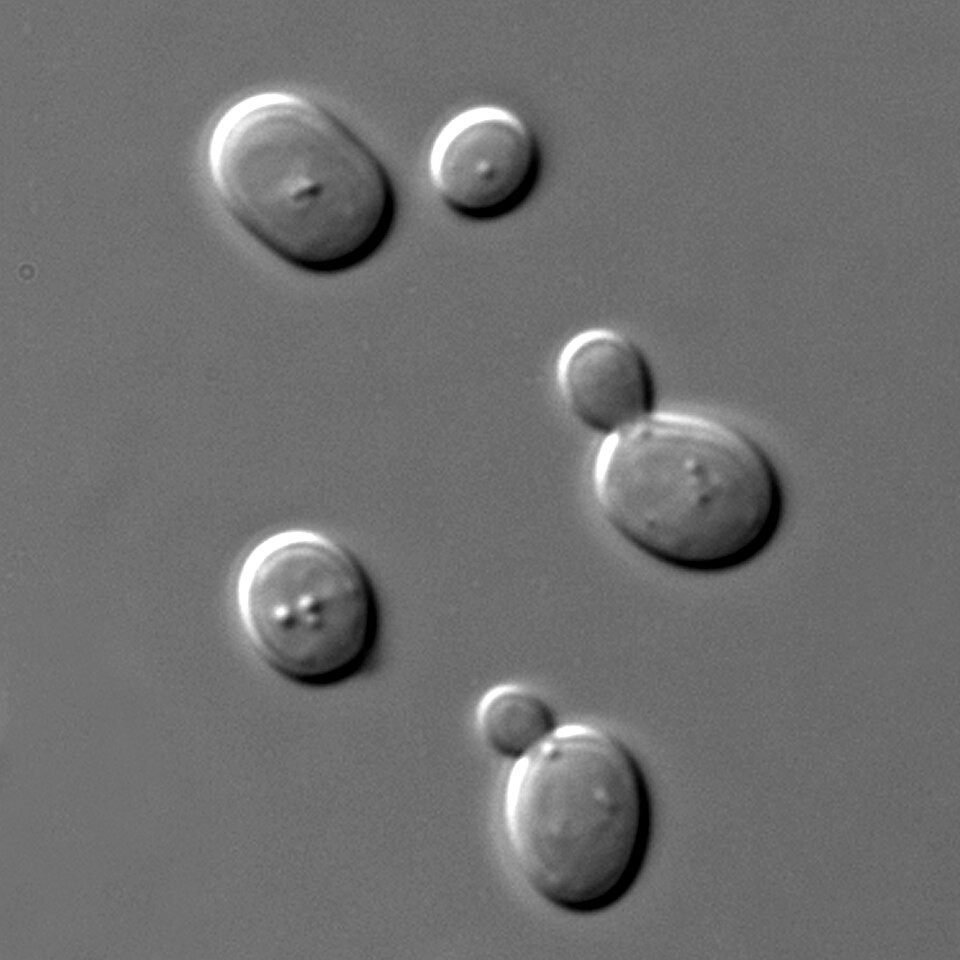
Baker's yeast (Saccharomyces cerevisiae) is a single-celled fungus that people have used for thousands of years to leaven bread and ferment beer and wine. It is also one of the most important model organisms in cell biology and genetics.
Baker's yeast (Saccharomyces cerevisiae) is a single-celled fungus that people have used for thousands of years to leaven bread and ferment beer and wine. It is also one of the most important model organisms in cell biology and genetics.
🧬 Field Guide Specimen: Open Baker's Yeast in the CRV Science Field Guide to log the specimen, see its place among the Opisthokonta lineages in the Cladogram Explorer, and test your recall in the Red List conservation game.
Baker's Yeast at a Glance
| Property | Value |
|---|---|
| Scientific name | Saccharomyces cerevisiae |
| Kingdom | Fungi |
| Phylum | Ascomycota |
| Class | Saccharomycetes |
| Order | Saccharomycetales |
| Family | Saccharomycetaceae |
| Field Guide group | Opisthokonta: Fungi (True Fungi & Lichens) |
| Diagnostic feature (Field Guide) | Unicellular globular budding cells forming 4-spored naked asci under nutrient deprivation without fruiting ascocarps. |
| Genome sequenced | 1996 |
| Chromosomes | 16 |
Taxonomy, Phylogenetics, and Evolutionary History
Saccharomyces cerevisiae (Meyen ex E.C. Hansen, 1883) is the type species of Saccharomyces in the family Saccharomycetaceae (order Saccharomycetales, subphylum Saccharomycotina, phylum Ascomycota). Its name combines the Greek sakcharon ("sugar") and mykes ("fungus") with Latin cerevisia ("beer"). A unicellular budding yeast that lost multicellular hyphal fruiting ~300–400 million years ago, it belongs to the Saccharomyces sensu stricto complex alongside S. paradoxus and S. eubayanus (the cold-tolerant parent of lager yeast, S. pastorianus). Genomic surveys of >1,000 isolates trace its wild origin to East Asian oak (Quercus) and beech (Fagus) forests, followed by independent domestications for wine, sake, ale, and bread over the past 9,000 years.
Roughly 100 million years ago, a Saccharomyces ancestor underwent whole-genome duplication (WGD) from 8 to 16 chromosomes, followed by ~85% duplicate gene loss and retention of glycolytic paralogs. In April 1996, strain S288C became the first eukaryotic genome sequenced: its 12.1-Mbp nuclear genome spans 16 chromosomes with ~6,000 open reading frames (~4% intron-bearing), an 85.8-kbp mitochondrial genome, and the 2-micron plasmid.
Cellular Physiology, the Crabtree Effect, and the Mating Cycle
Individual Saccharomyces cerevisiae cells are ovoid (4–10 micrometers wide), enclosed by a 100- to 200-nanometer wall of β-1,3- and β-1,6-glucan cross-linked to minor chitin bud scars and outer mannoproteins. Cells proliferate mitotically via asymmetric budding (~90-minute generation time at 30 °C): during the G1-to-S transition ("Start") of the Cell cycle, the GTPase Cdc42 polarizes the actin cytoskeleton to extrude a daughter bud.
Metabolically, Saccharomyces cerevisiae is a facultative anaerobe exhibiting the Crabtree effect (Cellular respiration). Even under high O2, when extracellular glucose exceeds ~0.1–0.2 g L−1, the repressor Mig1 downregulates tricarboxylic acid (TCA) cycle and oxidative phosphorylation genes. Rather than oxidizing pyruvate in mitochondria (~30–32 ATP per glucose), the cell channels pyruvate via pyruvate decarboxylase (Pdc1) and alcohol dehydrogenase (Adh1) into ethanol and CO2 (C6H12O6 + 2 ADP + 2 Pi → 2 C2H5OH + 2 CO2 + 2 ATP), generating 2 ATP per glucose at high flux while accumulating antiseptic ethanol (12–18% v/v). Once glucose is depleted, the diauxic shift derepresses Adh2 and respiration to oxidize ethanol into CO2 and H2O.
Cells propagate as haploids (1n = 16) or diploids (2n = 32). Haploids belong to mating type MATa or MATα (chromosome III) and secrete peptide pheromones (a-factor or α-factor) that arrest opposite-type cells in G1, form "shmoo" projections, and fuse into an a/α diploid. Wild homothallic strains express the HO endonuclease to switch mating type using silent cassettes (HMLα/HMRa). Under nitrogen and sugar starvation, a/α diploids undergo meiosis (sporulation) to form a four-spored naked ascus.
| Biological Process or Discovery | Molecular Mechanism in Saccharomyces cerevisiae | Scientific, Industrial, and Biomedical Impact |
|---|---|---|
| Cell-Free Zymase Fermentation | Glycolytic enzyme cascade converting C6H12O6 to 2 C2H5OH + 2 CO2 | Eduard Buchner (1897; Nobel Prize 1907) founded modern biochemistry by disproving vitalism |
| Crabtree Effect & Diauxic Shift | Glucose repression (Mig1) of oxidative phosphorylation; Adh1/Adh2 paralog switching | Rapidly converts sugars to ethanol in aerobic wort/must; oxidizes ethanol after glucose depletion |
| Cell-Cycle Control (CDC Genes) | Cyclin-dependent kinase Cdc28 (CDK1) and checkpoint regulators identified via cdc mutants | Leland Hartwell (Nobel Prize 2001) established conserved eukaryotic cell-cycle regulation |
| Macroautophagy (ATG Genes) | Phagophore nucleation and vacuolar cargo degradation via ATG1–ATG15 machinery | Yoshinori Ohsumi (Nobel Prize 2016) elucidated intracellular self-digestion and organelle turnover |
| Synthetic Yeast Project (Sc2.0) | De novo chemical synthesis of all 16 chromosomes + tRNA neochromosome with loxPsym sites | Enables SCRaMbLE genome rearrangement and recombinant insulin, artemisinic acid, and vaccine production |
Model Organism Discoveries and Synthetic Genomics
Combining eukaryotic organelle architecture with rapid clonal growth, homologous recombination, and tetrad dissection of all four meiotic spores from a single ascus, Saccharomyces cerevisiae has served as a premier model system for eukaryotic molecular biology. Five Nobel Prizes have recognized discoveries in Saccharomyces cerevisiae: Eduard Buchner's discovery of cell-free enzymatic fermentation (1907); Leland Hartwell's screen of cell-division-cycle (cdc) mutants, including CDC28 (2001); Roger Kornberg's X-ray crystal structures of yeast RNA Polymerase II (2006); Randy Schekman's identification of the SEC genes governing vesicular trafficking (2013); and Yoshinori Ohsumi's dissection of the ATG genes controlling autophagy (2016).
In industrial biotechnology (Genetic engineering), engineered Saccharomyces cerevisiae strains manufacture recombinant human insulin, hepatitis B surface antigen vaccines, human papillomavirus (HPV) virus-like particles, bioethanol, and the antimalarial precursor artemisinic acid. Building on the 1996 genome sequence, the Synthetic Yeast Genome Project (Sc2.0) completed the chemical synthesis and assembly of all 16 designer yeast chromosomes plus a 17th supernumerary neochromosome housing relocated tRNA genes, inserting loxPsym recombination sites downstream of non-essential genes to enable inducible evolution via the SCRaMbLE system.
Frequently Asked Questions
Why does baker's yeast produce alcohol and CO2 even when plenty of oxygen is available?
Unlike most eukaryotes, which only ferment when deprived of oxygen (the Pasteur effect), Saccharomyces cerevisiae is a "Crabtree-positive" yeast. Whenever external sugar concentrations are high, yeast actively represses its mitochondrial respiration genes and ferments glucose into ethanol and CO2 even under aerobic conditions—sacrificing ATP yield per glucose molecule in exchange for faster ATP production rates and the accumulation of ethanol that poisons competing microorganisms.
Why do laboratory yeast strains stay haploid, whereas wild yeasts are almost always diploid?
Wild Saccharomyces cerevisiae strains carry a functional HO gene, which encodes an endonuclease that switches a haploid cell's mating type (between MATa and MATα) after cell division, causing sister cells in a colony to mate and form stable a/α diploids. Laboratory reference strains (such as S288C and W303) carry a mutated, inactive ho allele, allowing geneticists to maintain stable haploid MATa or MATα cultures indefinitely to screen recessive mutations directly.
How does baker's yeast differ from lager brewing yeast?
Bread baking, wine making, and warm top-fermenting ale brewing all use strains of Saccharomyces cerevisiae, which grows optimally at 25–32 °C. Cold bottom-fermenting lager beer (fermented at 7–13 °C), by contrast, is brewed with Saccharomyces pastorianus—an allopolyploid interspecies hybrid formed several centuries ago in Central European breweries when domesticated Saccharomyces cerevisiae mated with the cold-tolerant wild Patagonian/Tibetan yeast Saccharomyces eubayanus.
References
- Goffeau, A., Barrell, B. G., Bussey, H., Davis, R. W., Dujon, B., Feldmann, H., et al. (Oct 25, 1996). Life with 6000 Genes. Science, 274(5287), 546–567. https://doi.org/10.1126/science.274.5287.546
- Peter, J., De Chiara, M., Friedrich, A., Yue, J.-X., Pflieger, D., Bergström, A., et al. (Apr 11, 2018). Genome evolution across 1,011 Saccharomyces cerevisiae isolates. Nature, 556(7701), 339–344. https://doi.org/10.1038/s41586-018-0030-5
- Richardson, S. M., Mitchell, L. A., Stracquadanio, G., Yang, K., Dymond, J. S., DiCarlo, J. E., et al. (Mar 10, 2017). Design of a synthetic yeast genome. Science, 355(6329), 1040–1044. https://doi.org/10.1126/science.aaf4557
- Pfeiffer, T., & Morley, A. (Oct 21, 2014). An evolutionary perspective on the Crabtree effect. Frontiers in Molecular Biosciences, 1, 17. https://doi.org/10.3389/fmolb.2014.00017