Domestic Pig
The domestic pig (Sus scrofa domesticus) is descended from wild boar domesticated independently in the Near East and in China about 9,000 to 10,000 years ago. Pigs are intelligent omnivores, and their similarity to humans makes them important in medicine.
The domestic pig (Sus scrofa domesticus) is descended from wild boar domesticated independently in the Near East and in China about 9,000 to 10,000 years ago. Pigs are intelligent omnivores, and their similarity to humans makes them important in medicine.
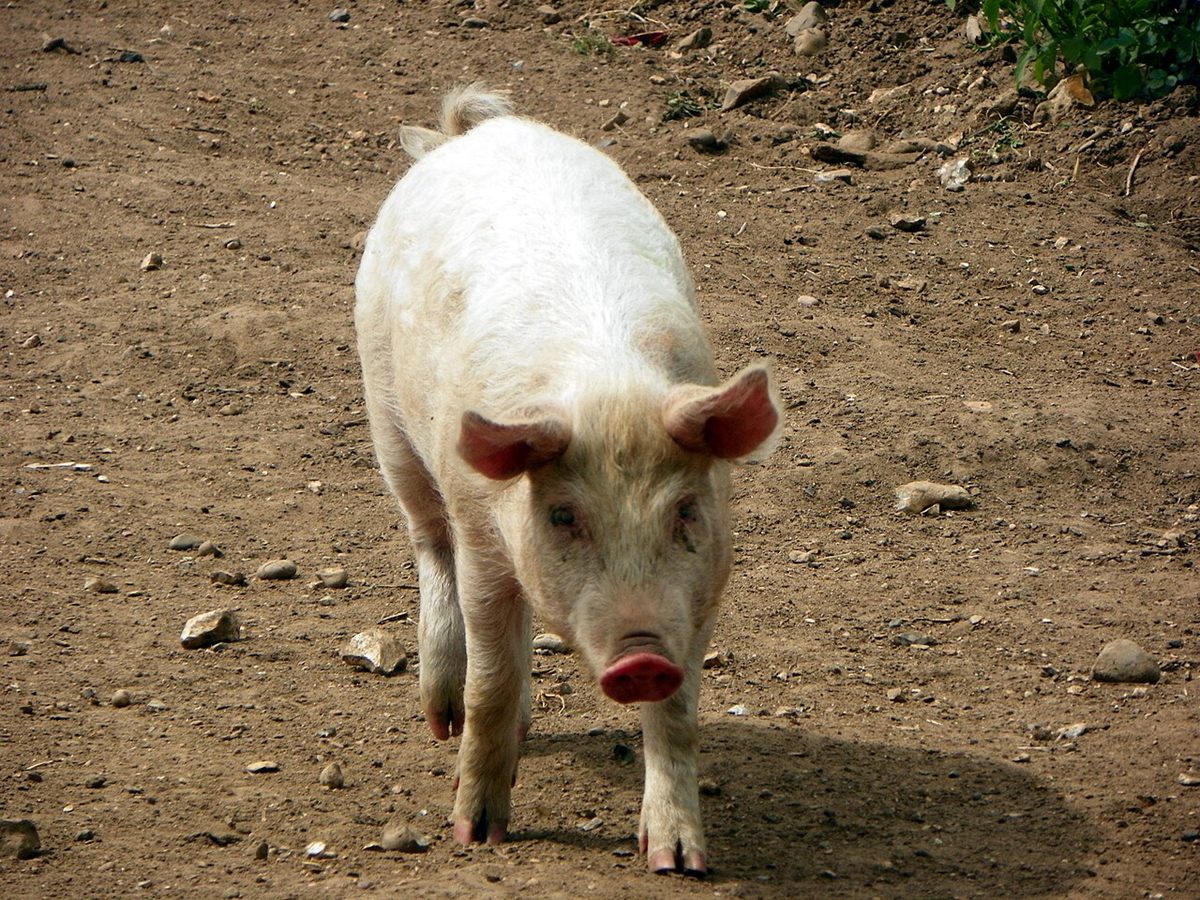
🧬 Field Guide Specimen: Open Domestic Pig in the CRV Science Field Guide to log the specimen, see its place among the Mammals lineages in the Cladogram Explorer, and test your recall in the Red List conservation game.
Domestic Pig at a Glance
| Property | Value |
|---|---|
| Scientific name | Sus scrofa domesticus |
| Kingdom | Animalia |
| Phylum | Chordata |
| Class | Mammalia |
| Order | Cetartiodactyla |
| Family | Suidae |
| Field Guide group | Mammals: Eutheria (Placentals) |
| Diagnostic feature (Field Guide) | Vital biomedical model for xenotransplantation and artiodactyl (even-toed) organ systems. |
| Wild ancestor | Wild boar |
| Domesticated | About 9,000 to 10,000 years ago |
Taxonomy, Phylogenetics, and Dual-Center Domestication
Independent Domestication in Anatolia and China
Classified in the suborder Suina (family Suidae, order Cetartiodactyla), the domestic pig (Sus scrofa domesticus) descends from the Eurasian wild boar (Sus scrofa). Whole-genome assemblies (2.5 Gb, 2*n* = 38, Martien A. M. Groenen et al., 2012) and ancient DNA analyses by Greger Larson and Laurent Frantz showed that pigs were domesticated independently in two centers around 9,000 to 10,500 years BP:
- Anatolian / Near Eastern Center (~10,500–9,000 years BP): Neolithic farmers domesticated Near Eastern wild boar and brought them into Europe ~7,500 years BP, where interbreeding with European wild boar replaced their Near Eastern nuclear ancestry while preserving coat-color mutations at MC1R.
- Chinese Center (Yellow/Yangtze Valleys, ~9,000–8,000 years BP): Millet and rice cultivators domesticated East Asian wild boar; 18th–19th century British breeders crossed Chinese sows with European pigs, introducing Asian alleles for prolificacy and the NR6A1 mutation (P192L) that increases thoracolumbar vertebrae from 19 to 21–23.
Comparative Anatomy, Xenotransplantation, and Gene Editing
Triple-Glycan Knockout and 69-Gene CRISPR-Edited Donor Pigs
Because adult swine possess hearts, kidneys, and livers matched in dimensions and hemodynamics to adult humans, Sus scrofa domesticus is the primary donor species for clinical xenotransplantation (see Genetic engineering). Transplanting an unmodified pig organ into a primate triggers hyperacute rejection (HAR) within minutes as preformed human antibodies bind porcine endothelial carbohydrate antigens and activate the classical complement cascade. Immunological studies identified the three porcine xeno-glycan antigens lacking in humans, alongside endogenous retroviruses and human transgenes targeted in donor lines:
| Porcine Gene Target or Modification | Biochemical Product or Pathway | Role in Preventing Xenograft Rejection or Infection |
|---|---|---|
| GGTA1 knockout (α-1,3-galactosyltransferase) | Eliminates galactose-α-1,3-galactose (α-Gal) epitope on porcine endothelial glycoproteins | Prevents binding of ~1% of circulating human natural anti-Gal IgG/IgM antibodies (main trigger of hyperacute rejection) |
| CMAH knockout (CMP-N-acetylneuraminic acid hydroxylase) | Eliminates N-glycolylneuraminic acid (Neu5Gc) sialic acid epitope | Removes the second major non-human glycan target (humans lost CMAH ~2–3 million years ago) |
| B4GALNT2 knockout (β-1,4-N-acetylgalactosaminyltransferase 2) | Eliminates the Sda-like pentasaccharide glycan antigen | Removes the third major carbohydrate target of preformed human natural xenoantibodies |
| PERV inactivation (50–62 copies) | CRISPR-Cas9 catalytic inactivation of the pol reverse transcriptase gene across all Porcine Endogenous Retroviruses | Eliminates the risk of cross-species retroviral transmission from the donor pig genome to the human recipient |
| Human transgenes (hCD46, hCD55, hCD59, hTHBD, hEPCR, hCD47) | Endothelial expression of human complement inhibitors, thrombomodulin, endothelial protein C receptor, and CD47 | Blocks complement activation, prevents consumptive coagulopathy/thrombosis, and inhibits human macrophage phagocytosis |
In 2015–2017, Luhan Yang, Dong Niu, and George M. Church used multiplex CRISPR-Cas9 editing to inactivate all 59 to 62 copies of Porcine Endogenous Retrovirus (PERV), and in 2023 Wenning Qin and Tatsuo Kawai generated Yucatan miniature pigs carrying 69 genomic edits (triple-glycan knockout + 59 PERV knockouts + 7 human complement/coagulation transgenes), enabling clinical xenotransplantations of gene-edited pig hearts (2022–2023) and kidneys (from 2024).
Influenza Reassortment ("Mixing Vessel" Biology) and Cognition
In viral epidemiology, Sus scrofa domesticus serves as a host for pandemic Influenza A Virus reassortment. Whereas avian Influenza A viruses bind α-2,3 sialic acids (SAα2,3Gal) and human Influenza A viruses bind α-2,6 sialic acids (SAα2,6Gal), Toshihiro Ito and Yoshihiro Kawaoka (1998) showed that the porcine tracheal epithelium expresses both SAα2,3Gal and SAα2,6Gal receptors, permitting eight-segment RNA reassortment (antigenic shift) during co-infection—as in the 2009 H1N1 pandemic virus. Anatomically, the snout contains the median rostral bone (os rostri) and >1,100 olfactory receptor genes, and in cognitive studies by Donald M. Broom, pigs pass mirror-guided spatial localization tasks.
Frequently Asked Questions
How were domestic pigs domesticated twice on opposite sides of Eurasia?
Because wild boar (Sus scrofa) naturally inhabited Eurasia from western Europe to China, Neolithic farming communities independently domesticated local wild boar populations in southeastern Anatolia (~10,000 years ago) and in the Yellow and Yangtze River valleys of China (~8,500 years ago). When Near Eastern farmers brought their pigs into Europe, those pigs hybridized extensively with local European wild boar, replacing their Near Eastern genes, and in the 18th–19th centuries British breeders crossed prolific Chinese pigs with European pigs to create modern commercial breeds like the Yorkshire and Landrace.
Why are gene-edited pigs used for human organ transplants instead of non-human primates?
Although chimpanzees and baboons are evolutionary closer to humans, non-human primates pose high risks of transmitting zoonotic viruses, breed slowly, have small organs (in baboons), and raise ethical and conservation barriers. Domestic pigs grow to adult human organ size within 6 months, produce large litters under pathogen-free containment, and can be engineered via CRISPR-Cas9 to knock out the three pig sugar antigens (GGTA1, CMAH, B4GALNT2) that trigger human antibody rejection, inactivate endogenous retroviruses (PERVs), and express human complement- and coagulation-regulating proteins.
Why are pigs called a "mixing vessel" for pandemic influenza viruses?
Influenza A viruses attach to host cells via surface sialic acid sugars: bird flu viruses bind α-2,3-linked sialic acids, whereas human flu viruses bind α-2,6-linked sialic acids. Because the cells lining a pig's windpipe (trachea) carry both α-2,3 and α-2,6 sialic acid receptors, a pig can be infected by avian, swine, and human influenza viruses at the same time. Inside a co-infected pig cell, the viruses can swap their eight RNA gene segments (reassortment), generating novel hybrid strains—such as the 2009 H1N1 pandemic virus—capable of spreading between humans.
References
- Groenen, M. A. M., Archibald, A. L., Uenishi, H., Tuggle, C. K., Takeuchi, Y., Rothschild, M. F., Rogel-Gaillard, C., Park, C., Milan, D., Megens, H.-J., Li, S., Larkin, D. M., et al., & Schook, L. B. (2012). Analyses of pig genomes provide insight into porcine demography and evolution. Nature, 491(7424), 393–398. https://doi.org/10.1038/nature11622
- Frantz, L. A. F., Schraiber, J. G., Madsen, O., Megens, H.-J., Cagan, A., Bosse, M., Paudel, Y., Crooijmans, R. P. M. A., Larson, G., & Groenen, M. A. M. (2015). Evidence of long-term gene flow and selection during domestication from analyses of Eurasian wild and domestic pig genomes. Nature Genetics, 47(10), 1141–1148. https://doi.org/10.1038/ng.3394
- Niu, D., Wei, H.-J., Lin, L., George, H., Wang, T., Lee, I.-H., Zhao, H.-Y., Wang, Y., Kan, Y., Shrock, E., Lesha, E., Wang, G., et al., Yang, L., & Church, G. M. (2017). Inactivation of porcine endogenous retrovirus in pigs using CRISPR-Cas9. Science, 357(6357), 1303–1307. https://doi.org/10.1126/science.aan4187
- Anand, R. P., Layer, J. V., Heja, D., Hirose, T., Lassiter, G., Firl, D. J., Paragas, V. B., et al., Kawai, T., & Qin, W. (2023). Design and testing of a humanized porcine donor for xenotransplantation. Nature, 622(7982), 393–401. https://doi.org/10.1038/s41586-023-06594-4