Drosophila melanogaster
Drosophila melanogaster, the common fruit fly, is a small fly that breeds on rotting fruit and one of the most important model organisms in biology.
Drosophila melanogaster, the common fruit fly, is a small fly that breeds on rotting fruit and one of the most important model organisms in biology. It has been used to establish the chromosome theory of heredity and has contributed to a number of Nobel Prizes.
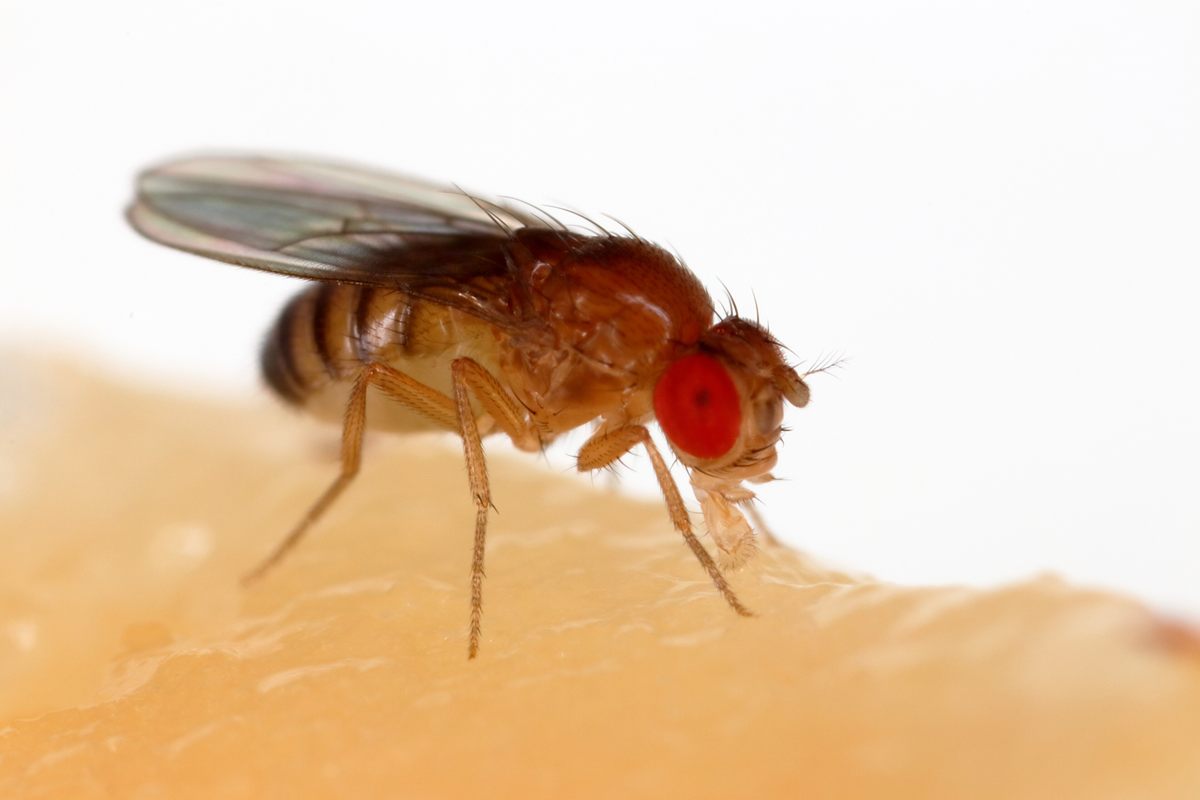
🧬 Field Guide Specimen: Open Fruit Fly in the CRV Science Field Guide to log the specimen, see its place among the Ecdysozoa lineages in the Cladogram Explorer, and test your recall in the Red List conservation game.
Drosophila melanogaster at a Glance
| Property | Value |
|---|---|
| Scientific name | Drosophila melanogaster |
| Kingdom | Animalia |
| Phylum | Arthropoda |
| Class | Insecta |
| Order | Diptera |
| Family | Drosophilidae |
| Field Guide group | Ecdysozoa: Hexapoda (Insects) |
| Diagnostic feature (Field Guide) | The gold standard invertebrate model for genetics, development, and chromosome mapping. |
| Genome sequenced | 2000 |
| Generation time | About 10 days at 25 °C |
Taxonomy, Biogeography, and the Columbia "Fly Room"
Sub-Saharan Miombo Origin and Morgan's white Mutant
Described by Johann Wilhelm Meigen in 1830 (from the Greek drosos, "dew," philos, "loving," and melanogaster, "black-bellied"), Drosophila melanogaster belongs to the subgenus Sophophora (family Drosophilidae, order Diptera). Population genomic reconstructions by John E. Pool and Charles F. Aquadro show that wild D. melanogaster originated in the Miombo woodlands of southern-central Africa (Zambia and Zimbabwe) as a breeding specialist on the fermented fruit of the marula tree (Sclerocarya birrea), shifting to human commensalism ~10,000 years ago and spreading worldwide.
In Thomas Hunt Morgan's "Fly Room" at Columbia University in May 1910, Morgan isolated a male fly with white compound eyes lacking the brown ommochrome and red drosopterin pigments transported by the ABC transporter encoded by the white (w) gene. Observing that the white trait segregated with the X chromosome in F1 and F2 crosses, Morgan established the chromosome theory of Genetics (1933 Nobel Prize). His students Alfred H. Sturtevant (who constructed the first linear genetic linkage map in centimorgans in 1913), Calvin B. Bridges (who proved chromosome heredity via X-chromosome nondisjunction and mapped salivary polytene chromosomes), and Hermann J. Muller (who demonstrated X-ray Genetic mutation in 1927 [1946 Nobel Prize] and invented inversion-carrying balancer chromosomes such as ClB, CyO, and TM3) built the foundation of modern transmission genetics.
Karyotype, Polytene Chromosomes, and the Genetic Toolkit
Four Chromosome Pairs, Hox Complexes, and the GAL4/UAS System
The diploid genome of Drosophila melanogaster (2*n* = 8, totaling ~180 Mb, of which 120 Mb is euchromatic) is partitioned into four chromosome pairs: the sex chromosomes (Chromosome 1: X/Y, where sex is determined by the X-chromosome dose activating the RNA-splicing switch Sex-lethal [Sxl] rather than by the Y chromosome), two metacentric autosomes (Chromosomes 2 and 3), and the tiny dot chromosome (Chromosome 4). In larval salivary glands, 10 rounds of endoreduplication align 1,024 sister chromatids into giant polytene chromosomes with over 5,000 reproducible bands. Sequenced in March 2000 by Celera Genomics (Craig Venter, Eugene W. Myers) and the Berkeley Drosophila Genome Project (Gerald M. Rubin), the genome encodes ~13,900 protein-coding genes, including orthologs for ~75% of human disease genes.
| Nobel Prize Year & Laureates | Core Discovery in Drosophila melanogaster | Principal Genes & Molecular Pathways |
|---|---|---|
| 1933 — Thomas Hunt Morgan | Localization of genes on chromosomes and linear linkage mapping | X-linked white (w) ABC transporter, crossing-over, and centimorgan map units |
| 1946 — Hermann J. Muller | Induction of mutations by X-ray ionizing radiation and invention of balancer chromosomes | Radiation mutagenesis and inverted ClB / CyO / TM3 balancer chromosomes |
| 1995 — E. B. Lewis, C. Nüsslein-Volhard, & E. F. Wieschaus | Genetic control of early embryonic segmentation and anterior-posterior body segment identity | Maternal gradients (bicoid, nanos), gap/pair-rule/segment-polarity (hedgehog, wingless), & Bithorax/Antennapedia Hox complexes |
| 2011 — Jules A. Hoffmann (shared) | Activation of innate immunity via the Toll receptor pathway | Antifungal/antibacterial NF-κB cascade via Spatzle → Toll → Dorsal/Dif → Drosomycin |
| 2017 — J. C. Hall, M. Rosbash, & M. W. Young | Molecular transcriptional-translational feedback loop of the circadian clock | CLOCK/CYCLE activation and PERIOD (per) / TIMELESS (tim) nuclear feedback loop |
During its 10-day life cycle at 25 °C, the fertilized egg undergoes 13 synchronous nuclear divisions without cytokinesis (syncytial blastoderm) before cellularizing at cycle 14 and developing through three larval instars and pupal metamorphosis via epithelial imaginal discs. In their 1980 Heidelberg screen, Christiane Nüsslein-Volhard and Eric F. Wieschaus identified gap, pair-rule, and segment-polarity genes, while Edward B. Lewis characterized the colinear Antennapedia and Bithorax Hox complexes on Chromosome 3R (see Evolutionary developmental biology). Genetic manipulation uses P-element transposons, FLP/FRT recombination, and the GAL4/UAS binary expression system (Andrea H. Brand and Norbert Perrimon, 1993).
Frequently Asked Questions
What is a balancer chromosome, and why is it so useful in fruit fly genetics?
Invented by Hermann J. Muller, a balancer chromosome (such as CyO for chromosome 2 or TM3 for chromosome 3) is an engineered chromosome carrying three features: (1) multiple nested inversions that scramble the linear order of genes so that meiotic recombination (crossing-over) with a normal homolog produces inviable acentric/dicentric chromatids; (2) a dominant visible marker (like Curly wings or Stubble bristles) so geneticists can see which flies carry the balancer under a stereomicroscope; and (3) a recessive lethal mutation so that homozygotes for the balancer die as embryos. When a recessive lethal mutation of interest is placed opposite a balancer, the stock automatically breeds true in vials without geneticists having to sort flies each generation.
How did Drosophila lead to the discovery of human Toll-like receptors (TLRs) and circadian clocks?
Until the 1990s, the Drosophila Toll gene was known only as a maternal gene controlling dorsal-ventral embryonic polarity. In 1996, Bruno Lemaitre and Jules A. Hoffmann discovered that adult flies carrying Toll loss-of-function mutations failed to synthesize the antifungal peptide drosomycin and died covered in fungal hyphae when pricked with Aspergillus fumigatus. This revelation prompted Charles Janeway, Ruslan Medzhitov, and Bruce Beutler to identify mammalian Toll-like receptors (TLR4) as sensors of innate immunity. Similarly, Seymour Benzer and Ronald Konopka's isolation of period (per) clock mutants in 1971 enabled Jeffrey C. Hall, Michael Rosbash, and Michael W. Young to solve the transcription-translation feedback loop (CLOCK/CYCLE and PER/TIM) governing 24-hour circadian rhythms.
How does sex determination in Drosophila melanogaster differ from human XY sex determination?
Although both humans and Drosophila melanogaster have XX females and XY males, the Drosophila Y chromosome does not trigger male development (an XO fly lacking a Y chromosome is a morphologically normal, sterile male, whereas an XXY fly is a fertile female). Instead, sex in Drosophila is determined by an X-chromosome counting mechanism: four X-linked transcription factors (scute, sisA, runt, unpaired) activate the master female splicing factor Sex-lethal (Sxl) when two X chromosomes are present, initiating a sex-specific alternative mRNA splicing cascade through transformer (tra) and doublesex (dsx).
References
- Morgan, T. H. (1910). Sex limited inheritance in Drosophila. Science, 32(812), 120–122. https://doi.org/10.1126/science.32.812.120
- Nüsslein-Volhard, C., & Wieschaus, E. (1980). Mutations affecting segment number and polarity in Drosophila. Nature, 287(5785), 795–801. https://doi.org/10.1038/287795a0
- Adams, M. D., Celniker, S. E., Holt, R. A., Evans, C. A., Gocayne, J. D., Amanatides, P. G., Scherer, S. E., Li, P. W., Hoskins, R. A., Galle, R. F., George, R. A., Lewis, S. E., et al., Rubin, G. M., & Venter, J. C. (2000). The genome sequence of Drosophila melanogaster. Science, 287(5461), 2185–2195. https://doi.org/10.1126/science.287.5461.2185
- Brand, A. H., & Perrimon, N. (1993). Targeted gene expression as a means of altering cell fates and generating dominant phenotypes. Development, 118(2), 401–415. https://doi.org/10.1242/dev.118.2.401