Pork Tapeworm
The pork tapeworm (Taenia solium) is a parasitic flatworm that lives as an adult in the human intestine and as larval cysts in pigs, and sometimes in people.
The pork tapeworm (Taenia solium) is a parasitic flatworm that lives as an adult in the human intestine and as larval cysts in pigs, and sometimes in people. It is a cause of neurocysticercosis, a leading cause of acquired epilepsy in many developing countries.
🧬 Field Guide Specimen: Open Pork Tapeworm in the CRV Science Field Guide to log the specimen, see its place among the Lophotrochozoa lineages in the Cladogram Explorer, and test your recall in the Red List conservation game.
Pork Tapeworm at a Glance
| Property | Value |
|---|---|
| Scientific name | Taenia solium |
| Kingdom | Animalia |
| Phylum | Platyhelminthes |
| Class | Cestoda |
| Order | Cyclophyllidea |
| Family | Taeniidae |
| Field Guide group | Lophotrochozoa: Worms, Shells & Allies |
| Diagnostic feature (Field Guide) | Shows extreme anatomical reduction via parasitic adaptation (scolex and proglottids). |
| Disease | Taeniasis and cysticercosis |
Evolutionary Systematics and Cestode Anatomy
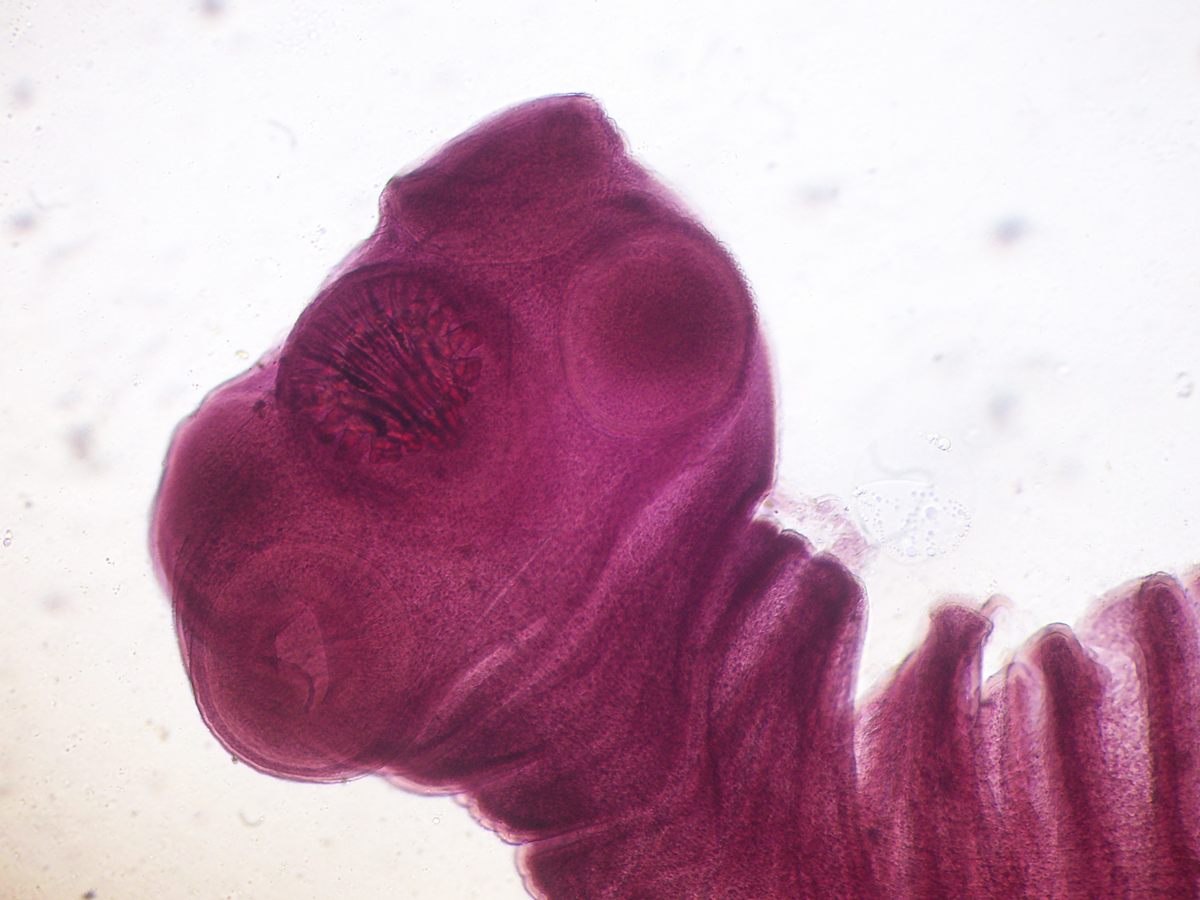
Taenia solium is a cyclophyllidean cestode within the phylum Platyhelminthes (clade Neodermata), a lineage of obligate parasitic flatworms that shed their ciliated epidermis during larval metamorphosis in favor of a continuous, multinucleate syncytial tegument. Phylogenetic reconstructions of mitochondrial genomes demonstrate that human-infecting Taenia species (T. solium, T. saginata, and T. asiatica) evolved from carnivoran-hosted ancestors that colonized hominins on the African savanna during the Plio-Pleistocene prior to the domestication of swine and cattle. In contrast to the unarmed beef tapeworm (Taenia saginata), the anterior attachment organ (scolex) of T. solium measures roughly 1 mm in diameter and bears four hemispherical muscular acetabula (suckers) surrounding a dome-shaped rostellum armed with a double crown of 22 to 32 chitinous-keratinous hooks.
Posterior to the scolex lies a short, unsegmented proliferative neck zone whose totipotent stem cells (neoblasts) continuously bud a ribbon-like chain (strobila) of 700 to 1,000 serially repeated reproductive units called proglottids, extending the adult worm to 2 to 7 meters in length within the human jejunum. Each proglottid is a hermaphroditic reproductive module containing follicular testes, a bilobed ovary, vitelline glands, and a blind-ended uterus. As proglottids mature and move posteriorly along the strobila, the male and female reproductive organs degenerate, leaving gravid terminal segments packed with 30,000 to 50,000 embryonated eggs. Morphologically, gravid proglottids of T. solium are distinguished from those of T. saginata by possessing 7 to 13 primary lateral uterine branches per side rather than 15 to 20.
Syncytial Tegument Physiology and Host Immune Evasion
Lacking a mouth, pharynx, or digestive tract throughout its life cycle, Taenia solium relies on its outer syncytial neodermis to maintain cellular homeostasis and absorb predigested nutrients directly from the host intestinal lumen. The apical plasma membrane of the tegument is folded into dense, spine-like projections termed microtriches, which amplify the absorptive surface area up to tenfold and interdigitate with the brush border of host enterocytes. Monosaccharides—predominantly D-glucose and D-galactose—are imported across the tegument via active Na+-coupled glucose cotransporters (SGLTs) and facilitated diffusion GLUT carriers, while free amino acids, purines, pyrimidines, and short-chain fatty acids enter through specialized stereospecific permeases. Because adult worms inhabit an anaerobic or microaerophilic intestinal environment, energy metabolism centers on glycolysis and the malate-dismutation pathway within modified mitochondria, reducing fumarate to succinate and excreting acetate, propionate, and lactate as metabolic end-products.
To survive for years in the host gut or for decades as tissue cysts in parenchymal organs, T. solium deploys a complex suite of immunomodulatory molecules at the tegumental interface. The apical glycocalyx continuously turns over and sheds bound host immunoglobulins (IgA and IgG), while secreted serine and cysteine protease inhibitors (taeniastatin and paramyosin) block both the classical and alternative pathways of complement activation by binding C1q and C3b. In tissue-dwelling cysticerci, excretory-secretory glycoproteins polarize surrounding host macrophages toward an alternatively activated (M2) phenotype, upregulate anti-inflammatory cytokines including interleukin-10 (IL-10) and transforming growth factor-beta (TGF-β), and suppress dendritic cell maturation, allowing viable cysts to persist in brain or muscle tissue with minimal perilesional inflammation.
Two-Host Life Cycle and Neurocysticercosis Pathogenesis
The life cycle of Taenia solium alternates between humans, the sole natural definitive host for the adult intestinal tapeworm, and domestic pigs (Sus scrofa domesticus), the primary intermediate host for the larval metacestode stage. When a pig ingests human feces or contaminated forage containing gravid proglottids or free taeniid eggs, gastric HCl, pepsin, and duodenal bile salts dissolve the radially striated embryophore blocks and activate the six-hooked larva (oncosphere or hexacanth embryo). Using its muscular hooks and lytic gland secretions, the oncosphere penetrates the intestinal mucosa within 30 to 120 minutes, enters the mesenteric venules or lymphatics, and disseminates via the systemic circulation to striated skeletal muscle, myocardium, subcutaneous tissues, and the central nervous system. Over 60 to 70 days, the oncosphere vesiculates into a fluid-filled bladder worm (cysticercus, historically termed Cysticercus cellulosae) measuring 5 to 15 mm in diameter and containing a single invaginated protoscolex. When a human consumes raw or undercooked pork ("measly pork") harboring viable cysticerci, bile acids and pancreatic enzymes trigger evagination of the scolex, which anchors to the jejunal wall and matures into a patent, egg-shedding adult within 8 to 12 weeks—an infection termed intestinal taeniasis.
Human cysticercosis arises when a person accidentally ingests T. solium eggs via fecal-oral contamination, unclean water, unwashed produce, or autoinfection from an existing adult worm, turning the human into an aberrant intermediate host. Unlike ingesting undercooked pork, which produces only an intestinal tapeworm, ingesting T. solium eggs releases invasive oncospheres that encyst in human tissues. When cysticerci lodge in the cerebral cortex, subarachnoid space, or cerebral ventricles, the resulting condition—neurocysticercosis—accounts for roughly 30% of active epilepsy cases across endemic regions of Latin America, sub-Saharan Africa, and South and Southeast Asia. Viable parenchymal cysts often remain clinically silent for years due to active parasite immune evasion; however, when the cyst degenerates naturally or following anthelmintic therapy with albendazole or praziquantel, the sudden release of somatic antigens provokes an intense granulomatous inflammatory cascade, perilesional cerebral edema, and eventual calcified scarring that acts as an epileptogenic focus.
Frequently Asked Questions
What is the clinical difference between taeniasis and cysticercosis?
Taeniasis is an infection of the human small intestine by the adult Taenia solium tapeworm, acquired by eating raw or undercooked pork containing larval cysts (cysticerci); it typically causes mild abdominal discomfort or no symptoms at all. Cysticercosis is a systemic tissue infection acquired by swallowing microscopic T. solium eggs shed in human feces, allowing larvae to encyst in human muscles, eyes, or the brain (neurocysticercosis).
How does the pork tapeworm absorb nutrients without a digestive tract?
Taenia solium lacks a mouth and gut at every stage of development, absorbing all nutrients across its outer syncytial skin, the neodermis or tegument. The surface of the tegument is covered in microscopic projections called microtriches that increase surface area and house membrane transport proteins, allowing the worm to import glucose, amino acids, and nucleosides directly from the host's intestinal fluid.
How can transmission of Taenia solium be interrupted in endemic communities?
Breaking the transmission cycle requires coordinated interventions targeting both human definitive hosts and porcine intermediate hosts. Effective measures include mass drug administration of praziquantel or niclosamide to eliminate adult worms in humans, vaccination of pigs with the recombinant TSOL18 oncosphere antigen alongside oxfendazole treatment, confinement of free-roaming pigs away from human waste, and thorough cooking of pork to internal temperatures above 65 °C.
References
- García, H. H., Gonzalez, A. E., Evans, C. A. W., & Gilman, R. H. (2003). Taenia solium cysticercosis. The Lancet, 362(9383), 547–556. https://doi.org/10.1016/S0140-6736(03)14117-7
- Tsai, I. J., Zarowiecki, M., Holroyd, N., Garciarrubio, A., Sanchez-Flores, A., Brooks, K. L., Tracey, A., Bobes, R. J., Fragoso, G., Sciutto, E., Aslett, M., Beasley, H., Bennett, H. M., Cai, J., Camicia, F., Clark, R., Cucher, M., De Silva, N., Day, T. A., ... Berriman, M. (2013). The genomes of four tapeworm species reveal adaptations to parasitism. Nature, 496(7443), 57–63. https://doi.org/10.1038/nature12031
- Hoberg, E. P., Alkire, N. L., de Queiroz, A., & Jones, A. (2001). Out of Africa: origins of the Taenia tapeworms in humans. Proceedings of the Royal Society of London. Series B: Biological Sciences, 268(1469), 781–787. https://doi.org/10.1098/rspb.2000.1579
- White, A. C., Jr., Coyle, C. M., Rajshekhar, V., Singh, G., Hauser, W. A., Mohanty, A., Zunt, J. R., & Garcia, H. H. (2018). Diagnosis and treatment of neurocysticercosis: 2017 clinical practice guidelines by the Infectious Diseases Society of America (IDSA) and the American Society of Tropical Medicine and Hygiene (ASTMH). Clinical Infectious Diseases, 66(8), e49–e75. https://doi.org/10.1093/cid/cix1084