Southern Marsupial Mole
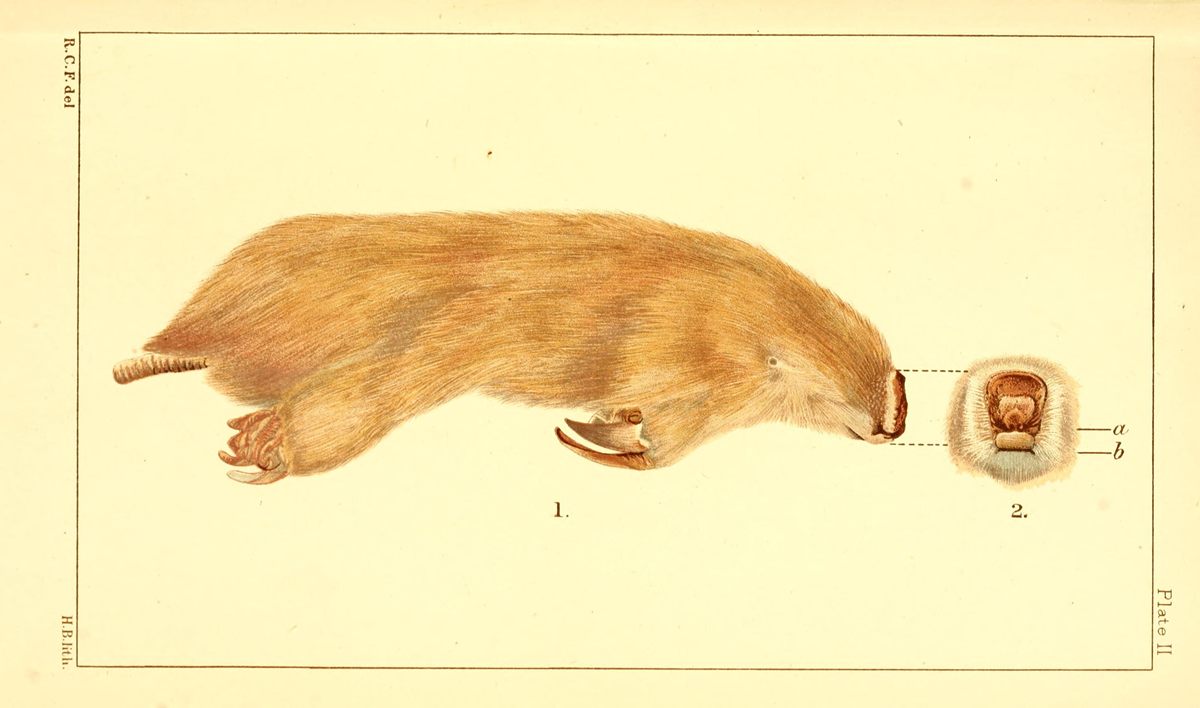
The southern marsupial mole (Notoryctes typhlops) is a blind, burrowing marsupial of the central Australian deserts that 'swims' through sand. It looks remarkably like the moles of other continents, but is only distantly related to them.
The southern marsupial mole (Notoryctes typhlops) is a blind, burrowing marsupial of the central Australian deserts that "swims" through sand. It looks remarkably like the moles of other continents, but is only distantly related to them.
🧬 Field Guide Specimen: Open Southern Marsupial Mole in the CRV Science Field Guide to log the specimen, see its place among the Mammals lineages in the Cladogram Explorer, and test your recall in the Red List conservation game.
Convergent Evolution: Why Does It Look Like a Mole?
Living underground has pushed unrelated mammals toward similar forms. The marsupial mole has silky fur, a leathery shield on its snout, vestigial eyes hidden under the skin and enormous digging claws on the third and fourth digits. Placental moles of the Northern Hemisphere and golden moles of Africa evolved similar features independently.
A Secretive Life
The animal moves through loose sand and rarely comes to the surface. It eats ants, beetle larvae and other underground invertebrates. Because it is so hard to find, most of what is known comes from chance encounters and Aboriginal knowledge.
Evolutionary Placement
It belongs to its own order, Notoryctemorphia, within the Australian marsupial radiation. Its pouch opens backward so that sand does not enter as it digs.
Southern Marsupial Mole at a Glance
| Property | Value |
|---|---|
| Scientific name | Notoryctes typhlops |
| Kingdom | Animalia |
| Phylum | Chordata |
| Class | Mammalia |
| Order | Notoryctemorphia |
| Family | Notoryctidae |
| Field Guide group | Mammals: Marsupialia (Metatherians) |
| Diagnostic feature (Field Guide) | Horny nose shield, eyes reduced to subcutaneous non-functional lenses, large spade-like spade claws on digits 3 and 4. |
| IUCN Red List status | Least Concern (LC), assessed 2016 |
| Order | Notoryctemorphia |
| Habitat | Sandy deserts of central Australia |
See Also
- Natural selection — convergent evolution
- Evolution — adaptive radiation of marsupials