Turkey Tail
Turkey tail (Trametes versicolor) is a thin, leathery bracket fungus whose concentric colored bands resemble a turkey's tail. It grows on dead hardwood logs worldwide and is one of the most common wood-rotting fungi.
Turkey tail (Trametes versicolor) is a thin, leathery bracket fungus whose concentric colored bands resemble a turkey's tail. It grows on dead hardwood logs worldwide and is one of the most common wood-rotting fungi.
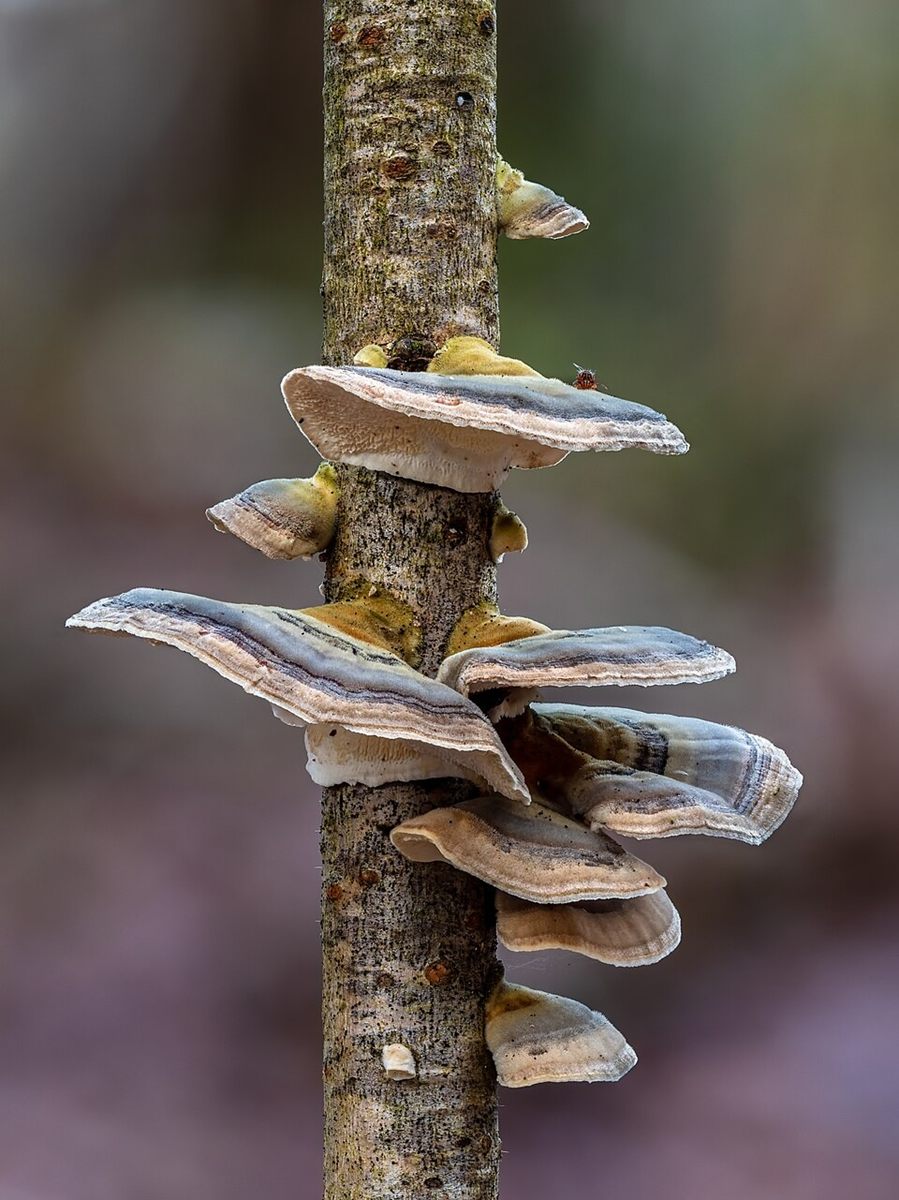
🧬 Field Guide Specimen: Open Turkey Tail Bracket Fungus in the CRV Science Field Guide to log the specimen, see its place among the Opisthokonta lineages in the Cladogram Explorer, and test your recall in the Red List conservation game.
White Rot: How Does It Break Down Wood?
Turkey tail secretes enzymes such as laccases and peroxidases that break down lignin, the tough polymer of wood, leaving pale cellulose behind. Few organisms can degrade lignin, so fungi like this are key to carbon recycling in forests. The same enzymes are being investigated for bioremediation of pollutants. See Bioremediation.
A Medicinal Mushroom?
Extracts of the fungus, including a protein-bound polysaccharide called PSK (krestin), have been approved in Japan as an adjunct to chemotherapy since the 1970s. Evidence from clinical trials is mixed and the use remains debated. See Cancer.
Identification
The pore surface on the underside distinguishes true turkey tail from look-alikes with gills or a smooth surface. It is not poisonous, but tough and inedible.
Turkey Tail at a Glance
| Property | Value |
|---|---|
| Scientific name | Trametes versicolor |
| Kingdom | Fungi |
| Phylum | Basidiomycota |
| Class | Agaricomycetes |
| Order | Polyporales |
| Family | Polyporaceae |
| Field Guide group | Opisthokonta: Fungi (True Fungi & Lichens) |
| Diagnostic feature (Field Guide) | Thin, leathery semicircular bracket shelves showing concentric zones of brown, rust, blue, and cream colors, with porous white undersides. |
| Order | Polyporales |
| Decay type | White rot |