Veiled Chameleon
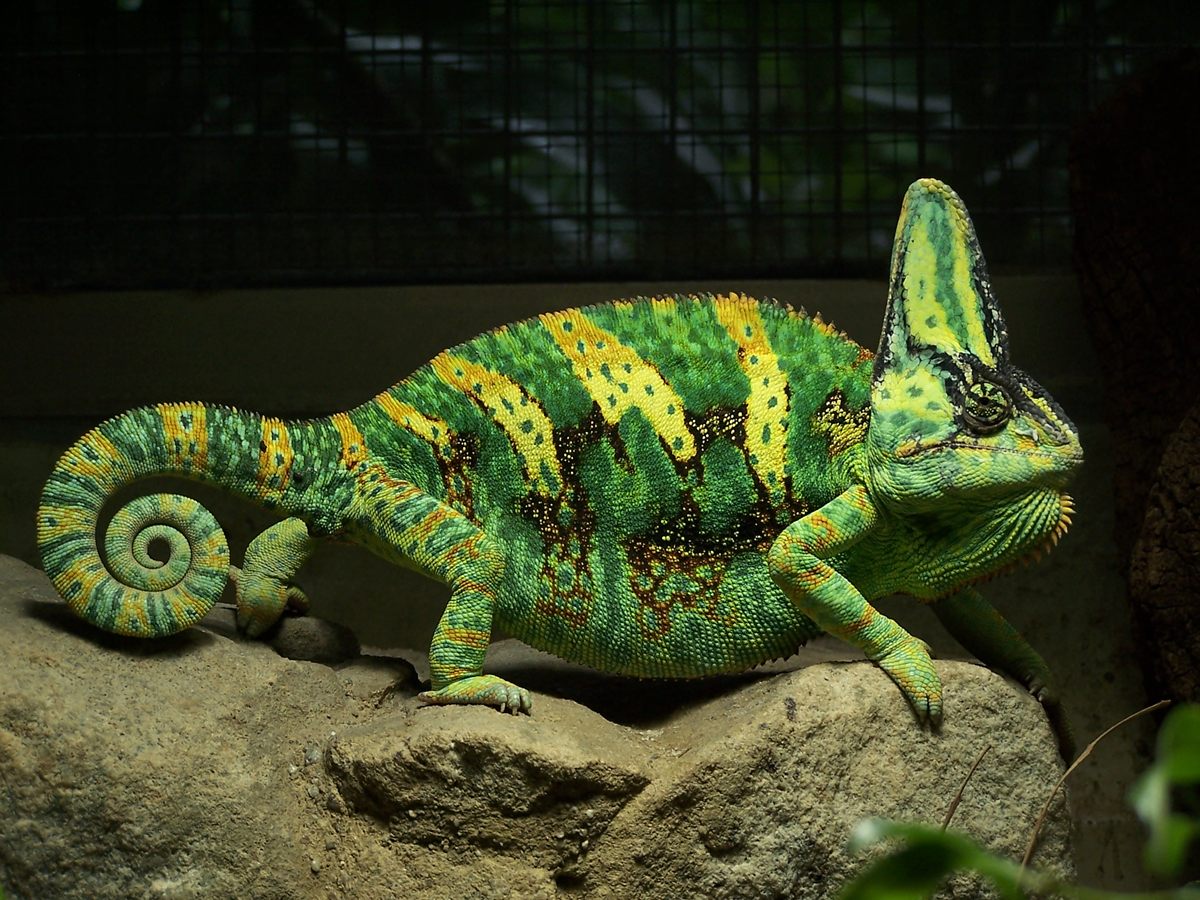
The veiled chameleon (Chamaeleo calyptratus) is a large chameleon from the mountains and coasts of Yemen and southwestern Saudi Arabia, named for the tall casque on its head.
The veiled chameleon (Chamaeleo calyptratus) is a large chameleon from the mountains and coasts of Yemen and southwestern Saudi Arabia, named for the tall casque on its head. It is widely bred in captivity and has established invasive populations in Florida and Hawaii.
🧬 Field Guide Specimen: Open Veiled Chameleon in the CRV Science Field Guide to log the specimen, see its place among the Reptilia lineages in the Cladogram Explorer, and test your recall in the Red List conservation game.
The Ballistic Tongue: How Does It Capture Prey?
The tongue can be shot out to more than the length of the body in a few hundredths of a second. It is launched by the release of elastic energy stored in tissues around a tongue bone, a mechanism that is faster than muscle alone could deliver. A sticky, suction-like tip grips the prey.
Eyes, Feet and Color
Each eye can move independently, so the animal can look in two directions and then focus both on a target. Opposable toe bundles grip branches. Color change in chameleons is used mainly for social signals and temperature regulation rather than camouflage.
A Chameleon in an Arid Land
The veiled chameleon collects dew and rain by licking droplets from leaves, and has a tolerance of dry, hot habitats unusual for the group.
Veiled Chameleon at a Glance
| Property | Value |
|---|---|
| Scientific name | Chamaeleo calyptratus |
| Kingdom | Animalia |
| Phylum | Chordata |
| Class | Reptilia |
| Order | Squamata |
| Clade | Iguania |
| Field Guide group | Reptilia (Reptiles) |
| Diagnostic feature (Field Guide) | Zygodactylous pincers feet, independently mobile stereoscopic eyes, ballistic projectile tongue. |
| IUCN Red List status | Least Concern (LC), assessed 2012 |
| Range | Yemen and southwestern Saudi Arabia |
| Order | Squamata |
See Also
- Natural selection — adaptation of feeding mechanics
- Biodiversity — invasive reptiles