Arbuscular Mycorrhizal Soil Fungus
Rhizophagus irregularis is a soil fungus that forms arbuscular mycorrhizas, a partnership with the roots of most land plants that dates back more than 400 million years. It is the best-studied member of the Glomeromycota.
Rhizophagus irregularis is a soil fungus that forms arbuscular mycorrhizas, a partnership with the roots of most land plants that dates back more than 400 million years. It is the best-studied member of the Glomeromycota.
🧬 Field Guide Specimen: Open Arbuscular Mycorrhizal Soil Fungus in the CRV Science Field Guide to log the specimen, see its place among the Opisthokonta lineages in the Cladogram Explorer, and test your recall in the Red List conservation game.
A Trade in Phosphorus and Fat
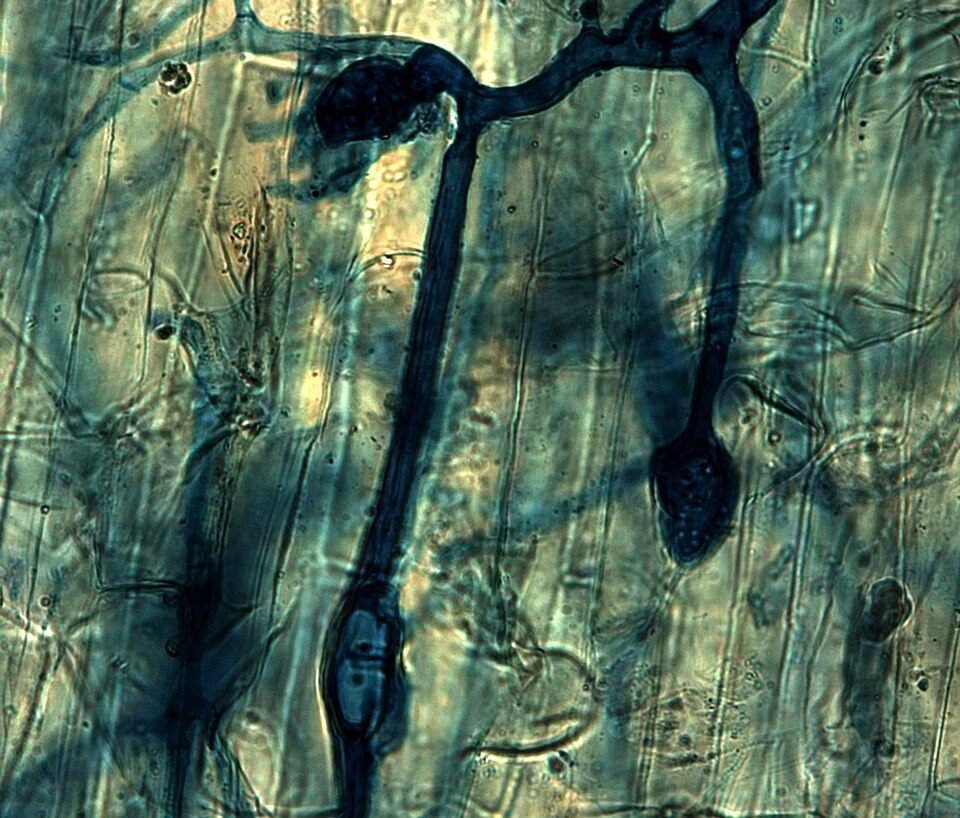
Fungal hyphae extend far beyond the root, scavenging phosphate and other nutrients, and deliver them to the plant inside root cells in branching structures called arbuscules. In return, the plant gives sugars and fats. The fungus cannot make certain fatty acids and depends on its host for them.
Ancient Alliance
Fossils in the 407-million-year-old Rhynie chert show arbuscule-like structures in early land plants, and the partnership is thought to have helped plants colonize land. About 70 to 80 percent of plant species still form such associations.
Networks and Agriculture
Hyphae can link multiple plants into a shared network. Mycorrhizal fungi improve plant growth in poor soils and are used as inoculants, though tillage and heavy fertilizer reduce them. The genome of this fungus was published in 2013.
Arbuscular Mycorrhizal Soil Fungus at a Glance
| Property | Value |
|---|---|
| Scientific name | Rhizophagus irregularis |
| Kingdom | Fungi |
| Phylum | Glomeromycota |
| Class | Glomeromycetes |
| Order | Glomerales |
| Family | Glomeraceae |
| Field Guide group | Opisthokonta: Fungi (True Fungi & Lichens) |
| Diagnostic feature (Field Guide) | Microscopic hyphae without cross-walls forming tree-like branched exchange structures and lipid-storing vesicles inside living plant root cells. |
| Group | Glomeromycota |
| Partner plants | About 70 to 80% of land plants |