Atlantic Hagfish
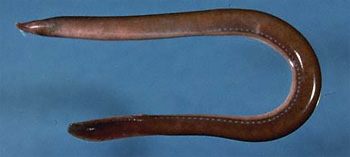
The Atlantic hagfish (Myxine glutinosa) is an eel-like, jawless marine animal that lives on muddy seafloors of the North Atlantic.
The Atlantic hagfish (Myxine glutinosa) is an eel-like, jawless marine animal that lives on muddy seafloors of the North Atlantic. When threatened it releases enormous amounts of slime, and it is one of the few living members of the oldest lineages of vertebrates.
🧬 Field Guide Specimen: Open Hagfish in the CRV Science Field Guide to log the specimen, see its place among the Vertebrates lineages in the Cladogram Explorer, and test your recall in the Red List conservation game.
Instant Slime: How Does It Form?
Glands along the body release a tiny amount of material that mixes with seawater in a fraction of a second and swells into a thick, fibrous slime. Protein threads, each many times thinner than a hair and tightly coiled in gland cells, uncoil and form the network. The slime can choke the gills of attacking fish.
Jawless: Where Do Hagfish Fit?
Hagfish have a skull but lack jaws and true vertebrae. Genetic evidence groups hagfish and lampreys together as cyclostomes, a sister group to the jawed vertebrates. They have degenerate eyes, four hearts and a body that can tie itself into a knot to get leverage or scrape off slime.
Scavengers of the Deep
Hagfish burrow into carcasses and even absorb nutrients through their skin. They are important recyclers on the deep sea floor, including whale falls, and are fished for leather and food in some countries.
Atlantic Hagfish at a Glance
| Property | Value |
|---|---|
| Scientific name | Myxine glutinosa |
| Kingdom | Animalia |
| Phylum | Chordata |
| Class | Myxini |
| Field Guide group | Marine and Freshwater Fish |
| Diagnostic feature (Field Guide) | A craniate lacking true vertebrae; notable for its defensive slime production and accessory hearts. |
| IUCN Red List status | Least Concern (LC) |
| Class | Myxini |
| Jaws | None |