Atlas Moth
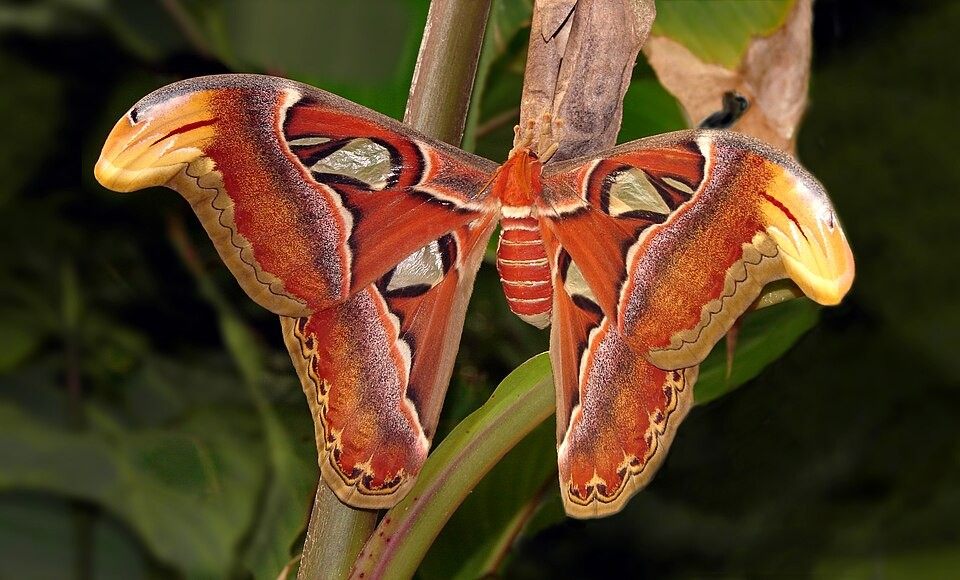
The Atlas moth (Attacus atlas) is one of the largest moths in the world, with a wing area of several hundred square centimeters. It lives in the tropical forests of Southeast Asia and is named for its vast wings.
The Atlas moth (Attacus atlas) is one of the largest moths in the world, with a wing area of several hundred square centimeters. It lives in the tropical forests of Southeast Asia and is named for its vast wings.
🧬 Field Guide Specimen: Open Atlas Moth in the CRV Science Field Guide to log the specimen, see its place among the Ecdysozoa lineages in the Cladogram Explorer, and test your recall in the Red List conservation game.
No Mouth and a Short Life
Adult Atlas moths do not feed. They live for only about one to two weeks, relying on fat stored by the huge caterpillar. The female releases pheromones that males detect with feathery antennae from far away.
Snake-Head Wingtips
The tip of each forewing resembles the head of a snake, complete with an eye-like patch, an example of mimicry that may scare off predators. In some places, the moth is called the snake's head moth.
Silk and Culture
The large cocoons produce a coarse silk called fagara silk. In Taiwan, empty cocoons are used as purses.
Atlas Moth at a Glance
| Property | Value |
|---|---|
| Scientific name | Attacus atlas |
| Kingdom | Animalia |
| Phylum | Arthropoda |
| Class | Insecta |
| Order | Lepidoptera |
| Family | Saturniidae |
| Field Guide group | Ecdysozoa: Hexapoda (Insects) |
| Diagnostic feature (Field Guide) | Giant triangular forewings with wingtip projections mimicking a cobra snake head, translucent fenestrae windows, vestigial mouthparts. |
| Family | Saturniidae |
| Adult lifespan | About one to two weeks |
See Also
- Queen Alexandra's Birdwing — the largest butterfly
- Natural selection — mimicry