Queen Alexandra's Birdwing
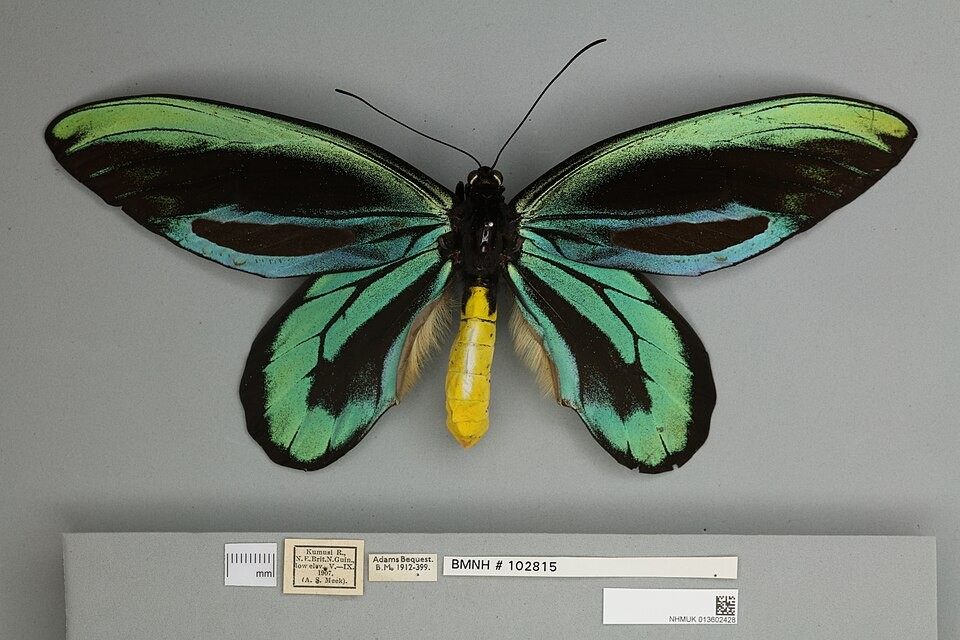
Queen Alexandra's birdwing (Ornithoptera alexandrae) is the largest butterfly in the world, with a wingspan of up to about 25 to 28 centimeters. It lives only in a small area of rainforest in Papua New Guinea and is listed as Endangered.
Queen Alexandra's birdwing (Ornithoptera alexandrae) is the largest butterfly in the world, with a wingspan of up to about 25 to 28 centimeters. It lives only in a small area of rainforest in Papua New Guinea and is listed as Endangered.
🧬 Field Guide Specimen: Open Queen Alexandra's Birdwing in the CRV Science Field Guide to log the specimen, see its place among the Ecdysozoa lineages in the Cladogram Explorer, and test your recall in the Red List conservation game.
A Giant Butterfly: Size and Sexes
The female is bigger and brown with cream markings, while the male is smaller and has iridescent blue-green and gold wings. The caterpillars feed on a poisonous pipevine (Aristolochia), whose toxins make the adults unpalatable.
A Tiny Home Range
The butterfly is found in the coastal forests of the Oro Province. The eruption of Mount Lamington in 1951 destroyed much of its forest, and clearing for oil palm plantations has further reduced its habitat.
Protected by Law
The species was named after Queen Alexandra in 1907 and is listed in CITES Appendix I, which prohibits commercial trade. Villagers raise related butterflies in ranching schemes.
Queen Alexandra's Birdwing at a Glance
| Property | Value |
|---|---|
| Scientific name | Ornithoptera alexandrae |
| Kingdom | Animalia |
| Phylum | Arthropoda |
| Class | Insecta |
| Order | Lepidoptera |
| Family | Papilionidae |
| Field Guide group | Ecdysozoa: Hexapoda (Insects) |
| Diagnostic feature (Field Guide) | Largest species of its order, with a 31 cm wingspan; wings covered in microscopic scales, iridescent green-gold males and velvet-brown females, coiled feeding proboscis. |
| IUCN Red List status | Endangered (EN), assessed 2018 |
| Wingspan | Up to about 25 to 28 centimeters |
See Also
- Monarch Butterfly — another toxic butterfly
- Deforestation — habitat loss