Basking Shark
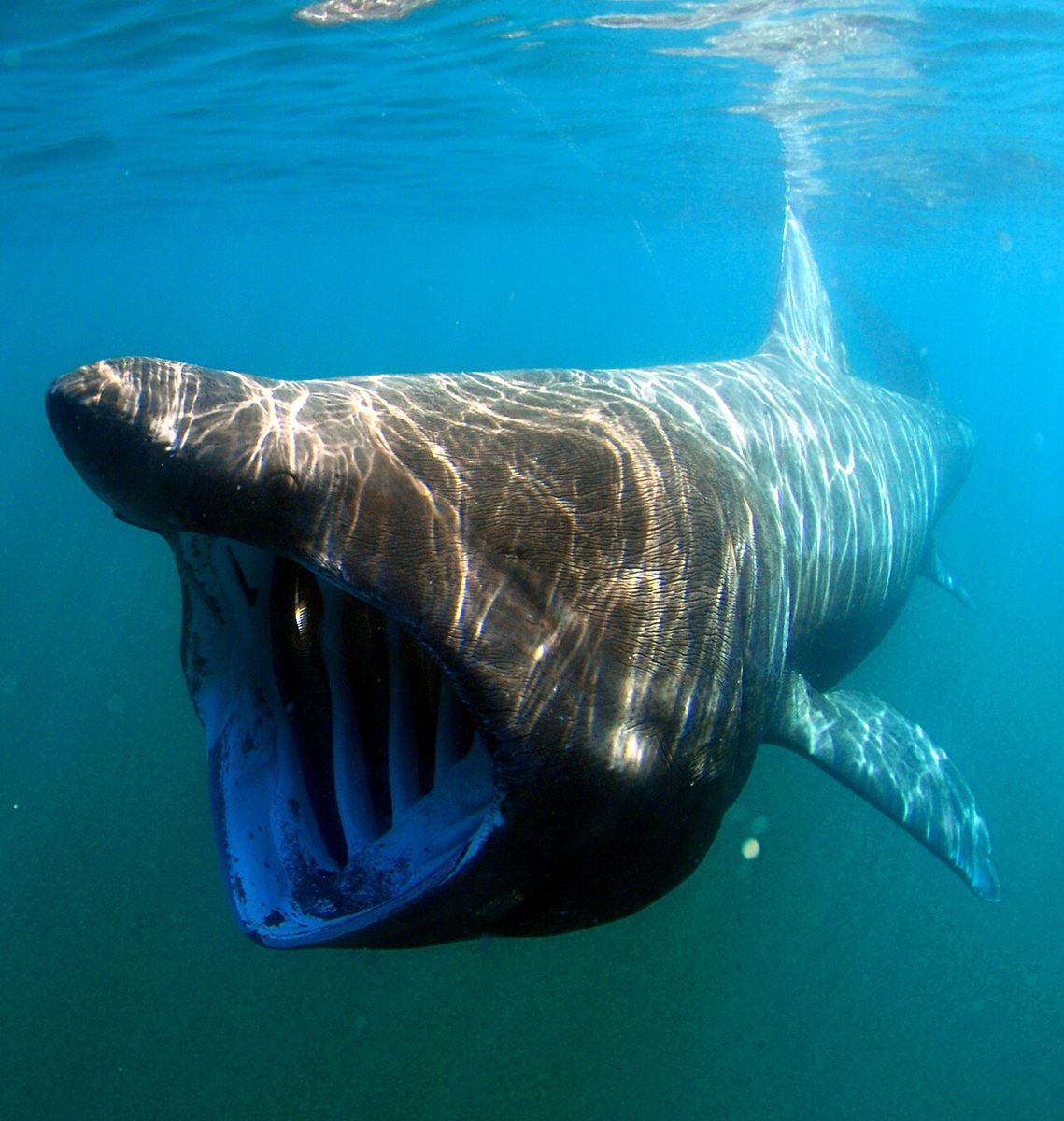
The basking shark (Cetorhinus maximus) is the second-largest fish in the world, reaching about 10 meters. It swims slowly at the surface with its enormous mouth open, filtering plankton. It is listed as Endangered.
The basking shark (Cetorhinus maximus) is the second-largest fish in the world, reaching about 10 meters. It swims slowly at the surface with its enormous mouth open, filtering plankton. It is listed as Endangered.
🧬 Field Guide Specimen: Open Basking Shark in the CRV Science Field Guide to log the specimen, see its place among the Vertebrates lineages in the Cladogram Explorer, and test your recall in the Red List conservation game.
Basking Shark at a Glance
| Property | Value |
|---|---|
| Scientific name | Cetorhinus maximus |
| Kingdom | Animalia |
| Phylum | Chordata |
| Class | Chondrichthyes |
| Order | Lamniformes |
| Family | Cetorhinidae |
| Field Guide group | Marine and Freshwater Fish |
| Diagnostic feature (Field Guide) | Second-largest living marine vertebrate, cruising near the surface with a cavernous, hoop-like open mouth and bristle-fringed gill rakers that encircle the head to strain zooplankton from up to 2,000 tons of water per hour. |
| IUCN Red List status | Endangered (EN), assessed 2021 |
| Feeding | Filter feeding on zooplankton |
Taxonomy, Phylogenetics, and Evolutionary History
Cetorhinus maximus (described by Johan Ernst Gunnerus in 1765 as Squalus maximus) is the sole extant species of the family Cetorhinidae within the order Lamniformes (mackerel sharks). It is the second-largest extant fish after the orectolobiform Whale Shark (Rhincodon typus) and one of three planktivorous shark species alongside the whale shark and megamouth shark (Megachasma pelagios). Despite its suspension-feeding lifestyle, mitochondrial and nuclear phylogenies confirm that C. maximus is nested near apex predatory lamnids, including the great white shark (Carcharodon carcharias), shortfin mako (Isurus oxyrinchus), and porbeagle (Lamna nasus).
Fossilized vertebrae, gill rakers, and teeth assigned to Keasius and early Cetorhinus from the Eocene through the Pliocene epochs indicate that cetorhinid filter-feeding diverged from macrophagous lamniform ancestors 35 to 45 million years ago, coinciding with high-latitude copepod blooms. Thermal studies show that C. maximus retains the ancestral lamnid capacity for regional endothermy—elevating the temperature of its red swimming muscles and viscera 1.0 to 5.5 °C above ambient seawater via vascular countercurrent heat exchangers (retia mirabilia).
Comparative Anatomy, Physiology, and Biomechanics
Cross-Flow Ram Filtration and Annual Gill-Raker Shedding
Unlike the Whale Shark and Giant Manta Ray, which can suction-pump water, Cetorhinus maximus is an obligate ram filter feeder relying on forward swimming at 0.85 to 1.1 m/s (about 2 knots) with its jaw distended up to 1 meter wide. Water enters the mouth and exits through five pairs of gill slits encircling the head, filtering 1,500 to 2,000 cubic meters of seawater per hour.
Each of the five cartilaginous gill arches bears 1,000 to 1,300 bristle-like gill rakers (10 to 15 cm long, spaced 0.7 to 0.8 mm apart) composed of osteodentine dermal denticles that erect into the flow when the mouth opens. Rather than acting as a dead-end sieve, the curved arches generate cross-flow vortices directing calanoid copepods (Calanus finmarchicus, C. helgolandicus), decapod larvae, and fish eggs toward the pharynx while water exits the gills. Every 30 to 60 seconds, the shark closes its mouth to swallow the bolus. In late autumn, C. maximus sheds its worn gill rakers and regenerates a new set over 4 to 5 months.
| Anatomical System | Structural Specialization | Biomechanical Function | Quantitative Parameter |
|---|---|---|---|
| Branchial filtration | 5 pairs of encircling gill slits; ~1,200 rakers/arch | Obligate ram cross-flow filtration of copepods | Filters 1,500–2,000 m3/h at 0.85–1.1 m/s |
| Hepatic buoyancy | Bilobed liver rich in squalene (C30H50, 0.858 g/cm3) | Static hydrostat lift from 0 to 1,260 m | 18–25% of body mass (up to 1,000 kg) |
| Jaw dentition | 6–9 rows of minute, hooked conical teeth (~1,500) | Non-functional in feeding; courtship grasping | Teeth measure 4–6 mm in a 9-m adult |
| Endothermy | Subcutaneous red muscle and retia mirabilia | Maintains elevated myotomal and brain warmth | 1.0–5.5 °C above ambient seawater |
Squalene-Mediated Buoyancy and Mesopelagic Diving
Lacking a gas-filled swim bladder, Cetorhinus maximus achieves near-neutral buoyancy through a bilobed liver accounting for 18% to 25% of total body mass. The liver stores low-density lipids dominated by the triterpene hydrocarbon squalene (C30H50, specific gravity 0.858 g/cm3). Because squalene is nearly incompressible, buoyancy remains stable across hydrostatic pressure changes from the surface to depths exceeding 1,200 meters.
Trophic Ecology, Reproductive Life History, and Conservation
Satellite archival tags deployed in the Atlantic and Pacific demonstrate that C. maximus does not hibernate in winter, but undertakes trans-equatorial migrations exceeding 9,000 kilometers while spending months at mesopelagic depths of 200 to 1,000 meters feeding on overwintering Calanus copepods. In spring and summer, basking sharks return to coastal shelf-break fronts (8 to 16 °C). Using electroreceptive ampullae of Lorenzini and olfaction responsive to dimethyl sulfide (DMS), sharks track plankton patches exceeding 1.0 to 1.5 g/m3, below which ram feeding becomes energetically unprofitable.
Like other lamniforms, Cetorhinus maximus is aplacental viviparous and practices intrauterine oophagy, wherein embryos within the functional right uterus consume unfertilized nutritive ova. Female maturity is delayed until 16 to 20 years, and gestation lasts 2.5 to 3.5 years. Depleted by historical harpoon fisheries targeting its squalene-rich liver oil and fins, the basking shark is classified by the IUCN Red List as Endangered (EN) and protected under CITES Appendix II.
Frequently Asked Questions
Do basking sharks hibernate on the ocean floor during winter when they shed their gill rakers?
No. Satellite tracking has proven that basking sharks do not hibernate. Although they shed and regrow their keratinous gill rakers over a four- to five-month period in late autumn and winter, tagged sharks remain active throughout the winter, migrating thousands of kilometers across ocean basins into subtropical and tropical waters while diving repeatedly between 200 and 1,000 meters depth to forage on deep-water zooplankton layers.
Why are basking sharks called "basking" sharks if they are cold-water animals?
The common name comes from their habit of swimming slowly at the sea surface on calm, sunny spring and summer days with their triangular dorsal fin, snout tip, and upper caudal fin lobe protruding above the water, making them appear to be sunbathing. In reality, they are ram-filtering dense surface patches of copepods that congregate along thermal fronts where phytoplankton blooms occur.
How does the basking shark's filter-feeding method differ from that of a whale shark?
The basking shark (Cetorhinus maximus) is an obligate ram filter feeder: it cannot suck water into its mouth and must swim forward continuously at about 2 knots to push water across its bristle-like gill rakers. In contrast, the Whale Shark (Rhincodon typus) has spongy filter pads across its internal gill slits and can hang vertically stationary in the water column while gulping and suction-pumping plankton.
References
- Sims, D. W., Southall, E. J., Richardson, A. J., Reid, P. C., & Metcalfe, J. D. (2003). Seasonal movements and behaviour of basking sharks from archival tagging: no 'hibernation' behaviour and new insights into shelf-edge foraging. Marine Ecology Progress Series, 248, 187–196. https://doi.org/10.3354/meps248187
- Skomal, G. B., Zeeman, S. I., Chisholm, J. H., Summers, E. L., Walsh, H. J., McMahon, K. W., & Thorrold, S. R. (2009). Transequatorial migrations by basking sharks in the western Atlantic Ocean. Current Biology, 19(12), 1019–1022. https://doi.org/10.1016/j.cub.2009.04.019
- Sims, D. W. (1999). Threshold foraging behaviour of basking sharks on zooplankton: life on an energetic knife-edge? Proceedings of the Royal Society B: Biological Sciences, 266(1427), 1437–1443. https://doi.org/10.1098/rspb.1999.0798
- Dolton, H. R., Gell, F. R., Hall, J., Hall, G., Hawkes, L. A., Witt, M. J., & Payne, N. L. (2023). Regionally endothermic traits in planktivorous basking sharks Cetorhinus maximus. Endangered Species Research, 51, 227–232. https://doi.org/10.3354/esr01257