Giant Manta Ray
The giant manta ray (Mobula birostris) is the largest ray, with a wingspan that can approach 7 meters. It glides through tropical and subtropical seas feeding on plankton and is listed as Endangered.
The giant manta ray (Mobula birostris), also known as the oceanic manta ray, is the largest ray, with a wingspan that can approach 7 meters. It glides through tropical and subtropical seas feeding on plankton and is listed as Endangered. Verified specimens reach pectoral disc widths ("wingspans") of 6.7 to 8.8 meters and body masses of 1,500 to 2,400 kilograms, making Mobula birostris the largest extant batoid elasmobranch (outweighing all other rays and benthic skates such as the Little Skate, Leucoraja erinacea) and one of the ocean's four great planktivorous chondrichthyans alongside the Whale Shark (Rhincodon typus), basking shark (Cetorhinus maximus), and megamouth shark (Megachasma pelagios). Equipped with unfurling cephalic fins, non-clogging ricochet cross-flow gill plates, a counter-current cranial rete mirabile that warms its enlarged telencephalon and cerebellum during deep dives below 1,000 meters, and an exceptionally low K-selected fecundity of a single pup every 2 to 5 years, this pelagic filter feeder faces severe global depletion from targeted gill-plate fisheries and pelagic bycatch.
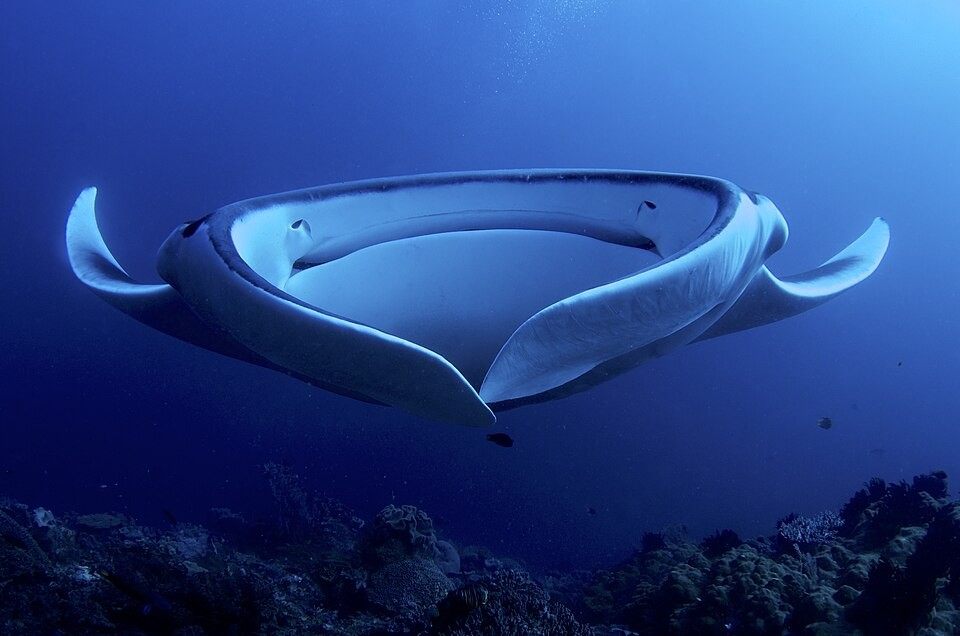
🧬 Field Guide Specimen: Open Giant Manta Ray in the CRV Science Field Guide to log the specimen, see its place among the Vertebrates lineages in the Cladogram Explorer, and test your recall in the Red List conservation game.
Giant Manta Ray at a Glance
| Property | Value |
|---|---|
| Scientific name | Mobula birostris |
| Kingdom | Animalia |
| Phylum | Chordata |
| Class | Chondrichthyes |
| Order | Myliobatiformes |
| Family | Mobulidae |
| Field Guide group | Marine and Freshwater Fish |
| Diagnostic feature (Field Guide) | Broad diamond-shaped pectoral disc spanning up to 7 meters, forward-facing cephalic fins directing plankton into terminal mouth. |
| IUCN Red List status | Endangered (EN), assessed 2022 |
| Wingspan | Up to about 7 meters |
Taxonomy, Phylogenetics, and the Dissolution of Genus *Manta*
Placement in Family Mobulidae, Species Split (2009), and Synonymization into Mobula (2017)
Described by the German physician and naturalist Johann Julius Walbaum in 1792 as Raja birostris ("two-beaked ray," referring to its pair of projecting cephalic lobes), the giant manta ray was assigned for nearly two centuries to the genus Manta Bancroft, 1829, as a supposedly monotypic, cosmopolitan species. In 2009, morphological, ecological, and acoustic tracking comparisons by Andrea D. Marshall, Leonard J. V. Compagno, and Michael B. Bennett demonstrated that Manta actually comprised at least two distinct sympatric species:
- The Giant or Oceanic Manta Ray (Mobula birostris): Reaches 7+ meters disc width, possesses a strictly terminal (forward-facing) mouth, displays sharply demarcated T-shaped white shoulder patches and a dark ventral margin, retains a calcified vestigial caudal spine encased in a bulbous knob at the base of the dorsal fin, and undertakes trans-oceanic pelagic migrations.
- The Reef Manta Ray (Mobula alfredi): Reaches 3.0 to 5.0 meters disc width, possesses a subterminal mouth, displays Y-shaped diffuse shoulder patches with dark spots between the five ventral gill slits, lacks a calcified caudal spine remnant, and exhibits higher residency around coastal coral reefs and atolls (with a third putative Atlantic species, the Caribbean manta Mobula cf. birostris, currently under genomic characterization).
In 2017, high-throughput mitochondrial genomes and ~1,200 nuclear exon loci sequenced across all living devil rays and manta rays by William T. White,Shannon Corrigan, Gavin J. P. Naylor, and colleagues revealed that birostris and alfredi nest deeply inside the devil ray genus Mobula Rafinesque, 1810 (sister to the spinetail devil ray, Mobula mobular). To eliminate paraphyly while preserving nomenclatural stability, Manta was formally synonymized into Mobula within the family Mobulidae (order Myliobatiformes), which diverged from benthic durophagous eagle rays (Myliobatidae) and cownose rays (Rhinopteridae) roughly 25 to 30 million years ago during the Oligocene transition to pelagic planktivory.
Hydrodynamics of Oscillatory Flight, Ricochet Filtration, and Neurobiology
Mobuliform Pectoral Swimming and Non-Clogging Cross-Flow Gill Plates
Whereas skates and electric rays swim by passing multiple sinusoidal waves along the margins of their pectoral fins (rajiform locomotion), Mobula birostris propels itself via mobuliform (oscillatory) locomotion—flapping its high-aspect-ratio, triangular pectoral wings vertically like a bird in underwater flight. Supported by radially arranged, cross-braced cartilaginous radialia calcified with hexagonal tesserae, the pectoral wings generate lift and forward thrust on both the downstroke and the upstroke, allowing the ray to cruise hydrodynamically despite lacking a swim bladder (compensating for negative buoyancy through dynamic lift and a massive, squalene-rich liver accounting for 15% to 20% of body mass).
During foraging, the ray unrolls its two muscular, pre-oral cephalic fins (which are tightly furled into streamlined spiral horns during fast transit swimming) to form a funnel directing zooplankton-rich seawater into its wide terminal mouth. Note that while the lower jaw retains a narrow band of 18 to 20 rows of tiny, non-functional vestigial teeth (used only by males to grip the female's pectoral wing during copulation), prey capture is accomplished entirely by the branchial filter pads (gill plates) spanning the five internal gill arches. In 2016 and 2018, Misty Paig-Tran, Thomas Divi, and Adam P. Summers discovered through microfluidic modeling and 3D-printed flow-tank experiments that Mobula birostris does not use dead-end sieve filtration (which would rapidly clog with gelatinous zooplankton and mucus), nor simple hydrosol cross-flow filtration, but a unique fluid-dynamic mechanism termed ricochet separation:
- Vortex-Driven Particle Ricochet: Each cartilaginous gill plate consists of parallel rows of leaf-like filter lobes tilted at an oblique angle to the incoming buccal water stream. As water flows across the arrayed lobes and exits downward through the inter-lobular pores toward the gill filaments and ventral gill slits, stationary recirculating vortices form inside each pore cavity.
- Pore-Size Independence and Self-Cleaning: Incoming copepods, euphausiids (krill), mysid shrimp, and fish eggs—even particles smaller than the physical gap between lobes—strike the leading edges of the lobes or the shear layer of the trapped vortices and ricochet (bounce) upward back into the main axial current, concentrating clean, water-depleted plankton along the roof of the pharynx toward the esophagus while keeping the filter surface 100% clog-free at high swimming speeds.
| Anatomical / Physiological System | Structural or Physical Mechanism | Functional / Ecological Role |
|---|---|---|
| High-aspect-ratio pectoral disc (7 m) | Calcified tessellated cartilage radials flapping in oscillatory (mobuliform) flight | Generates low-drag lift and thrust for trans-oceanic migrations and barrel-roll feeding |
| Pre-oral cephalic lobes | Anterior extensions of pectoral fins rolled into horns or unfurled as a funnel | Channels zooplankton into terminal mouth while minimizing drag when furled |
| Branchial filter plates (gill rakers) | Arrayed oblique cartilaginous lobes generating intrapore shear vortices | Ricochet cross-flow filtration concentrates plankton (> 200 µm) without clogging |
| Hypertrophied brain & rete mirabile | Encephalization quotient 5–10× typical sharks; counter-current arterial heat exchanger | Sustains cognitive processing and warms brain/eyes during dives to 4 °C at > 1,000 m |
| Histotrophic matrotrophy (trophonemata) | Oviductal villi secreting lipid- and protein-rich "uterine milk" (8%–13% lipid) | Nourishes single embryo from birth weight of ~0.1 kg to 1.8–2.0 m wingspan (50–70 kg) |
Cranial Endothermy (Rete Mirabile) and High Encephalization
Neuroanatomical studies by R. Glenn Northcutt and Csilla Ari demonstrated that Mobula birostris possesses the largest absolute brain mass (up to 120 to 200 grams) and highest encephalization quotient among all 30,000+ species of teleost and chondrichthyan fishes, driven primarily by extreme hypertrophy and foliation of the telencephalon (forebrain pallium, associated with spatial mapping and social cognition) and the corpus cerebelli (coordinating three-dimensional pectoral hydrofoil control). In captive behavioral trials by Csilla Ari and Dominic P. D'Agostino (2016), giant manta rays exposed to submerged mirrors exhibited repetitive self-directed contingency checking and unusual body postures (such as uncoiling cephalic fins and blowing bubbles exclusively in front of the mirror), providing preliminary evidence of visual self-recognition capacity.
Directly surrounding the braincase and optic capsules, Mobula birostris possesses a dense, counter-current vascular network called the cranial rete mirabile (discovered by Bruno Block and Alexander). Warm venous blood draining from the active pectoral swimming muscles transfers metabolic heat across thin vessel walls to cool arterial blood flowing from the gills to the brain and retina. Satellite archival tagging by Simon R. Thorrold and Joshua D. Stewart revealed why this cranial heater evolved: although giant mantas bask in warm surface waters (25 to 30 °C), they regularly execute steep mesopelagic and bathypelagic dives to depths of 600 to 1,246 meters (where ambient temperatures plunge to 3.5 to 6.0 °C and dissolved O2 drops) to forage on deep scattering layers of myctophids and krill, using the cranial rete to keep their brain and visual processing centers warm and responsive while hunting in the cold deep ocean.
Reproductive Life History, Gill-Plate Trade, and Conservation
Lipid-Rich Histotrophy (Uterine Milk) and Anthropogenic Threats
Mobula birostris exhibits one of the slowest, most extreme K-selected life histories in the marine realm. Sexual maturity is delayed until 8 to 12 years of age (~4.0 to 4.5 meters disc width in males; ~4.5 to 5.0 meters in females), and maximum lifespan exceeds 40 to 45 years. Like all myliobatiform rays, Mobula birostris reproduces via aplacental viviparity with lipid histotrophy (matrotrophy). Following a gestation period of 12 to 13 months, the female gives birth to a single massive live pup (very rarely twins) measuring 1.8 to 2.0 meters across the wings and weighing 45 to 70 kilograms—wrapped inside the uterus with its pectoral wings folded dorsally over its back like a burrito. During the first phase of gestation, the embryo absorbs its yolk sac; for the remaining 8 to 9 months, the lining of the maternal uterus develops thousands of vascularized glandular villi called trophonemata, which secrete a creamy "uterine milk" (histotrophe) containing 8% to 13% lipid and high protein directly into the embryo's mouth and spiracles, increasing embryonic dry mass by 3,000% to 4,900% before birth. Because rebuilding maternal lipid reserves requires 2 to 5 years between pregnancies, a female Mobula birostris may produce only 4 to 15 offspring in her entire lifetime, yielding an intrinsic population growth rate (rmax of 0.01 to 0.02 yr−1) lower than that of baleen whales or elephants.
Consequently, when commercial fisheries target manta aggregations at predictable seamounts, upwelling fronts, and reef cleaning stations (where mantas hover while cleaner wrasses, Labroides dimidiatus, and butterflyfishes remove parasitic copepods), populations collapse rapidly and cannot rebound. Beginning in the 1990s and 2000s, a lucrative international trade emerged in dried mobulid gill plates (Peng Yu Sai), marketed in southern China and Southeast Asia as a purported health tonic. Combined with targeted artisanal harpoon and gillnet fisheries in Indonesia, Sri Lanka, India, Peru, and Mexico, as well as incidental bycatch in industrial tuna purse-seine and pelagic longline fisheries, global abundance declined by 50% to 80% over three generations, prompting the IUCN Red List to uplist Mobula birostris from Vulnerable to Endangered (EN) in 2020 (reaffirmed in 2022) and triggering listings on CITES Appendix II and the Convention on Migratory Species (CMS Appendices I and II).
Frequently Asked Questions
How does the giant manta ray filter tiny plankton at high speed without clogging its gills?
Unlike whale sharks or baleen whales, which use cross-flow sieving or dead-end bristles, the giant manta ray uses a unique fluid-dynamic process called ricochet filtration. Its five pairs of branchial filter plates are lined with parallel rows of angled, wing-like lobes. As water streams through the mouth and turns downward through the gaps between these lobes, tiny stationary whirlpools (vortices) form inside each gap; incoming krill and copepods bounce (ricochet) off the angled lobes and vortex shear layers back into the center of the throat toward the esophagus, allowing water to exit cleanly through the gill slits while never clogging the filter.
Why do giant manta rays have such a large brain and a built-in brain heater?
Mobula birostris has the largest brain and highest brain-to-body ratio of any living fish, with an expanded forebrain (telencephalon) and cerebellum that support complex social behavior at reef cleaning stations, long-distance navigation across ocean basins, and potential mirror self-recognition. Surrounding the brain and eyes is a counter-current blood vessel network called the cranial rete mirabile, which transfers heat from the active pectoral wing muscles to the head so the manta's eyes and brain remain warm and fast-reacting when it dives deeper than 1,000 meters into 4 °C abyssal water to feed on deep plankton layers.
Why are giant manta ray populations so slow to recover from fishing?
Female giant manta rays do not reach sexual maturity until ~10 years of age and have one of the lowest reproductive rates of any vertebrate: after a 12- to 13-month pregnancy—during which the mother nourishes a single embryo inside the uterus with lipid-rich "uterine milk" (histotrophe) secreted by uterine villi—she gives birth to just one giant pup (already nearly 2 meters wide) and then rests for 2 to 5 years before breeding again. Because a female produces only 4 to 15 pups in her entire life, targeted fishing for dried gill plates rapidly depletes local populations.
References
- Divi, R. V., Strother, J. A., & Paig-Tran, E. W. M. (2018). Manta rays feed using ricochet separation, a novel nonclogging filtration mechanism. Science Advances, 4(9), eaat9533. https://doi.org/10.1126/sciadv.aat9533
- White, W. T., Corrigan, S., Yang, L., Henderson, A. C., Bazinet, A. L., Swofford, D. L., & Naylor, G. J. P. (2017). Phylogeny of the manta and devilrays (Chondrichthyes: Mobulidae), with an updated taxonomic arrangement for the family. Zoological Journal of the Linnean Society, 182(1), 50–75. https://doi.org/10.1093/zoolinnean/zlx018
- Marshall, A. D., Compagno, L. J. V., & Bennett, M. B. (2009). Redescription of the genus Manta with resurrection of Manta alfredi (Krefft, 1868) (Chondrichthyes; Myliobatoidei; Mobulidae). Zootaxa, 2301(1), 1–28. https://doi.org/10.11646/zootaxa.2301.1.1
- Thorrold, S. R., Afonso, P., Fontes, J., Braun, C. D., Santos, R. S., Skomal, G. B., & Berumen, M. L. (2014). Extreme diving behaviour in devil rays links surface waters and the deep ocean. Nature Communications, 5, 4274. https://doi.org/10.1038/ncomms5274