Spotted Eagle Ray
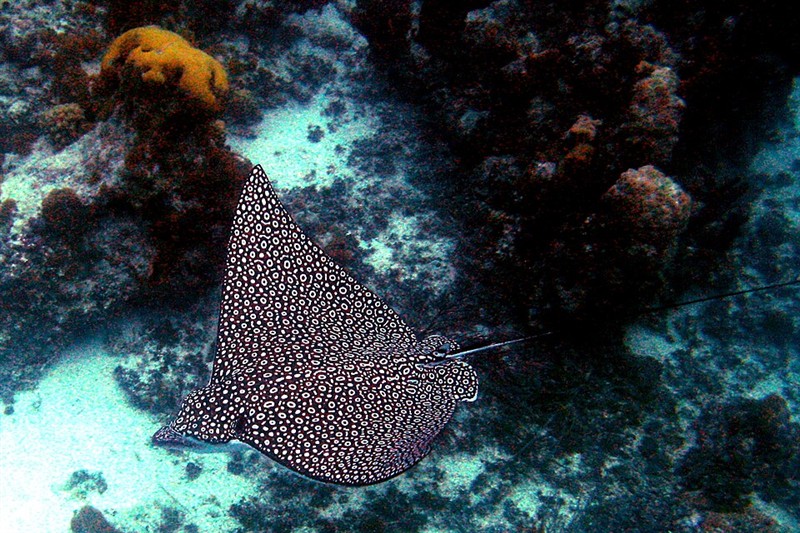
The spotted eagle ray (Aetobatus narinari) is a graceful, white-spotted ray that flaps its wing-like fins through tropical seas, sometimes leaping out of the water. It has a pointed snout and a long tail with venomous spines.
The spotted eagle ray (Aetobatus narinari) is a graceful, white-spotted ray that flaps its wing-like fins through tropical seas, sometimes leaping out of the water. It has a pointed snout and a long tail with venomous spines.
🧬 Field Guide Specimen: Open Spotted Eagle Ray in the CRV Science Field Guide to log the specimen, see its place among the Vertebrates lineages in the Cladogram Explorer, and test your recall in the Red List conservation game.
Spotted Eagle Ray at a Glance
| Property | Value |
|---|---|
| Scientific name | Aetobatus narinari |
| Kingdom | Animalia |
| Phylum | Chordata |
| Class | Chondrichthyes |
| Order | Myliobatiformes |
| Family | Aetobatidae |
| Field Guide group | Marine and Freshwater Fish |
| Diagnostic feature (Field Guide) | Pelagic circumtropical cartilaginous swimmer with a dark dorsal disc covered in white rings and spots, a duck-billed flattened snout used to excavate buried clams, flat pavement-like crushing tooth plates, and venomous barbed spines at the base of a whip-like tail. |
| IUCN Red List status | Endangered (EN), assessed 2021 |
| Order | Myliobatiformes |
| Diet | Shellfish |
Evolutionary Systematics & Comparative Anatomy
Aetobatus narinari is the type species of the genus Aetobatus within the family Aetobatidae (pelagic eagle rays), order Myliobatiformes, superorder Batoidea (skates and rays). Historically treated as a single circumtropical species within the broader family Myliobatidae, molecular phylogenetics using mitochondrial NADH2 and cytochrome b sequences alongside nuclear markers demonstrated that the Aetobatus narinari species complex comprises several distinct geographically structured lineages. Consequently, Indo-West Pacific populations have been elevated to the ocellated eagle ray (Aetobatus ocellatus) and the Pacific white-spotted eagle ray (Aetobatus laticeps in the eastern Pacific), restricting Aetobatus narinari sensu stricto to the warm-temperate and tropical Atlantic Ocean, including the Caribbean Sea and Gulf of Mexico. Within Myliobatiformes, Aetobatidae is closely allied to the cownose rays (Rhinopteridae) and devil and manta rays (Mobulidae, such as the Giant Manta Ray), while diverging from demersal batoids such as the Little Skate (order Rajiformes).
The body plan of A. narinari is specialized for pelagic cruising combined with benthic durophagy. Its pectoral fins are expanded into a wide, diamond-shaped rhomboidal disc whose width (up to 2.5 to 3.0 m in large adults, with body mass reaching 180 to 230 kg) is roughly twice its disc length. The dorsal skin lacks dermal denticles and displays a dark navy-blue to black ground color patterned with white or bluish-white spots and open ocelli, whereas the ventral surface is pure white—a classic countershading pattern that conceals the ray against both the sunlit sea surface and the dark seafloor. Anteriorly, the cranial rostral cartilages and modified anterior pectoral lobes project forward as a flattened, fleshy, duck-bill-like snout (rostral lobe) seated above a ventrally positioned mouth and five pairs of gill slits.
At the base of the elongated, whip-like tail—immediately posterior to the small dorsal fin and pelvic fins—sit 1 to 6 (typically 2 to 4) flattened, retroserrated caudal spines composed of vasodentine capped with enameloid. Each spine bears ventrolateral grooves housing holocrine venom-secreting glandular tissue encased within an integumentary sheath; when the spine punctures a predator's skin, the sheath tears open and releases heat-labile proteinaceous toxins that induce intense localized pain and tissue necrosis. Internally, the jaws are reinforced by multi-layered trabecular mineralization—internal struts of hydroxyapatite (Ca10(PO4)6(OH)2) that connect the upper and lower surfaces of the cartilaginous palatoquadrate and Meckel's cartilage—preventing jaw buckling under high compressive loads.
Physiology, Biomechanics & Sensory Biology
Unlike benthic stingrays (Dasyatidae) and skates (Rajidae), which propel themselves via undulatory waves passed along the outer margin of the pectoral disc (rajiform locomotion), Aetobatus narinari employs oscillatory mobuliform swimming. The radial cartilages inside the wing-like pectoral fins are stiffened by cross-braced calcification, allowing the ray to flap its fins dorsoventrally like bird wings. High-aspect-ratio wing geometry generates lift-based thrust on both the upstroke and downstroke, reducing drag during long-distance coastal migrations and providing the hydrodynamic power required for spectacular vertical leaps (breaching) up to 2 m above the sea surface. Breaching behaviors serve multiple biological functions, including dislodging ectoparasitic monogenean trematodes and copepods, evading pursuit by great hammerhead (Sphyrna mokarran) and tiger sharks (Galeocerdo cuvier), and signaling during courtship aggregations.
The feeding apparatus of A. narinari is one of the most extreme biomechanical crushing presses among vertebrates. In both the upper and lower jaws, the teeth are fused into a single median series of wide, flat, chevron-shaped dental plates arranged in a continuous pavement. As anterior tooth plates wear down from grinding abrasive calcium carbonate (CaCO3) shells, new plates migrate forward from the lingual dental lamina like a conveyor belt. The lower tooth plate projects anteriorly beyond the upper plate, acting as a wedge to scoop and position hard-shelled mollusks into the center of the jaws.
Hypertrophied adductor mandibulae muscles, combined with fused symphyseal jaw joints and trabecular cartilage struts, generate bite forces exceeding 800 to 1,200 N concentrated across the central crushing surface. Moreover, the osteodentine core of each tooth plate consists of vertically oriented vascular canals surrounded by woven collagen fibers, which arrest microcracks before they can fracture the plate.
To locate infaunal bivalves buried 10 to 30 cm beneath carbonate sand without visual cues, the ventral surface of the duck-billed snout and oral region is densely innervated with mechanoreceptive lateral line canals and electroreceptive ampullae of Lorenzini. These pores detect weak bioelectric fields and low-frequency hydrodynamic jets emitted by buried clams and whelks pumping water through their siphons. Once prey is pinpointed, the ray uses its muscular snout to plow into the sediment while jetting water from its mouth and gill slits (hydraulic jetting) to fluidize and blow away the overlying sand.
Trophic Ecology, Life History & Reproduction
Aetobatus narinari inhabits warm coastal waters, coral reef drop-offs, seagrass meadows, and estuarine lagoons from the surface down to 80 m depth across the western and eastern Atlantic. It is an active benthic predator whose diet consists of more than 90 percent shelled mollusks—specifically venerid, cardiid, and strombid bivalves and gastropods (such as queen conch Aliger gigas, surf clams, and ark clams)—supplemented by brachyuran crabs, hermit crabs, stomatopods, echinoderms, and burrowing polychaetes. After excavating a mollusk and crushing its shell between the pavement tooth plates, the ray uses cyclical oropharyngeal water currents and fleshy oral papillae to winnow and spit out every shard of broken CaCO3 shell before swallowing the soft visceral mass intact. Consequently, foraging groups of spotted eagle rays act as major bioturbators on tropical sand flats, turning over square meters of sediment daily and releasing benthic nutrients into the water column.
Mating takes place in open water following high-speed courtship chases in which one or several males pursue a receptive female, nipping at the trailing edges of her pectoral fins before grasping a pectoral margin to insert one of the paired pelvic claspers into the cloaca. Like other myliobatiform rays, A. narinari exhibits lipid-rich matrotrophic viviparity (histotrophy). Initially, the developing embryos absorb nutrients from their external yolk sacs inside the paired uteri, but once yolk reserves are exhausted, the maternal uterine lining forms vascularized villous projections called trophonemata. These secretory villi bathe the embryos—and even extend into their spiracles—in "uterine milk" (histotroph), an emulsion containing 10 to 20 percent lipid and protein that increases embryonic dry weight by more than 1,000 to 3,000 percent prior to birth.
After a gestation period of approximately 11 to 12 months, the female gives birth to a small litter of 1 to 4 live pups measuring 35 to 50 cm in disc width, with their caudal spines encased in flexible cartilaginous sheaths to protect the maternal birth canal. Females reach sexual maturity at 4 to 6 years of age (roughly 130 to 150 cm disc width), and maximum longevity is estimated at 20 to 25 years. Because of this low annual fecundity (typically 1 to 4 offspring per female per year) and its frequent occurrence in shallow coastal gillnet, trammel net, and trawl fisheries—coupled with targeted culling around commercial oyster and clam aquaculture beds—the species has undergone steep population declines across parts of its range and is listed as Endangered on the IUCN Red List.
Frequently Asked Questions
How does the spotted eagle ray crush hard clam and conch shells without breaking its cartilaginous jaws?
Although its skeleton is made of cartilage rather than bone, the jaws of the spotted eagle ray are reinforced internally by a honeycomb-like network of mineralized calcium phosphate struts called trabecular cartilage. Paired with fused, chevron-shaped pavement tooth plates and massive jaw muscles, this internal bracing distributes crushing forces without buckling.
How does a spotted eagle ray eat shellfish without swallowing sharp pieces of broken shell?
After digging up a clam or snail with its flattened snout and hydraulic water jets, the ray crushes the shell between its flat upper and lower tooth plates. It then uses agile movements of its jaws, tongue, and oral water currents to separate the soft meat from the debris, spitting out the broken shell fragments before swallowing.
How are unborn spotted eagle ray pups nourished inside the mother during their year-long gestation?
Spotted eagle rays reproduce via lipid-rich histotrophy, a specialized form of live birth. After the embryos consume their initial yolk sacs, the mother's uterine wall develops finger-like projections called trophonemata that secrete nutrient-dense "uterine milk" rich in fats and proteins directly into the uterine fluid and the embryos' spiracles.
References
- Summers, A. P. (2000). "Stiffening the stingray skeleton — an investigation of durophagy in myliobatid stingrays (Chondrichthyes, Batoidea, Myliobatidae)." Journal of Morphology, 243(2), 113–126. https://doi.org/10.1002/(SICI)1097-4687(200002)243:2<113::AID-JMOR1>3.0.CO;2-A1097-4687(200002)243:2<113::AID-JMOR1>3.0.CO;2-A)
- White, W. T., Last, P. R., Naylor, G. J. P., Jensen, K., & Caira, J. N. (2010). "Clarification of Aetobatus ocellatus (Kuhl, 1823) as a valid species, and a comparison with Aetobatus narinari (Euphrasen, 1790) (Rajiformes: Myliobatidae)." CSIRO Marine and Atmospheric Research Paper, 32, 141–164. https://doi.org/10.11646/zootaxa.3860.2.3
- Ajemian, M. J., Powers, S. P., & Murdoch, T. J. T. (2012). "Estimating the foraging rate and bioturbation potential of spotted eagle rays (Aetobatus narinari) in Bermuda." Marine Ecology Progress Series, 466, 207–219. https://doi.org/10.3354/meps09923
- Dulvy, N. K., Carlson, J., Charvet, P., Bassos-Hull, K., Blanco-Parra, M. P., Chartrain, E., Derrick, D., Dia, M., Diop, M., Doherty, P., Dossa, J., Ducrocq, M., & VanderWright, W. J. (2021). "*Aetobatus narinari*." The IUCN Red List of Threatened Species, e.T42564343A2924463. https://doi.org/10.2305/IUCN.UK.2021-1.RLTS.T42564343A2924463.en