Caribbean Box Jelly
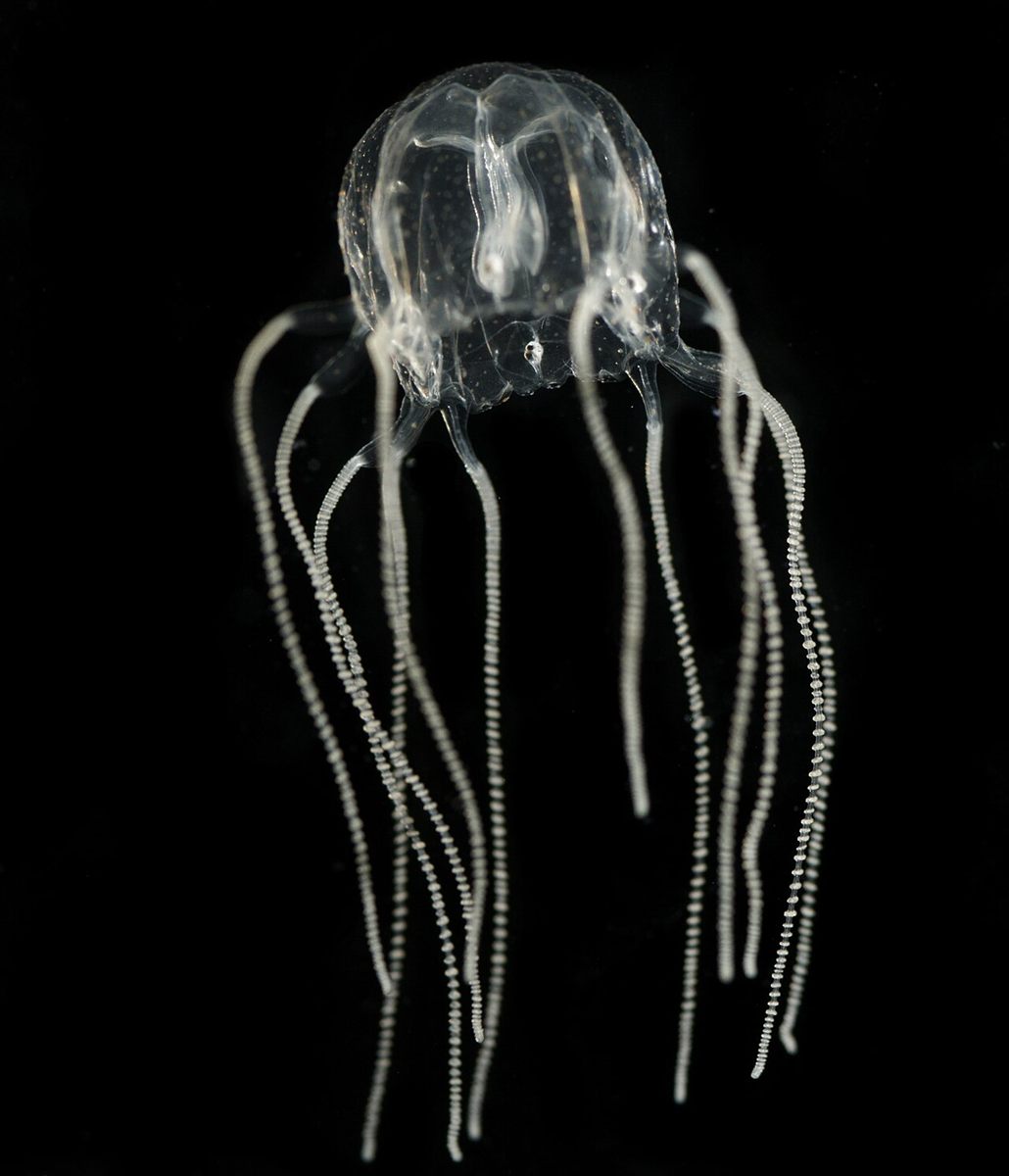
The Caribbean box jelly (Tripedalia cystophora) is a tiny box jellyfish, about a centimeter tall, living among the roots of mangroves. Its 24 eyes make it a model for studying vision in an animal with no brain.
The Caribbean box jelly (Tripedalia cystophora) is a tiny box jellyfish, about a centimeter tall, living among the roots of mangroves. Its 24 eyes make it a model for studying vision in an animal with no brain.
🧬 Field Guide Specimen: Open Caribbean Box Jelly in the CRV Science Field Guide to log the specimen, see its place among the Cnidaria+Ctenophora lineages in the Cladogram Explorer, and test your recall in the Red List conservation game.
Eyes Without a Brain: How Does It See?
Four sensory clubs each carry six eyes of different kinds, including two with lenses. The upward-looking eye points at the canopy and tells the jellyfish when it is under the mangrove, where it feeds. Signals from the eyes control the pulses of the bell directly.
Steering by Light
The jellyfish uses its vision to avoid the roots and to stay in the light shafts where its tiny prey gather. It has been used to study how simple nervous systems process visual information.
Courtship by Sperm Packets
Males release packets of sperm that females pick up, a rare case of mating-like behavior in jellyfish. See Sea Wasp.
Caribbean Box Jelly at a Glance
| Property | Value |
|---|---|
| Scientific name | Tripedalia cystophora |
| Kingdom | Animalia |
| Phylum | Cnidaria |
| Class | Cubozoa |
| Order | Carybdeida |
| Family | Tripedaliidae |
| Field Guide group | Cnidaria + Ctenophora (Radiata & Jellies) |
| Diagnostic feature (Field Guide) | Fingernail-sized, four-sided bell with three tentacles at each corner; uses its upward-looking eyes to see the mangrove canopy and stay near home. |
| Class | Cubozoa |
| Eyes | 24 |
See Also
- Sea Wasp — a larger box jelly
- Peacock Mantis Shrimp — another animal with unusual eyes