Mediterranean Box Jelly
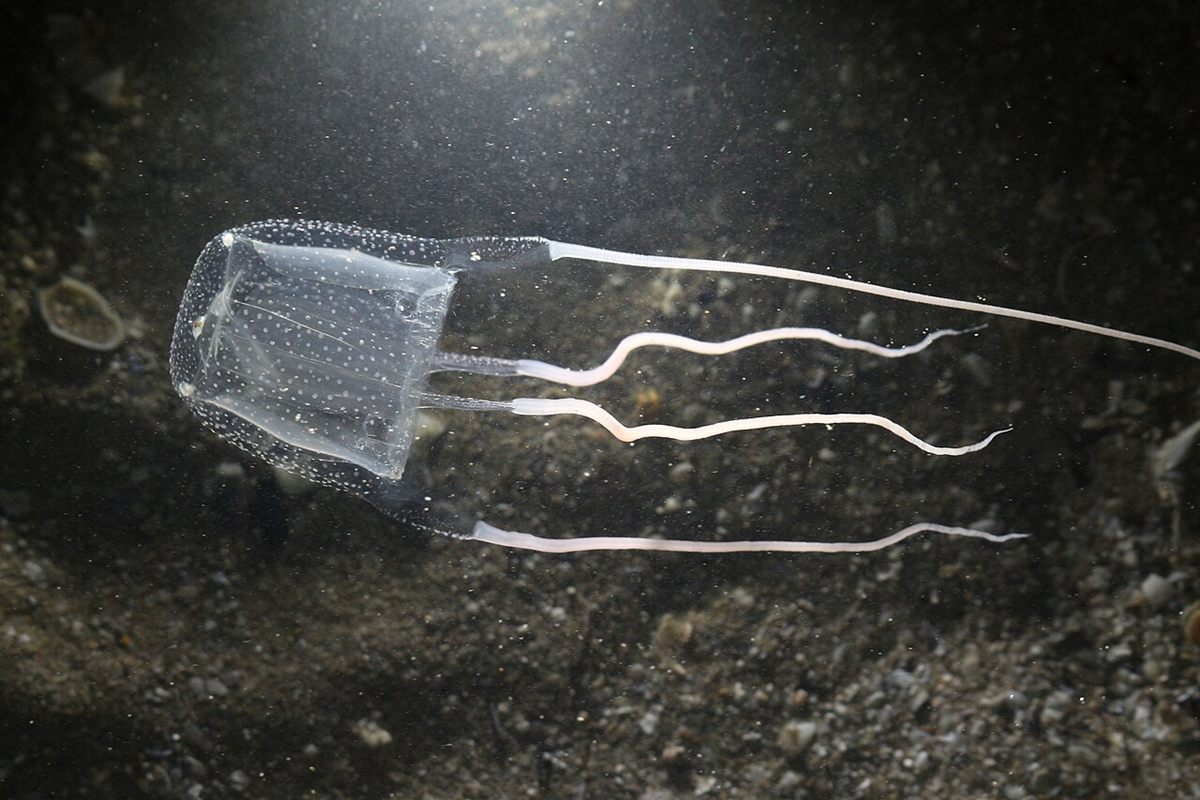
The Mediterranean box jelly (Carybdea marsupialis) is a small box jellyfish, with a cube-shaped bell about 5 centimeters tall, found in warm seas including the Mediterranean. Its sting is painful but not deadly.
The Mediterranean box jelly (Carybdea marsupialis) is a small box jellyfish, with a cube-shaped bell about 5 centimeters tall, found in warm seas including the Mediterranean. Its sting is painful but not deadly.
🧬 Field Guide Specimen: Open Mediterranean Box Jelly in the CRV Science Field Guide to log the specimen, see its place among the Cnidaria+Ctenophora lineages in the Cladogram Explorer, and test your recall in the Red List conservation game.
A Cube With Four Tentacles
Each corner of the box bears a single tentacle. The jellyfish swims actively and can steer using the sensory organs at the base of the bell, which have eyes. See Sea Wasp.
Summer Stings
Swarms drift near beaches on summer evenings, and sting swimmers, causing welts and pain. Nutrient-rich, warm waters are linked with more frequent blooms.
Cubozoa
Box jellyfish belong to the class Cubozoa and are the most active of the jellyfish. Their complex eyes are the subject of research on vision in simple animals.
Mediterranean Box Jelly at a Glance
| Property | Value |
|---|---|
| Scientific name | Carybdea marsupialis |
| Kingdom | Animalia |
| Phylum | Cnidaria |
| Class | Cubozoa |
| Order | Carybdeida |
| Family | Carybdeidae |
| Field Guide group | Cnidaria + Ctenophora (Radiata & Jellies) |
| Diagnostic feature (Field Guide) | Small transparent four-sided bell with a single tentacle at each corner and clusters of eyes, some with true lenses. |
| Class | Cubozoa |
| Tentacles | Four, one per corner |
See Also
- Sea Wasp — a dangerous box jelly
- Caribbean Box Jelly — a model for jellyfish vision