Chlorite Actinolite Schist
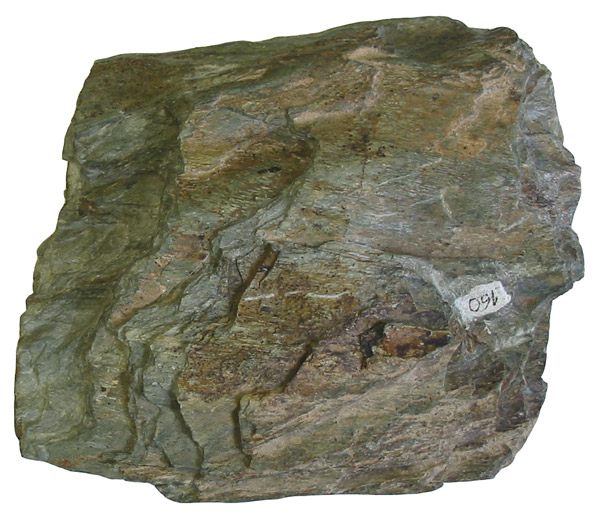
Chlorite actinolite schist is a deep-green foliated metamorphic rock made of platy chlorite and needle-like actinolite amphibole, formed from metamorphosed basalt. It is the classic rock of the greenschist facies.
Chlorite actinolite schist is a deep-green foliated metamorphic rock made of platy chlorite and needle-like actinolite amphibole, formed from metamorphosed basalt. It is the classic rock of the greenschist facies.
🪨 Geology Guide Specimen: Open Chlorite Actinolite Schist in the CRV Science Rock & Mineral ID Guide to log the specimen, compare it with the other 6 subgroups of Metamorphic, and test your eye in LithoClade.
Greenschist: How Does Basalt Become Green?
Basalt contains pyroxene and calcium-rich plagioclase that are unstable at low to medium temperature when water is present. At around 350 to 500 degrees Celsius they react to chlorite, actinolite, epidote and albite, all green or pale minerals, and the rock acquires a foliation that gives it its schist structure.
Seafloor Metamorphism: Where Do They Form?
Hot seawater circulating through newly formed oceanic crust alters basalt in a similar way, so greenschists are found in ophiolites and in the volcanic belts of Archean greenstone terranes. They carry an imprint of the ocean-floor hydrothermal systems that existed long ago.
The Facies Concept: What Does It Teach?
Metamorphic facies group rocks that formed under similar temperature and pressure, whatever their starting composition. A mudstone and a basalt at the same conditions give different rocks, such as slate and greenschist, which share one facies. Magnetite crystals are often scattered through.
Chlorite Actinolite Schist at a Glance
| Property | Value |
|---|---|
| Type / variety | Greenschist-Facies Mafic Chlorite Schist |
| Composition | Platy Green Chlorite + Acicular Green Actinolite Amphibole + Epidote + Albite |
| Geology Guide group | Metamorphic Rocks (Foliated, Granoblastic & High-P) |
| Rock Classification | Medium-Grade Foliated (Schists) |
| Mohs hardness | Mohs 2.5–5 |
| Texture / habit | Foliated platy and needle-like dark green crystal fabric |
| Density | 2.85–3.00 g/cm³ |
| Lustre and cleavage | Deep spinach-green pearly-to-silky foliated plates, sometimes with magnetite octahedra |
| Geological setting | Regional metamorphism of basaltic lavas and tuffs at 350–500 °C |
| Diagnostic feature (Geology Guide) | Deep spinach-green, strongly foliated rock composed of visible green platy flakes and radiating green amphibole needles, often studded with sharp black octahedral crystals of magnetite. |
| Protolith | Basalt or basaltic tuff |
| Typical minerals | Chlorite, actinolite, epidote and albite |