Yellow Network Lattice Sponge
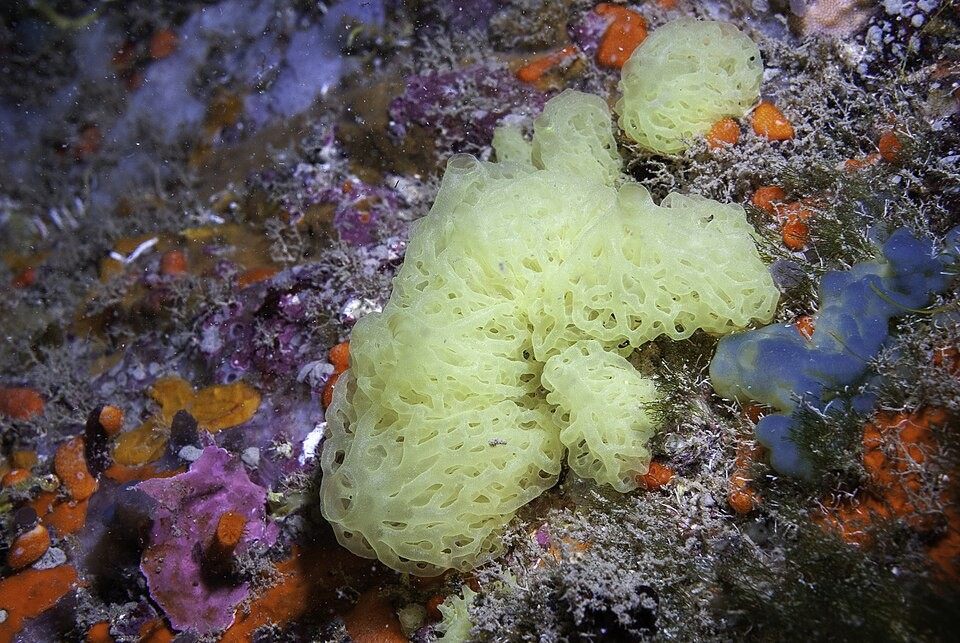
The yellow network lattice sponge (Clathrina clathrus) is a bright yellow calcareous sponge of the Mediterranean and eastern Atlantic, formed of a delicate network of interconnected tubes. It has one of the simplest body plans among sponges.
The yellow network lattice sponge (Clathrina clathrus) is a bright yellow calcareous sponge of the Mediterranean and eastern Atlantic, formed of a delicate network of interconnected tubes. It has one of the simplest body plans among sponges.
🧬 Field Guide Specimen: Open Yellow Network Lattice Sponge in the CRV Science Field Guide to log the specimen, see its place among the Metazoa lineages in the Cladogram Explorer, and test your recall in the Red List conservation game.
The Simplest Plan: The Asconoid Sponge
Each tube is a hollow cylinder lined with choanocytes that beat water through the wall and out a central opening. This is called the asconoid plan, and it limits size because water must be moved through a single thin layer.
Networks and Cloning
The tubes fuse into a mesh that can grow into a cushion several centimeters across. Pieces of sponge broken off can regrow into new individuals.
Where to Find It
It lives in shaded rock crevices and caves from the intertidal down to a few dozen meters. Like other calcareous sponges, it builds a skeleton from tiny calcite spicules.
Yellow Network Lattice Sponge at a Glance
| Property | Value |
|---|---|
| Scientific name | Clathrina clathrus |
| Kingdom | Animalia |
| Phylum | Porifera |
| Class | Calcarea |
| Order | Clathrinida |
| Family | Clathrinidae |
| Field Guide group | Porifera: Sponges (Basal Metazoans) |
| Diagnostic feature (Field Guide) | Tangled network of delicate anastomosing tubes with bright yellow coloration, supported by triactine calcium carbonate spicules. |
| Class | Calcarea |
| Body plan | Asconoid |