Leucosolenia Sponge
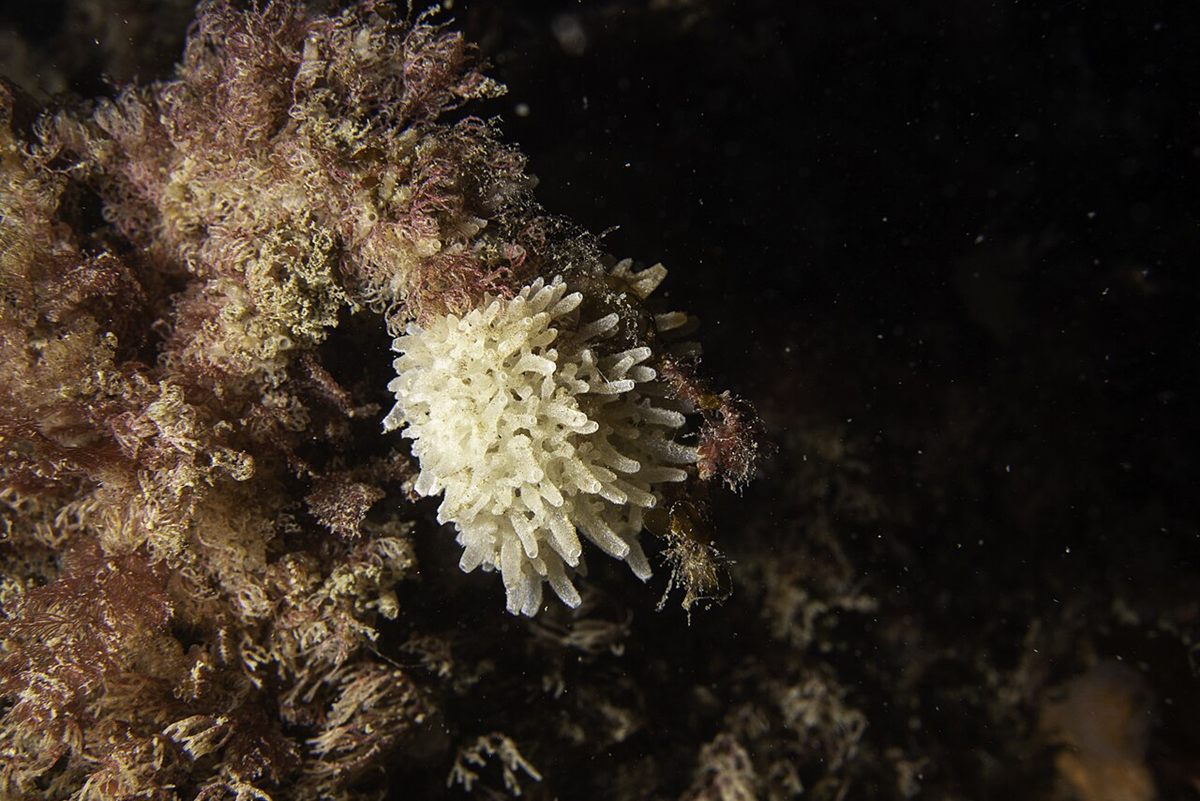
The Leucosolenia sponge (Leucosolenia botryoides) is a delicate calcareous sponge made of a branching network of tubes, which grows on rocks and seaweed in the cold North Atlantic.
The Leucosolenia sponge (Leucosolenia botryoides) is a delicate calcareous sponge made of a branching network of tubes, which grows on rocks and seaweed in the cold North Atlantic.
🧬 Field Guide Specimen: Open Leucosolenia Sponge in the CRV Science Field Guide to log the specimen, see its place among the Metazoa lineages in the Cladogram Explorer, and test your recall in the Red List conservation game.
The Simplest Plan
Each tube is an asconoid unit with a single wall lined with choanocytes and a central cavity open at the top. Like the lattice sponge, it is limited in size by the need to pump water through a single cell layer.
Spicules of Calcite
The skeleton consists of three-rayed and rod-like spicules. These spicules have been studied to learn how sponge cells shape mineral crystals. See Yellow Network Lattice Sponge.
Study of Regeneration
Leucosolenia has been used in experiments on how sponges reorganize their cells after being broken into pieces. See Sycon Sponge.
Leucosolenia Sponge at a Glance
| Property | Value |
|---|---|
| Scientific name | Leucosolenia botryoides |
| Kingdom | Animalia |
| Phylum | Porifera |
| Class | Calcarea |
| Order | Leucosolenida |
| Family | Leucosoleniidae |
| Field Guide group | Porifera: Sponges (Basal Metazoans) |
| Diagnostic feature (Field Guide) | Clusters of small white branching tubes in shady tide pools; each tube is a simple hollow chamber lined with collar cells and stiffened by three-rayed needles of calcite. |
| Class | Calcarea |
| Body plan | Asconoid |