Conglomerate
Conglomerate is a clastic sedimentary rock made of rounded gravel, with clasts larger than 2 millimeters, cemented in a finer matrix. A polymictic conglomerate contains clasts of many different rock types, as the Geology Guide specimen does.
Conglomerate is a clastic sedimentary rock made of rounded gravel, with clasts larger than 2 millimeters, cemented in a finer matrix. A polymictic conglomerate contains clasts of many different rock types, as the Geology Guide specimen does.
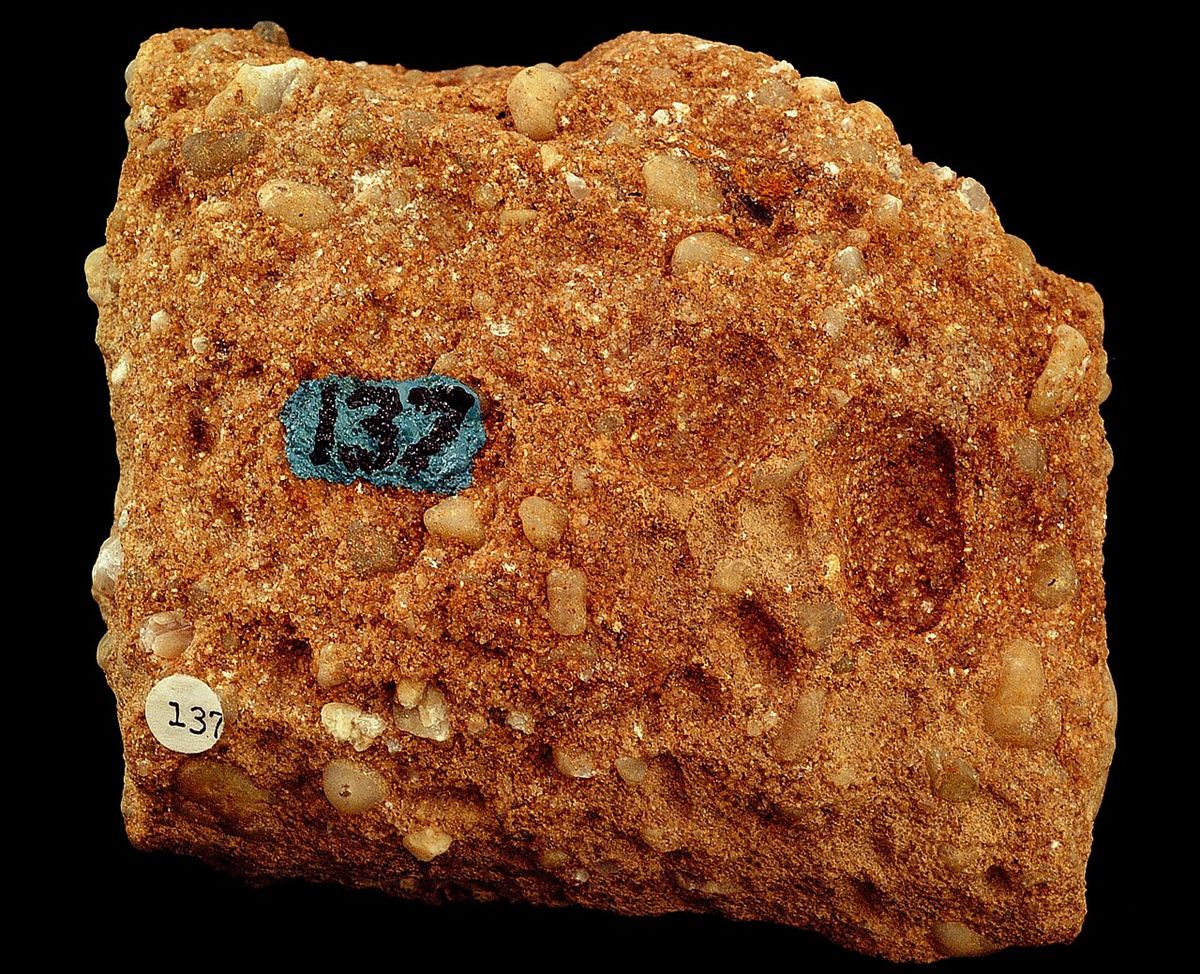
🪨 Geology Guide Specimen: Open Polymictic Conglomerate in the CRV Science Rock & Mineral ID Guide to log the specimen, compare it with the other 6 subgroups of Sedimentary, and test your eye in LithoClade.
Roundness: What Does It Say About Transport?
Pebbles and cobbles become rounded by abrasion as water rolls them along a river bed or beach. Well-rounded clasts therefore point to long or energetic transport, often many kilometers, in contrast to the sharp fragments of sedimentary breccia.
Settings: Where Does Gravel Accumulate?
Conglomerates collect where currents are strong enough to move gravel but then slow: alluvial fans at mountain fronts, braided rivers, wave-swept beaches, and glacial outwash plains. Their coarseness usually signals steep slopes and an uplifting source area nearby.
Provenance: What Do the Clasts Reveal?
Each clast is a sample of the source area, so counting the rock types tells geologists which mountains were being eroded and when. Some ancient conglomerates are also economic, such as the Witwatersrand deposits of South Africa, whose gold was concentrated in ancient river gravels.
Conglomerate at a Glance
| Property | Value |
|---|---|
| Type / variety | Rounded Gravel-Clast Fluvial Conglomerate |
| Composition | Water-Worn Pebbles & Cobbles (>2 mm) in Sand/Silica/Calcite Cement |
| Geology Guide group | Sedimentary Rocks (Clastic, Chemical & Biogenic) |
| Rock Classification | Coarse Clastic (Rudites) |
| Mohs hardness | Mohs 6–7 (clasts) |
| Texture / habit | Well-rounded gravel clasts (>2 mm) in sandy matrix |
| Density | 2.50–2.70 g/cm³ |
| Lustre and cleavage | Smooth, water-tumbled pebbles of mixed lithologies |
| Geological setting | Braided mountain rivers, alluvial fans, and wave-swept cobble beaches |
| Diagnostic feature (Geology Guide) | Natural 'concrete' composed of smooth, water-rounded pebbles and cobbles (>2 mm across) of diverse rock types cemented together in a finer sand matrix. |
| Clast size | Larger than 2 mm |
| Typical settings | Alluvial fans, braided rivers, beaches |