Sedimentary Breccia
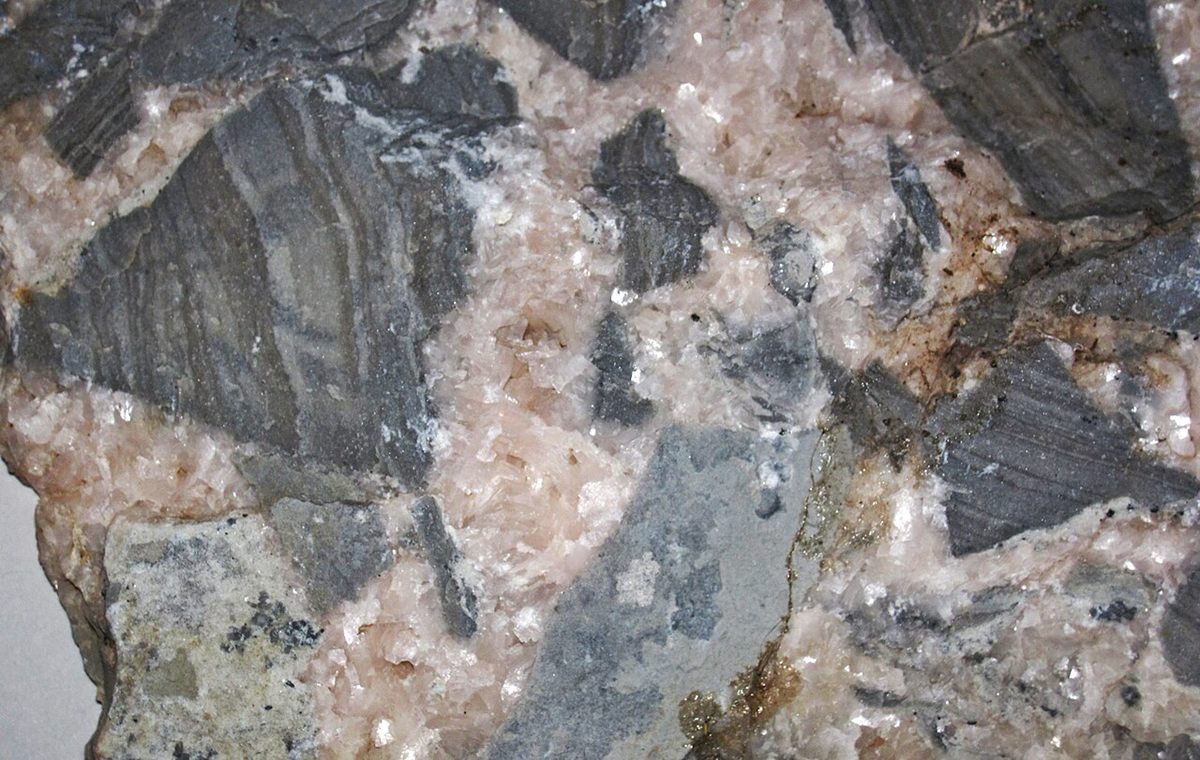
Sedimentary breccia is a coarse clastic rock of sharp, angular fragments larger than 2 millimeters, cemented in a finer matrix. Its angular clasts show that the debris was buried close to its source.
Sedimentary breccia is a coarse clastic rock of sharp, angular fragments larger than 2 millimeters, cemented in a finer matrix. Its angular clasts show that the debris was buried close to its source.
🪨 Geology Guide Specimen: Open Sedimentary Breccia in the CRV Science Rock & Mineral ID Guide to log the specimen, compare it with the other 6 subgroups of Sedimentary, and test your eye in LithoClade.
Little Transport: Why Are the Clasts Angular?
Rock fragments lose their sharp corners within a short distance of rolling in water. Breccia clasts that are still angular therefore traveled only a short way, often just falling or sliding downslope before they were buried and cemented by calcite, silica or iron oxide.
Settings: Scarps, Talus and Caves
Sedimentary breccias form at cliff bases as talus, along active fault scarps, in debris flows and in collapse breccias where cave roofs or evaporite beds have fallen in. They are common in the sedimentary record of rifting basins, where steep faults shed coarse debris.
Breccia or Conglomerate: How Do You Tell?
The test is shape: angular clasts make a breccia, rounded clasts make a conglomerate. Breccias with other origins include volcanic breccia and impact breccia, each recognized by its setting and by what the fragments are made of.
Sedimentary Breccia at a Glance
| Property | Value |
|---|---|
| Type / variety | Angular-Clast Talus Breccia |
| Composition | Sharp Angular Rock Fragments (>2 mm) in Carbonate or Iron-Oxide Matrix |
| Geology Guide group | Sedimentary Rocks (Clastic, Chemical & Biogenic) |
| Rock Classification | Coarse Clastic (Rudites) |
| Mohs hardness | Mohs 3–7 (varies by clast & cement) |
| Texture / habit | Unsorted, sharp-edged gravel/rubble clasts (>2 mm) |
| Density | 2.50–2.70 g/cm³ |
| Lustre and cleavage | Jagged, unrounded corners showing minimal transport |
| Geological setting | Cliff talus cones, fault scarps, cave-roof collapses, and debris flows |
| Diagnostic feature (Geology Guide) | Cemented rubble rock packed with sharp, jagged, unrounded fragments (>2 mm across) that were buried right next to their source cliff or fault scarp before water could round their corners. |
| Clast shape | Angular |
| Clast size | Larger than 2 mm |
See Also
- Conglomerate — the rounded-clast equivalent
- Volcanic Breccia — angular fragments from volcanic processes
- Tillite — poorly sorted glacial deposits