Desert Locust
The desert locust (Schistocerca gregaria) is a short-horned grasshopper that, under certain conditions, changes from a solitary insect into a gregarious one and forms vast swarms that devastate crops across Africa, the Middle East and South Asia.
The desert locust (Schistocerca gregaria) is a short-horned grasshopper that, under certain conditions, changes from a solitary insect into a gregarious one and forms vast swarms that devastate crops across Africa, the Middle East and South Asia.
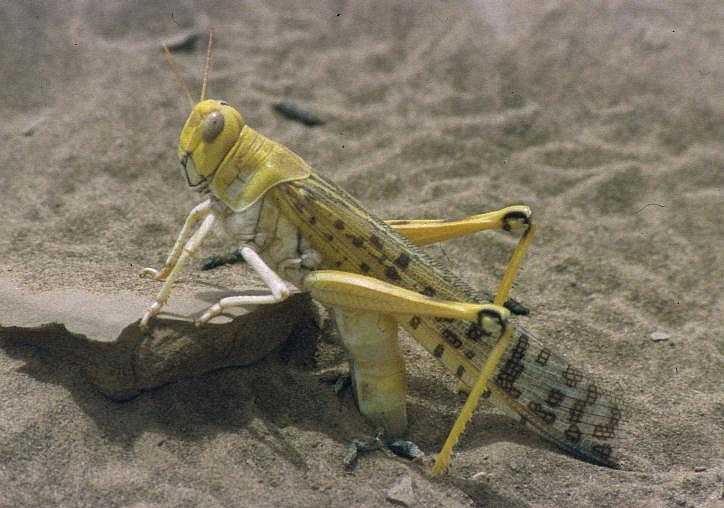
🧬 Field Guide Specimen: Open Desert Locust in the CRV Science Field Guide to log the specimen, see its place among the Ecdysozoa lineages in the Cladogram Explorer, and test your recall in the Red List conservation game.
Phase Change: How Does a Grasshopper Become a Plague?
When rain brings vegetation and then crowds the insects together, repeated touching of the hind legs triggers a surge of the neurotransmitter serotonin. Within hours, solitary nymphs become attracted to one another, change color and body shape, and march together. Adults then fly in swarms that can contain tens of millions of insects per square kilometer.
Scale of a Swarm
A swarm eats roughly its own weight in plants each day, and a large one can consume as much food as many thousands of people. An outbreak from 2019 to 2021 was the worst in East Africa in decades and threatened food security across several countries.
Anatomy and Classification
Locusts are grasshoppers (Acrididae, order Orthoptera) with enlarged hind legs for jumping and hearing organs on the first segment of the abdomen. Monitoring of rainfall and vegetation by satellite helps agencies predict and control outbreaks.
Desert Locust at a Glance
| Property | Value |
|---|---|
| Scientific name | Schistocerca gregaria |
| Kingdom | Animalia |
| Phylum | Arthropoda |
| Class | Insecta |
| Order | Orthoptera |
| Family | Acrididae |
| Field Guide group | Ecdysozoa: Hexapoda (Insects) |
| Diagnostic feature (Field Guide) | Enlarged jumping hind legs with chevron musculature, tympanal acoustic organs on first abdominal segment. |
| Order | Orthoptera |
| Key trait | Density-dependent phase change |