Migratory Locust
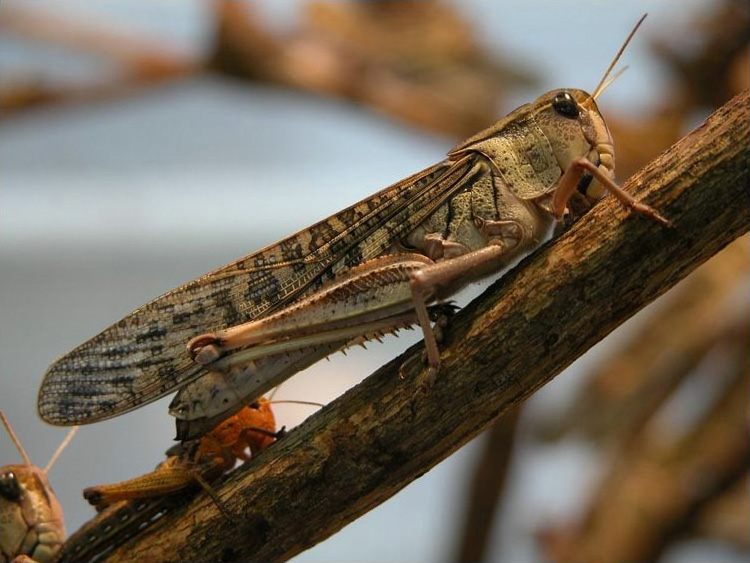
The migratory locust (Locusta migratoria) is the most widely distributed locust, found across Africa, Asia, Australia and New Zealand. Like the desert locust, it can change from a solitary form into a swarming one.
The migratory locust (Locusta migratoria) is the most widely distributed locust, found across Africa, Asia, Australia and New Zealand. Like the desert locust, it can change from a solitary form into a swarming one.
🧬 Field Guide Specimen: Open Migratory Locust in the CRV Science Field Guide to log the specimen, see its place among the Ecdysozoa lineages in the Cladogram Explorer, and test your recall in the Red List conservation game.
Solitary or Swarming: One Species, Two Forms
Crowding leads the insects to change color, shape and behavior, a phenomenon known as phase polyphenism. Gregarious nymphs march in bands and adults fly in swarms. Plague outbreaks have been recorded in China for thousands of years, including along the Yellow River.
A Giant Genome
The migratory locust has one of the largest insect genomes sequenced, about 6.5 billion base pairs, much of it repetitive DNA. Genomic work has identified genes involved in phase change, flight and detoxification.
Control and Use
Outbreaks are managed by monitoring and targeted spraying or biopesticides containing the fungus Metarhizium. Locusts are also eaten by people in many regions and farmed as food and feed.
Migratory Locust at a Glance
| Property | Value |
|---|---|
| Scientific name | Locusta migratoria |
| Kingdom | Animalia |
| Phylum | Arthropoda |
| Class | Insecta |
| Order | Orthoptera |
| Family | Acrididae |
| Field Guide group | Ecdysozoa: Hexapoda (Insects) |
| Diagnostic feature (Field Guide) | Demonstrates hemimetabolous development and density-dependent phase polyphenism. |
| IUCN Red List status | Least Concern (LC) |
| Order | Orthoptera |
| Genome size | About 6.5 billion base pairs |