Diamond
Diamond is a form of pure carbon, C, with a cubic crystal structure in which each atom bonds to four neighbors. It is the hardest natural substance, rated 10 on the Mohs scale, and forms deep in the mantle.
Diamond is a form of pure carbon, C, with a cubic crystal structure in which each atom bonds to four neighbors. It is the hardest natural substance, rated 10 on the Mohs scale, and forms deep in the mantle.
🪨 Geology Guide Specimen: Open Diamond in the CRV Science Rock & Mineral ID Guide to log the specimen, compare it with the other 8 mineral classes of Dana / Strunz Classes, and test your eye in LithoClade.
Carbon Polymorph: How Can Diamond and Graphite Differ So Much?
Diamond and graphite are both pure carbon, but diamond's three-dimensional network of strong bonds makes it extremely hard, transparent and an excellent conductor of heat, while graphite's sheets slide easily and conduct electricity. The difference is purely the arrangement of atoms.
Deep Origins: Where Does Diamond Form?
Most natural diamonds crystallize in the mantle below ancient continents at depths of about 150 kilometers or more, hundreds of millions to billions of years ago. They are brought up quickly in kimberlite and related volcanic pipes. Small diamonds also form in meteorite impacts.
Properties and Uses: Beyond Jewelry
A diamond has perfect cleavage in four directions and a brilliant luster, so cutters use it to make facets that sparkle. Most diamond is used industrially, for cutting, drilling and polishing, and synthetic diamonds can be grown in the laboratory. See carbon.
Diamond at a Glance
| Property | Value |
|---|---|
| Type / variety | C • Isometric Octahedral Native Carbon |
| Composition | C (sp³-Hybridized 3D Covalent Tetrahedral Carbon Network) |
| Geology Guide group | Minerals (8 Major Chemical Groups) |
| Mineral Group | Native Elements |
| Mohs hardness | Mohs 10 (hardest known natural mineral on Earth) |
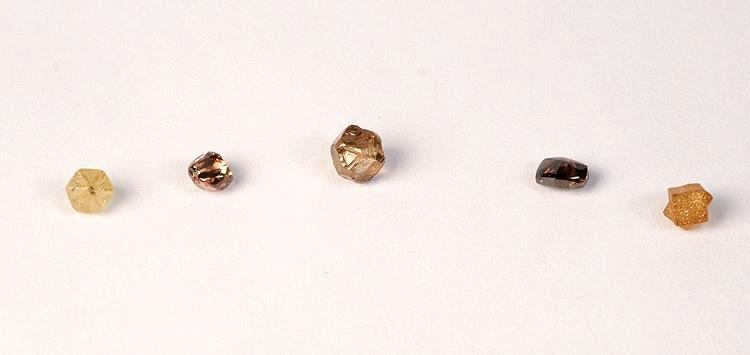
| Texture / habit | 8-sided isometric octahedra, dodecahedra, or cubes with triangular 'trigon' etch pits |
| Density | 3.51–3.52 g/cm³ |
| Lustre and cleavage | Brilliant greasy-to-adamantine lustre; perfect 4-directional octahedral cleavage; highest thermal conductivity |
| Geological setting | Cratonic lithospheric mantle roots (>150 km depth) brought up by kimberlite/lamproite pipes |
| Diagnostic feature (Geology Guide) | Eight-sided octahedral crystal with tiny triangular growth pits ('trigons'), a brilliant adamantine lustre, and Mohs 10 hardness—forged at >150 km depth where every atom is locked to four neighbors in a 3D sp³ tetrahedral cage. |
| Formula | C |
| Hardness | 10, the top of the Mohs scale |