Kimberlite
Kimberlite is a rare, volatile-rich igneous rock that erupts from the deep mantle through narrow, carrot-shaped pipes. It is the main primary source of diamonds and is named for the city of Kimberley, South Africa, where the first major diamond mines were dug.
Kimberlite is a rare, volatile-rich igneous rock that erupts from the deep mantle through narrow, carrot-shaped pipes. It is the main primary source of diamonds and is named for the city of Kimberley, South Africa, where the first major diamond mines were dug.
🪨 Geology Guide Specimen: Open Kimberlite in the CRV Science Rock & Mineral ID Guide to log the specimen, compare it with the other 7 subgroups of Igneous, and test your eye in LithoClade.
Rapid Ascent: How Do Diamonds Survive the Trip?
Diamonds form in the mantle at depths of roughly 150 kilometers or more. Kimberlite magma, rich in carbon dioxide and water, rises quickly, in hours to days, and gas expansion drives it to explosive eruption at the surface. The speed lets diamonds reach the surface before they revert to graphite or burn.
Pipe Anatomy: What Is Inside a Kimberlite Pipe?
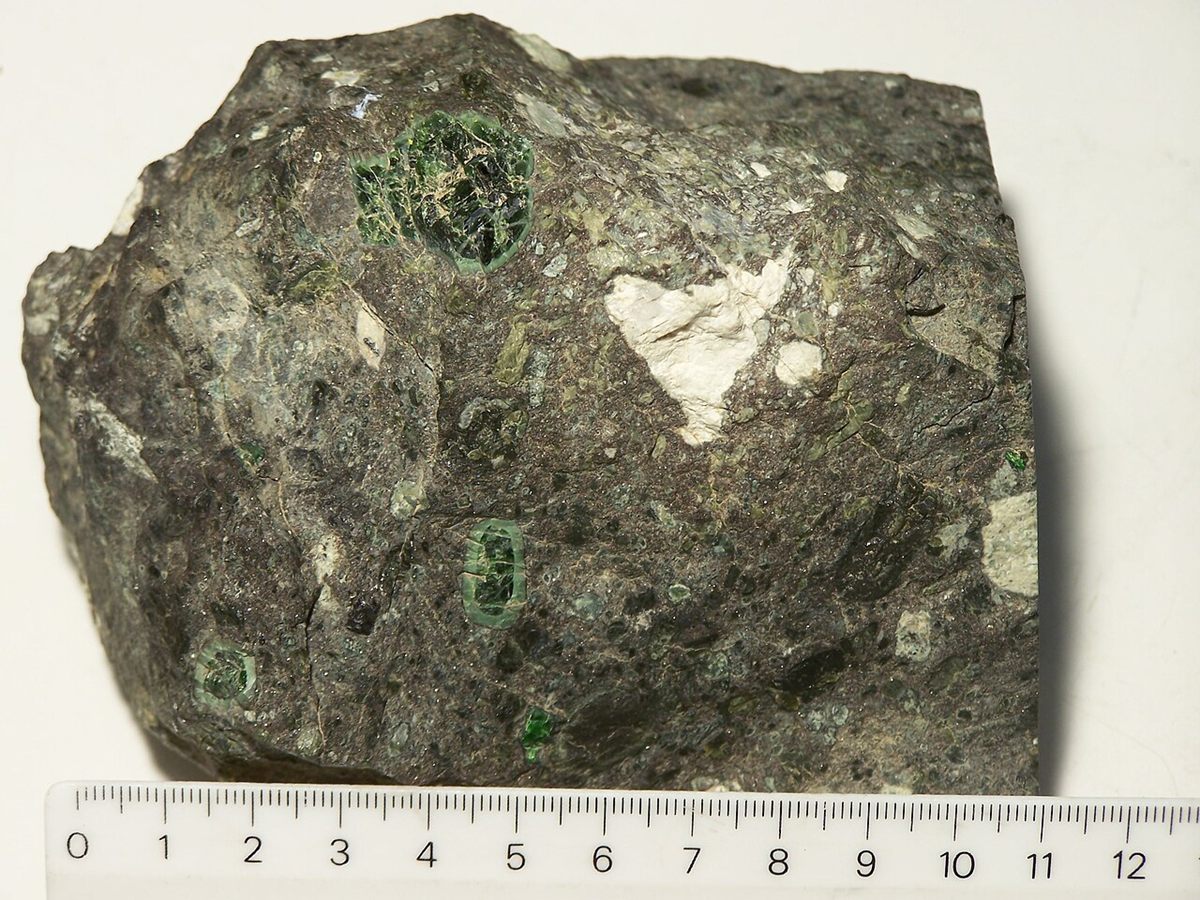
A pipe has a root zone of intrusive rock, a steep-sided diatreme filled with volcanic breccia, and sometimes a surface crater. The rock is a mixed breccia of olivine crystals, altered to serpentine, with mica and fragments of the mantle and crust that the magma tore off on the way.
Mantle Samples: What Does Kimberlite Carry?
Kimberlite brings fragments of peridotite, eclogite, garnet and other mantle rocks to the surface, which are among the few direct samples of the deep Earth. Red pyrope garnets, chrome diopside and other indicator minerals help explorers find pipes, but only a small fraction of kimberlites contain diamonds.
Kimberlite at a Glance
| Property | Value |
|---|---|
| Type / variety | Volatile-Rich Mantle Pipe Kimberlite |
| Composition | Serpentinized Olivine Macrocrysts + Phlogopite + Pyrope Garnet + Ilmenite |
| Geology Guide group | Igneous Rocks (Plutonic & Volcanic) |
| Rock Classification | Ultramafic & Mantle |
| Mohs hardness | Mohs 4–6 (matrix to xenocrysts) |
| Texture / habit | Inequigranular breccia with rounded mantle nodules |
| Density | 2.75–3.15 g/cm³ |
| Lustre and cleavage | Bluish-grey carbonate/serpentine matrix with red pyrope & green olivine |
| Geological setting | Supersonic CO₂-charged volcanic pipes piercing ancient cratons |
| Diagnostic feature (Geology Guide) | Bluish-grey brecciated pipe rock packed with rounded green olivine megacrysts, blood-red chromium-pyrope garnets, and bronzy phlogopite mica blasted upward from >150 km depth by CO₂ volatiles. |
| Named for | Kimberley, South Africa |
| Typical setting | Ancient continental cratons |