Eastern Barred Bandicoot
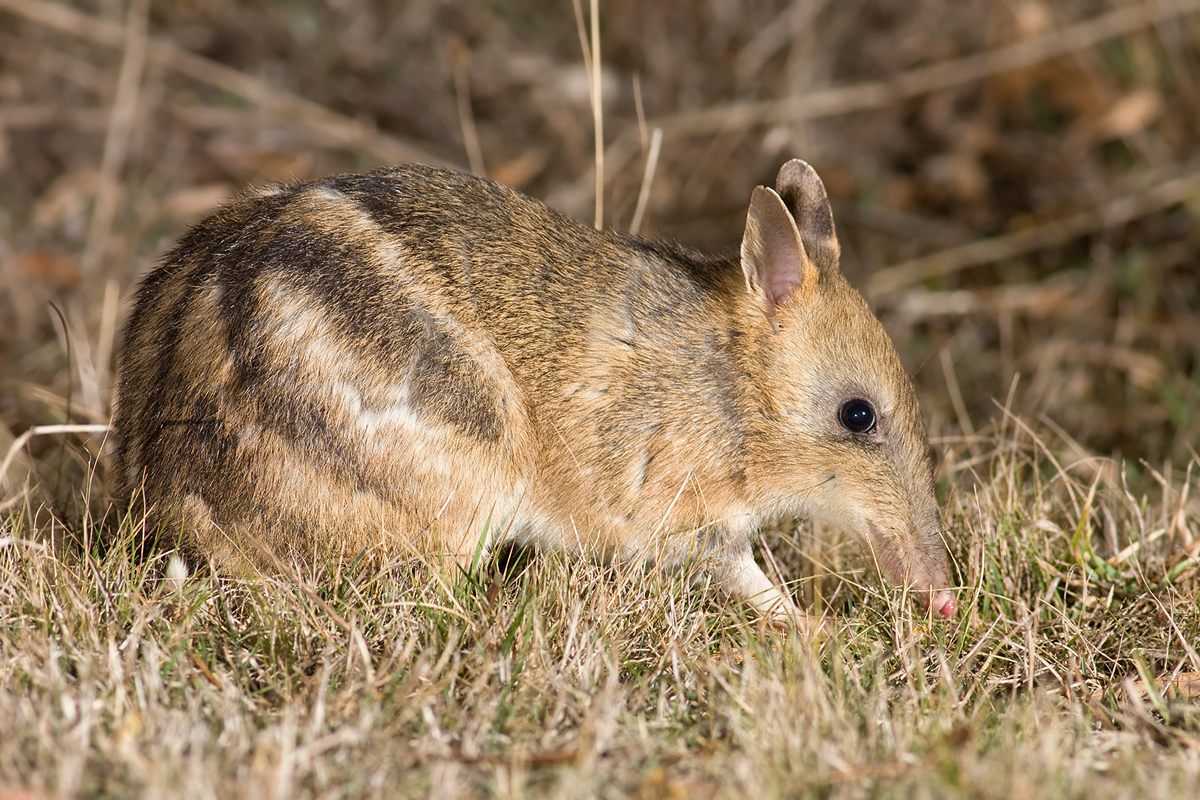
The eastern barred bandicoot (Perameles gunnii) is a small nocturnal marsupial with pale bars across its rump, once common on the grasslands of southeastern Australia.
The eastern barred bandicoot (Perameles gunnii) is a small nocturnal marsupial with pale bars across its rump, once common on the grasslands of southeastern Australia. The mainland population was declared extinct in the wild in 2013 and has since been restored through fox-free sanctuaries and island releases.
🧬 Field Guide Specimen: Open Eastern Barred Bandicoot in the CRV Science Field Guide to log the specimen, see its place among the Mammals lineages in the Cladogram Explorer, and test your recall in the Red List conservation game.
A Very Short Pregnancy
Bandicoots have one of the shortest gestations among mammals, about twelve and a half days, and a type of placenta that resembles the placentas of placental mammals more than those of most marsupials. The young are weaned in two months.
Collapse and Recovery
Fox predation and conversion of grassland to farms and suburbs reduced mainland animals to a handful of survivors. Captive breeding and release into predator-free fenced reserves and onto islands have rebuilt the population, and in 2021 the mainland subspecies was upgraded under Australian law from Extinct in the Wild to Endangered. Globally the IUCN lists the species as Vulnerable.
Ecological Role
Bandicoots dig conical pits while foraging for insects and roots, turning over soil. The Tasmanian population is in better condition than the mainland one.
Eastern Barred Bandicoot at a Glance
| Property | Value |
|---|---|
| Scientific name | Perameles gunnii |
| Kingdom | Animalia |
| Phylum | Chordata |
| Class | Mammalia |
| Order | Peramelemorphia |
| Family | Peramelidae |
| Field Guide group | Mammals: Marsupialia (Metatherians) |
| Diagnostic feature (Field Guide) | Distinctive pale vertical bars across hindquarters, elongated digging snout, chorioallantoic-like placenta. |
| IUCN Red List status | Vulnerable (VU), assessed 2016 |
| Order | Peramelemorphia |
| Gestation | About 12.5 days |