Field Horsetail
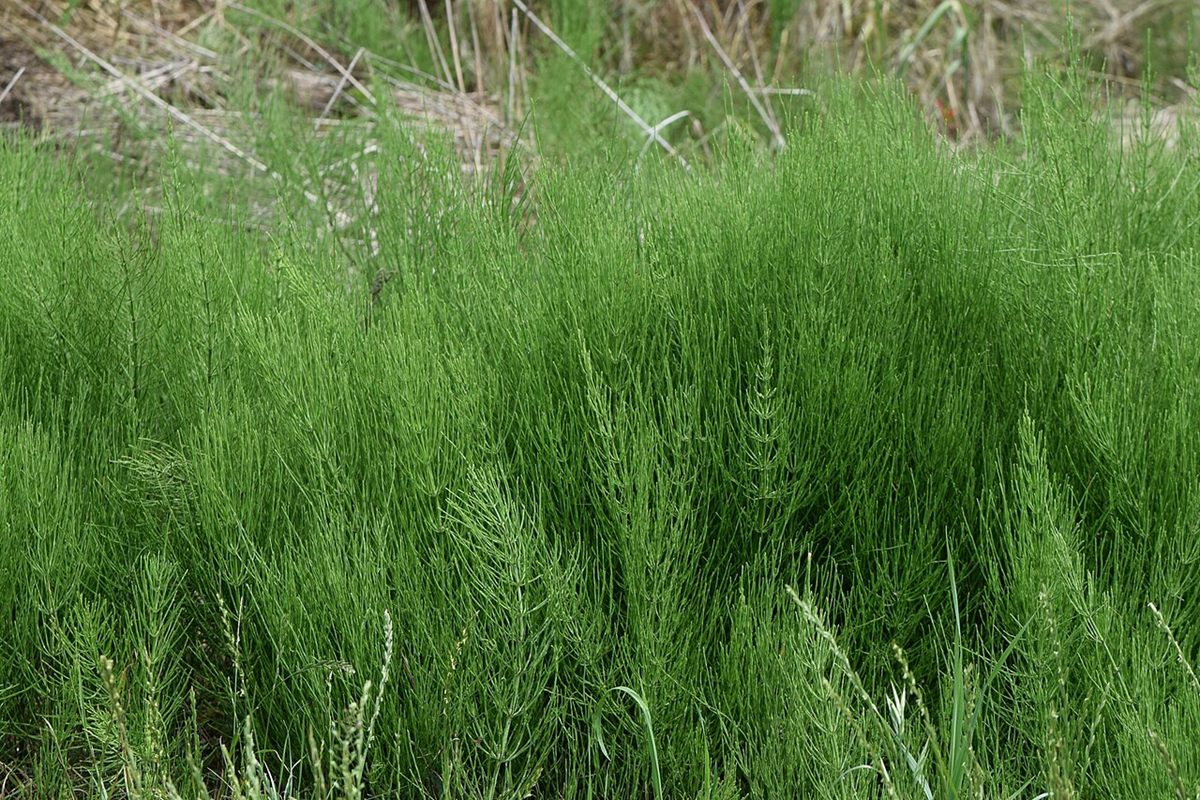
The field horsetail (Equisetum arvense) is a primitive, spore-bearing plant with jointed, hollow stems and whorls of thin branches. It is a survivor of a group that included tree-sized forms in the Carboniferous coal forests.
The field horsetail (Equisetum arvense) is a primitive, spore-bearing plant with jointed, hollow stems and whorls of thin branches. It is a survivor of a group that included tree-sized forms in the Carboniferous coal forests.
🧬 Field Guide Specimen: Open Field Horsetail in the CRV Science Field Guide to log the specimen, see its place among the Diaphoretickes lineages in the Cladogram Explorer, and test your recall in the Red List conservation game.
Glass in the Stems
The stems are rich in silica, which makes them rough. They were used as pot scourers, hence the nickname "scouring rush". Horsetails take up silicon from the soil and deposit it as tiny glass crystals in their cell walls.
Two Kinds of Shoots
In early spring, pale, unbranched shoots topped with a spore-bearing cone appear. These die back and green, branched shoots grow for the summer. The spores have wing-like elaters that coil and uncoil with humidity, helping spore dispersal.
A Tenacious Weed
Deep rhizomes make horsetail very hard to eradicate from gardens and farmland. It is toxic to horses and cattle if eaten in hay. See Common Clubmoss.
Field Horsetail at a Glance
| Property | Value |
|---|---|
| Scientific name | Equisetum arvense |
| Kingdom | Plantae |
| Phylum | Tracheophyta |
| Class | Polypodiopsida |
| Order | Equisetales |
| Family | Equisetaceae |
| Field Guide group | Diaphoretickes: Plants & Algae |
| Diagnostic feature (Field Guide) | Jointed hollow green stems with whorls of thin branches; tiny scale leaves; silica-rich stems once used for scouring pots. |
| IUCN Red List status | Least Concern (LC), assessed 2017 |
| Group | Horsetails (Equisetum) |
| Stem mineral | Silica |