Fried Egg Jellyfish
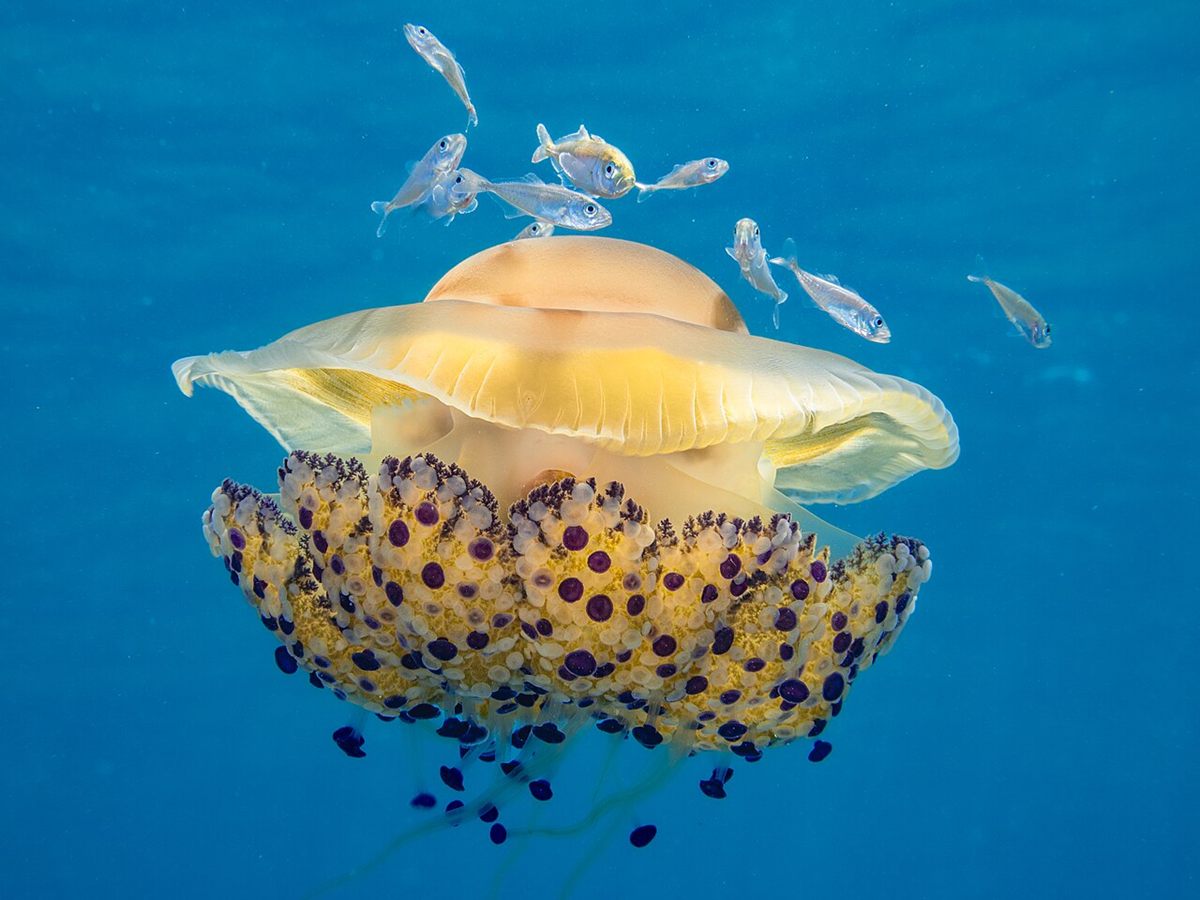
The fried egg jellyfish (Cotylorhiza tuberculata) is a Mediterranean jellyfish with a flat white bell and a yellow dome in the middle like a fried egg. Its sting is mild.
The fried egg jellyfish (Cotylorhiza tuberculata) is a Mediterranean jellyfish with a flat white bell and a yellow dome in the middle like a fried egg. Its sting is mild.
🧬 Field Guide Specimen: Open Fried Egg Jellyfish in the CRV Science Field Guide to log the specimen, see its place among the Cnidaria+Ctenophora lineages in the Cladogram Explorer, and test your recall in the Red List conservation game.
Fried Egg Jellyfish at a Glance
| Property | Value |
|---|---|
| Scientific name | Cotylorhiza tuberculata |
| Kingdom | Animalia |
| Phylum | Cnidaria |
| Class | Scyphozoa |
| Order | Rhizostomeae |
| Family | Cepheidae |
| Field Guide group | Cnidaria + Ctenophora (Radiata & Jellies) |
| Diagnostic feature (Field Guide) | Flat yellow-white bell with a raised orange dome, like a fried egg; short club-tipped oral arms host symbiotic algae. |
| Partner | Symbiotic zooxanthellae |
Taxonomy, Phylogenetics, and Evolutionary History
Originally described by Giuseppe Saverio Poli in 1791 as Medusa tuberculata and transferred to the genus Cotylorhiza by Louis Agassiz in 1862, the fried egg jellyfish (Cotylorhiza tuberculata) belongs to the family Cepheidae within the order Rhizostomeae (subclass Discomedusae, class Scyphozoa, phylum Cnidaria). Unlike semaeostome scyphozoans (such as Aurelia aurita), which possess a single central mouth surrounded by four ribbon-like oral arms and long marginal tentacles, rhizostome medusae lack marginal tentacles and fuse their oral arms during early ontogeny to close the primary central mouth, creating thousands of microscopic secondary mouthlets (ostioles) along eight branched oral arms.
Molecular phylogenetic analyses of nuclear 18S and 28S rDNA and mitochondrial COI and 16S rRNA genes place Cotylorhiza within the suborder Kolpophorae (clade Krykomyora), closely allied to the upside-down jellyfish family Cassiopeidae (Cassiopea) and the lagoon jellies (Mastigias). Across this kolpophoran clade, obligate endosymbiosis with photosynthetic dinoflagellates (family Symbiodiniaceae) evolved alongside club-shaped oral appendages that act as solar collectors. Cotylorhiza tuberculata is endemic to the Mediterranean Basin—reaching its highest abundances in the Adriatic Sea, the Aegean Sea, and coastal lagoons such as the Mar Menor in Spain.
Rhizostome Anatomy, Zooxanthellae Photobiology, and Jet-Paddle Propulsion
Exumbrellar Morphology and Oral-Arm Ostiolar Filtration
The medusa of Cotylorhiza tuberculata reaches an umbrella diameter of 20 to 35 centimeters and exhibits the "fried egg" profile: a smooth, raised central dome pigmented golden-yellow to burnt-orange ("the yolk"), surrounded by a flattened outer ring divided by radial grooves into 16 primary marginal lappets ("the egg white") that are subdivided into 80 to 144 sub-lappets. Eight marginal rhopalia—sensory clubs containing a calcium sulfate hemihydrate (CaSO4·0.5H2O, bassanite) statolith for gravity perception and pigment-cup ocelli for phototaxis—are recessed around the bell margin and act as pacemaker ganglia driving swimming contractions.
Beneath the subumbrella hang eight short, bifurcated oral arms. Because the embryonic central mouth seals shut during juvenile development, the oral arms house a branching network of internal gastrovascular canals opening to the exterior through thousands of ciliated ostioles (10 to 50 micrometers in diameter) borne on cauliflower-like frills and stalked, club-tipped appendages dotted with violet-blue and white knobs. Each contraction of the subumbrellar muscles forces water through the oral-arm bouquet, where ostioles sieve microzooplankton (ciliates, copepod nauplii, veliger larvae, and diatoms). Its cnidome consists of small euryteles and isorhizas with short tubules that penetrate thin crustacean cuticles but cause negligible irritation on human skin.
| Anatomical or Physiological System | Structural / Symbiotic Specialization | Functional Mechanism in Medusan Ecology |
|---|---|---|
| Exumbrellar dome and marginal lappets | Rigid central mesogleal dome surrounded by 16 flexible peripheral lappets | Generates vortex-ring "rowing" propulsion with low hydrodynamic drag and high mixing |
| Rhizostome ostiolar filtration network | Fused central mouth replaced by thousands of 10–50 μm ciliated pores on 8 oral arms | Continuous suspension feeding on copepod nauplii, veligers, and ciliate microplankton |
| Endosymbiotic Symbiodiniaceae | Intracellular Philozoon / Breviolum dinoflagellates inside mesogleal amoebocytes | Supplies >60–80% of medusan respiratory carbon requirements via translocation of glycerol |
| Violet-blue clubbed oral appendages | Stalked hyaline vesicles containing GFP-like chromoproteins and carotenoproteins | Filters damaging UV/excess PAR radiation and scatters optimal wavelengths to zooxanthellae |
| Aposymbiotic scyphistoma polyp | Microscopic benthic polyp requiring zooxanthellae infection to trigger strobilation | Undergoes monodisc strobilation in spring when water temperatures rise above 18–20 °C |
Symbiodiniaceae Endosymbiosis and Boundary-Layer Fluid Mechanics
Cotylorhiza tuberculata is a functional mixotroph harboring intracellular dinoflagellate algae (zooxanthellae of the family Symbiodiniaceae, principally Philozoon medusarum and Breviolum) inside mesogleal amoebocytes and gastrodermal cells. During daylight hours, the medusa swims in the upper 1 to 5 meters of the water column, pulsing its marginal lappet rim at 1.0 to 1.8 Hz. This continuous rowing propulsion generates vortex rings that sweep across the oral arms, stripping away diffusive boundary layers to deliver HCO3-, CO2, NH4+, and PO43- to the zooxanthellae. Photosynthetic oxygen production by the endosymbionts exceeds the jellyfish's respiratory O2 demand at irradiance levels above 150–200 μmol photons m-2 s-1, translocating glycerol, glucose, and fatty acids to the host.
Metagenetic Life Cycle, Pelagic Associations, and Coastal Lagoon Blooms
Cotylorhiza tuberculata exhibits a strict annual seasonality. In late summer, males release spermatozeugmata that females take up through their ostioles to fertilize ova internally, brooding embryos on the oral arms until ciliated planula larvae settle onto Posidonia oceanica rhizomes or shells and metamorphose into 1–2 millimeter benthic scyphistoma polyps. Acquisition of symbiotic zooxanthellae by the polyp and rising spring temperatures (>18 °C in April–May) trigger monodisc strobilation, releasing free-swimming ephyrae, while adult medusae senesce when water cools below 15 °C in late autumn.
In pelagic waters, C. tuberculata medusae act as floating nurseries for juvenile horse mackerel (Trachurus), bogues (Boops boops), and amberjacks (Seriola dumerili). Conversely, in enclosed coastal lagoons receiving agricultural nitrate (NO3-) and phosphate (PO43-) runoff—such as Spain's Mar Menor—C. tuberculata forms dense summer blooms.
Frequently Asked Questions
Can the fried egg jellyfish sting humans?
Although Cotylorhiza tuberculata possesses functional cnidocytes (microbasic euryteles and isorhizas) on its oral arms, its sting is virtually harmless to humans. Because it is a rhizostome jellyfish, it lacks long marginal fishing tentacles and feeds on microscopic plankton through tiny pores on its short oral arms; its nematocyst tubules are too short to penetrate human skin, producing at most mild tingling.
Why does Cotylorhiza tuberculata have no central mouth?
Like all jellyfish in the order Rhizostomeae ("root-mouthed" jellies), Cotylorhiza tuberculata begins its ephyra stage with a single central mouth, but as the juvenile grows, the margins of the eight oral arms fold inward and fuse over the central opening. This fusion creates thousands of microscopic secondary mouthlets (ostioles) connected to internal canals, turning the oral arms into a biological sieve for microplankton.
How does agricultural nutrient runoff trigger blooms of Cotylorhiza tuberculata in lagoons like the Mar Menor?
Because Cotylorhiza tuberculata combines filter feeding on microplankton with internal photosynthesis via its Symbiodiniaceae zooxanthellae, it benefits doubly from coastal eutrophication. Agricultural runoff rich in nitrates (NO3-) and phosphates (PO43-) stimulates both the phytoplankton/ciliate food web eaten by the polyps and the intracellular growth of the jellyfish's own photosynthetic zooxanthellae, accelerating strobilation and juvenile growth.
References
- Kikinger, R. (1992). Cotylorhiza tuberculata (Cnidaria: Scyphozoa) – life history of a stationary population. Marine Ecology, 13(4), 333–362. https://doi.org/10.1111/j.1439-0485.1992.tb00359.x
- Prieto, L., Astorga, D., Navarro, G., & Ruiz, J. (2010). Environmental control of phase transition and polyp survival of a massive-outbreaker jellyfish. PLOS ONE, 5(11), e13793. https://doi.org/10.1371/journal.pone.0013793
- Astorga, D., Ruiz, J., & Prieto, L. (2012). Ecological aspects of early life stages of Cotylorhiza tuberculata (Scyphozoa: Rhizostomae) affecting its pelagic population success. Hydrobiologia, 690(1), 141–155. https://doi.org/10.1007/s10750-012-1036-x
- LaJeunesse, T. C., et al. (2018). Systematic revision of Symbiodiniaceae highlights the antiquity and diversity of coral endosymbionts. Current Biology, 28(16), 2570–2580.e6. https://doi.org/10.1016/j.cub.2018.07.008