Upside-down Jellyfish
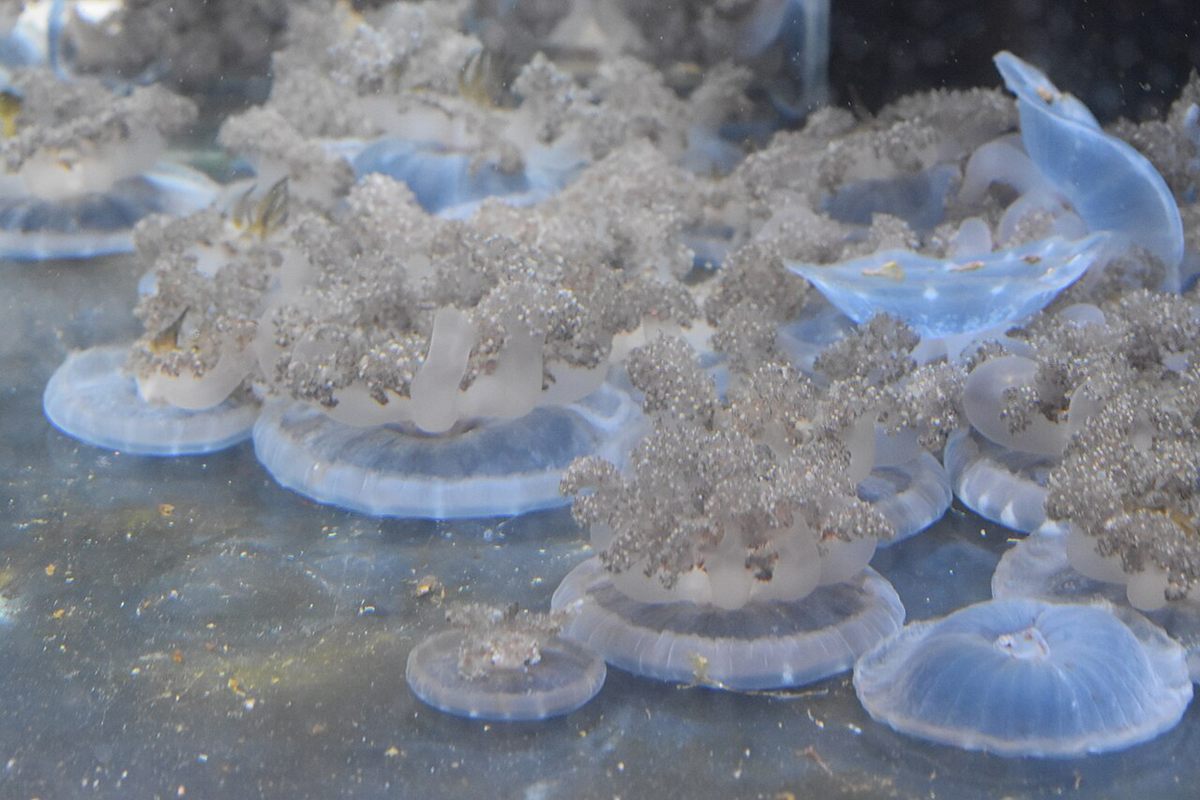
The upside-down jellyfish (Cassiopea andromeda) lies on the bottom of warm, shallow lagoons with its bell down and its frilly arms up, facing the sun. It originated in the Red Sea and has invaded the eastern Mediterranean.
The upside-down jellyfish (Cassiopea andromeda) lies on the bottom of warm, shallow lagoons with its bell down and its frilly arms up, facing the sun. It originated in the Red Sea and has invaded the eastern Mediterranean.
🧬 Field Guide Specimen: Open Upside-down Jellyfish in the CRV Science Field Guide to log the specimen, see its place among the Cnidaria+Ctenophora lineages in the Cladogram Explorer, and test your recall in the Red List conservation game.
Upside-down Jellyfish at a Glance
| Property | Value |
|---|---|
| Scientific name | Cassiopea andromeda |
| Kingdom | Animalia |
| Phylum | Cnidaria |
| Class | Scyphozoa |
| Order | Rhizostomeae |
| Family | Cassiopeidae |
| Field Guide group | Cnidaria + Ctenophora (Radiata & Jellies) |
| Diagnostic feature (Field Guide) | Rests bell-down on shallow sandy seafloors, waving frilly arms upward so symbiotic algae inside can photosynthesize. |
| Orientation | Bell down, arms up |
Evolutionary Systematics & Comparative Anatomy
Cassiopea andromeda, first described by Peter Forsskål in 1775 from the Red Sea, is the type species of the genus Cassiopea and family Cassiopeidae within the order Rhizostomeae, subclass Discomedusae, and class Scyphozoa (phylum Cnidaria). Unlike semaeostome scyphozoans such as the pelagic Moon Jellyfish (Aurelia aurita), which possess marginal tentacles and a single central mouth surrounded by four curtains of oral arms, rhizostome medusae—a clade that also includes the Fried Egg Jellyfish (Cotylorhiza tuberculata)—lack marginal bell tentacles and fuse their oral arms during early medusa development, replacing the primary central mouth with thousands of microscopic secondary mouthlets (ostioles). Molecular phylogenetic analyses of mitochondrial COI and nuclear 28S rDNA indicate that Cassiopea comprises a cryptic species complex across tropical Indo-Pacific and Atlantic-Caribbean mangrove lagoons, with Cassiopea andromeda representing a Lessepsian migrant that traversed the Suez Canal from the Red Sea to establish dense populations across the eastern and central Mediterranean Sea.
The adult medusa of Cassiopea andromeda exhibits a flattened, saucer-shaped exumbrella (bell) measuring 10 to 30 cm in diameter. Whereas pelagic medusae have a convex aboral surface for swimming through the water column, the aboral surface of Cassiopea andromeda is flattened or slightly concave and functions as a muscular suction disc that adheres to carbonate mud, sand, and seagrass beds against tidal shear. The bell margin is divided into 64 to 80 small marginal lappets and houses 16 (range 12 to 19) club-shaped sensory structures termed rhopalia, situated within shallow rhopaliar clefts.
Arising from the subumbrella is a short gastrovascular manubrium that divides into eight pinnately branched, cauliflower-like oral arms extending slightly beyond the bell margin. The oral surfaces of these arms bear densely clustered digitata (frilly tentacular projections) perforated by thousands of ciliated ostioles (10–50 μm wide) that lead via anastomosing gastrovascular canals into the central stomach cavity. Scattered among the digitata are elongated, flattened club-shaped or ribbon-like vesicles called vesicular appendages, which are colored olive-brown, tan, blue, or violet by structural pigments and dense intracellular populations of photosynthetic dinoflagellates.
Physiology, Biomechanics & Sensory Biology
The inverted, benthic posture of Cassiopea andromeda represents a biomechanical and metabolic specialization for photoautotrophic-heterotrophic mixotrophy. The gastrodermis and mesoglea of the oral arms and vesicular appendages harbor endosymbiotic dinoflagellates of the family Symbiodiniaceae (predominantly Symbiodinium microadriaticum, Cladocopium, and Durusdinium spp.), hosted inside specialized phagocytic mesogleal cells called amoebocytes at densities of 106 to 107 algal cells per gram of wet tissue. Under photosynthetically active radiation (PAR) in shallow lagoons (0.2 to 5 meters depth), the zooxanthellae fix dissolved inorganic carbon (HCO3- and CO2) into glycerol, glucose, and fatty acids, translocating up to 80–100% of the carbon required for the medusa's basal respiratory metabolism.
To sustain boundary-layer transport while resting on stagnant sediment, Cassiopea andromeda contracts its coronal and radial subumbrellar striated musculature at a continuous frequency of 0.5 to 1.2 Hz (30 to 70 pulses per minute). Particle-image velocimetry demonstrates that each bell contraction draws benthic porewater—enriched in NH4+, NO3-, and PO43- released by microbial sediment mineralization—radially inward under the bell margin, accelerates it across the branched oral arms, and ejects a vertical turbulent jet upward into the water column at velocities of 1 to 3 cm s-1. This active pumping simultaneously supplies inorganic nutrients and CO2 to the zooxanthellae, ventilates the tissue with dissolved O2, and drives demersal copepods, ostracods, and nematode prey against the nematocyst-armed digitata and ostioles.
When disturbed by predators or grazing fishes, Cassiopea andromeda releases clouds of mucus packed with autonomous, self-propelling cellular structures termed cassiosomes—described structurally in 2020. Each cassiosome is a hollow, popcorn-shaped multicellular body (100 to 550 μm in diameter) bounded by an outer epithelial layer of stinging nematocytes (predominantly birhopaloid and isorhiza nematocysts) interspersed with motile ciliated cells, surrounding a core of mesogleal jelly and symbiotic amoebocytes. Ciliary beating keeps cassiosomes suspended and spinning in the water column for up to 10 days, causing contact dermatitis ("stinging water" phenomenon) in swimmers and paralyzing planktonic crustacean prey at a distance. Furthermore, neurobiological monitoring by Nath et al. (2017) demonstrated that Cassiopea exhibits a reversible, homeostatically regulated circadian quiescent state at night—characterized by a 30% reduction in bell pulsing frequency, elevated arousal thresholds to mechanical stimuli, and compensatory rebound following nocturnal deprivation—establishing that behavioral sleep evolved in decentralized cnidarian nerve nets prior to the centralization of a bilaterian brain.
Trophic Ecology, Life History & Reproduction
In tropical mangrove fringes, back-reef flats, and coastal lagoons, Cassiopea andromeda acts as a benthic ecosystem engineer. At high population densities (often 10 to 60 medusae m-2), its continuous bell pulsing bioturbates the upper millimeters of sediment, oxygenates the water-sediment interface, and alters benthic-pelagic nutrient fluxes by sequestering dissolved inorganic nitrogen from porewater into cnidarian-algal biomass. Although armed with nematocysts and toxic peptides, the medusae are preyed upon by specialist nudibranchs (Dondice spp.), sea turtles, and butterflyfishes.
Like most scyphozoans, Cassiopea andromeda alternates between a benthic asexual polyp (scyphistoma) generation and a sexually reproducing dioecious medusa generation. Mature male medusae release flagellated spermatozoa from gastrodermal gonads into the water column, which are drawn into the ostioles of females to fertilize ova internally. Fertilized zygotes are brooded in clusters attached to the female's central vesicular appendages until they hatch as free-swimming, ciliated planula larvae. After 2 to 6 days, the planula detects specific chemical cues—such as low-molecular-weight peptides derived from decomposing mangrove leaves (Rhizophora mangle) and Vibrio bacterial biofilms—settles on the shaded underside of submerged mangrove roots or dead coral rubble, and metamorphoses into a goblet-shaped scyphistoma polyp with a long stalk and 32 perradial tentacles.
The scyphistoma reproduces asexually in two distinct ways: it buds off motile, planula-like lateral buds (planuloids) from its calyx base that crawl away to form new polyps, and it undergoes monodisc strobilation at the oral disc to pinch off a single juvenile medusa (ephyra, 2–4 mm wide) at a time. Specifically, aposymbiotic polyps will not initiate strobilation until they acquire zooxanthellae horizontally from the surrounding seawater into their oral endoderm, linking the developmental metamorphosis of the medusa directly to establishment of the algal symbiosis.
Frequently Asked Questions
How can Cassiopea andromeda sting swimmers who never touch the jellyfish?
When agitated or feeding, Cassiopea andromeda sheds mucus containing thousands of microscopic, autonomous multicellular spheres called cassiosomes into the surrounding water. Lined with venomous nematocysts and propelled by beating cilia, these tiny cellular grenades drift in shallow lagoon currents for days, stinging human skin on contact and causing the itchy rash known to divers as "stinging water."
Why does the upside-down jellyfish rest on its back instead of swimming in open water?
The oral arms of Cassiopea andromeda house millions of photosynthetic dinoflagellate algae (Symbiodiniaceae) that require direct sunlight to synthesize sugars via photosynthesis. By resting with its flattened bell pressed against the lagoon floor and its frilly oral arms spread upward like a solar collector, the jellyfish maximizes light capture for its symbionts while pulsing gently to circulate nutrient-rich sediment water.
How can a jellyfish sleep if it does not have a brain?
Although Cassiopea lacks a centralized brain and instead coordinates movement through a decentralized ring of pacemakers and a diffuse nerve net, laboratory tracking shows that it meets all behavioral criteria for sleep. At night its bell-pulsing rate drops by roughly one-third, it requires stronger sensory stimuli to react, and if kept awake at night by water jets, it exhibits daytime sleep rebound.
References
- Hofmann, D. K., Fitt, W. K., & Fleck, J. (1996). Checkpoints in the life-cycle of Cassiopea spp.: control of metagenesis and metamorphosis in a tropical cnidarian. International Journal of Developmental Biology, 40(1), 331–338. https://doi.org/10.1387/ijdb.8735945
- Santhanakrishnan, A., Dollinger, M., Hamlet, C. L., Colin, S. P., & Miller, L. A. (2012). Flow structure and transport characteristics of feeding and exchange currents generated by upside-down jellyfish Cassiopea spp. Journal of Experimental Biology, 215(14), 2369–2381. https://doi.org/10.1242/jeb.053744
- Nath, R. D., Bedbrook, C. N., Abrams, M. J., Basinger, T., Bois, J. S., Prober, D. A., Sternberg, P. W., Gradinaru, V., & Goentoro, L. (2017). The jellyfish Cassiopea exhibits a sleep-like state. Current Biology, 27(19), 2984–2990.e3. https://doi.org/10.1016/j.cub.2017.08.014
- Ames, C. L., Klompen, A. M. L., Badhiwala, K., Muffett, K., Reft, A. J., Kumar, M., Janssen, J. D., Schultzhaus, J. N., Field, L. D., Muroski, M. E., Bezuidenhout, D., Robinson, J. T., Leary, D. H., Cartwright, P., Collins, A. G., & Vora, G. J. (2020). Cassiosomes are stinging-cell structures in the mucus of the upside-down jellyfish Cassiopea xamachana. Communications Biology, 3(1), 67. https://doi.org/10.1038/s42003-020-0777-8