Moon Jellyfish
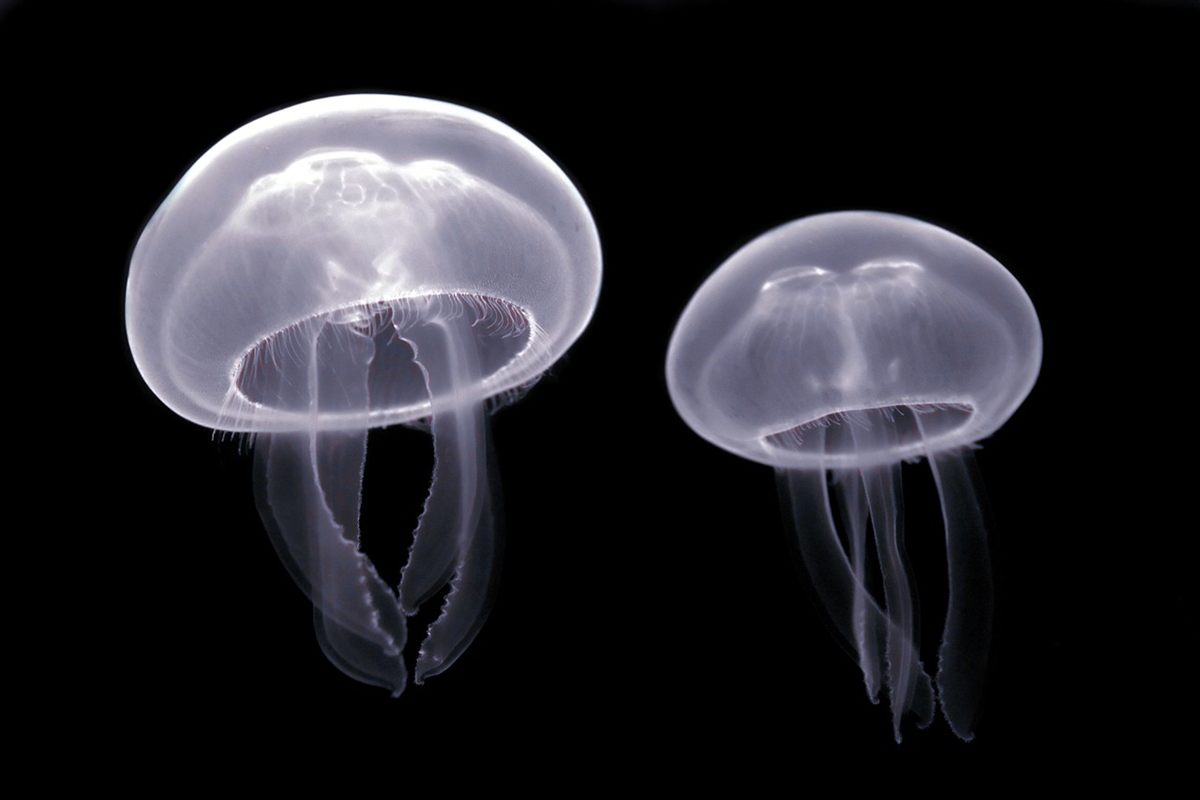
The moon jellyfish (Aurelia aurita) is a nearly worldwide, translucent jellyfish with four horseshoe-shaped gonads showing through its bell. Its sting is too weak to harm most people, and it is among the best-studied jellyfish.
The moon jellyfish (Aurelia aurita) is a nearly worldwide, translucent jellyfish with four horseshoe-shaped gonads showing through its bell. Its sting is too weak to harm most people, and it is among the best-studied jellyfish.
🧬 Field Guide Specimen: Open Moon Jellyfish in the CRV Science Field Guide to log the specimen, see its place among the Cnidaria+Ctenophora lineages in the Cladogram Explorer, and test your recall in the Red List conservation game.
A Two-Phase Life Cycle
Fertilized eggs develop into larvae that settle and become small polyps. In the right season a polyp divides into a stack of discs that break away as tiny medusae (ephyrae), which grow into adults. Polyps can multiply asexually, which explains the sudden blooms.
Catching Food
The jelly pulses to move water across a fringe of short tentacles coated in mucus, which traps plankton that is then wiped into the mouth. Efficient pulsing makes jellyfish one of the most energy-economical swimmers. See Scyphozoa propulsion.
Jellyfish in Space
In 1991, moon jelly polyps were flown aboard the Space Shuttle Columbia and produced thousands of ephyrae in orbit. After returning to Earth, many had pulsing abnormalities, evidence that gravity influences the development of the balance organs.
Moon Jellyfish at a Glance
| Property | Value |
|---|---|
| Scientific name | Aurelia aurita |
| Kingdom | Animalia |
| Phylum | Cnidaria |
| Class | Scyphozoa |
| Order | Semaeostomeae |
| Field Guide group | Cnidaria + Ctenophora (Radiata & Jellies) |
| Diagnostic feature (Field Guide) | Translucent saucer bell, four prominent horseshoe-shaped gonads, scalloped margin with rhopalia. |
| Class | Scyphozoa |
| Distribution | Temperate and tropical oceans worldwide |
See Also
- Scyphozoa propulsion — how jellyfish swim
- Ocean acidification — changing seas and jellyfish blooms