Great Auk
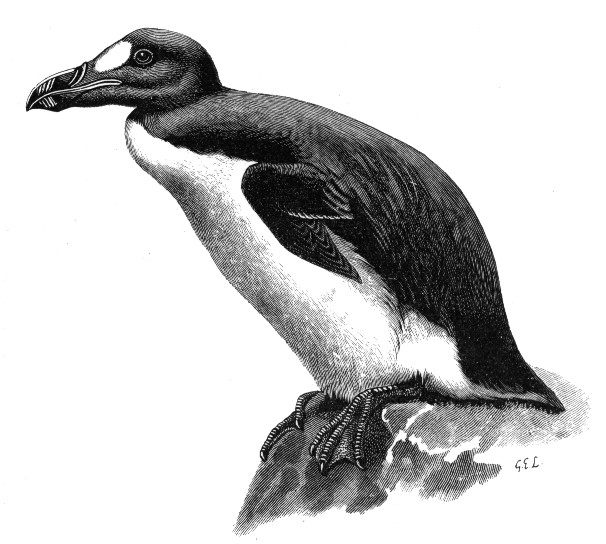
The great auk (Pinguinus impennis) was a large, flightless seabird of the North Atlantic that looked like a penguin. Hunted for meat, eggs and feathers, the last known pair was killed in 1844 off Iceland.
The great auk (Pinguinus impennis) was a large, flightless seabird of the North Atlantic that looked like a penguin. Hunted for meat, eggs and feathers, the last known pair was killed in 1844 off Iceland.
🧬 Field Guide Specimen: Open Great Auk in the CRV Science Field Guide to log the specimen, see its place among the Evolutionary lineages in the Cladogram Explorer, and test your recall in the Red List conservation game.
The Original Penguin
The word "penguin" was first applied to the great auk. When European explorers found similar flightless birds in the Southern Hemisphere, they were named for it, though the two groups are unrelated. This is a case of convergent evolution of a wing-propelled swimmer.
Why Did It Vanish?
Great auks nested in a few dense colonies on rocky islands, where they were easy to kill. Sailors and fishermen harvested them for food, oil and down for pillows, and collectors paid high prices for skins and eggs as the birds became rare.
A Warning
The great auk is a textbook case of human-caused extinction, and the IUCN lists it as Extinct. Its closest living relatives are the razorbill and other auks. See Dodo.
Great Auk at a Glance
| Property | Value |
|---|---|
| Scientific name | Pinguinus impennis |
| Kingdom | Animalia |
| Phylum | Chordata |
| Class | Aves |
| Order | Charadriiformes |
| Family | Alcidae |
| Field Guide group | Evolutionary Oddities (Unique & Disputed Lineages) |
| Diagnostic feature (Field Guide) | Extinct flightless North Atlantic alcid with black back, white belly, large grooved beak, and tiny flipper-like wings. |
| IUCN Red List status | Extinct (EX), assessed 2021 |
| Last record | 1844, off Iceland |
See Also
- Dodo — another extinct flightless bird
- Emperor Penguin — a true penguin