Great Horned Owl
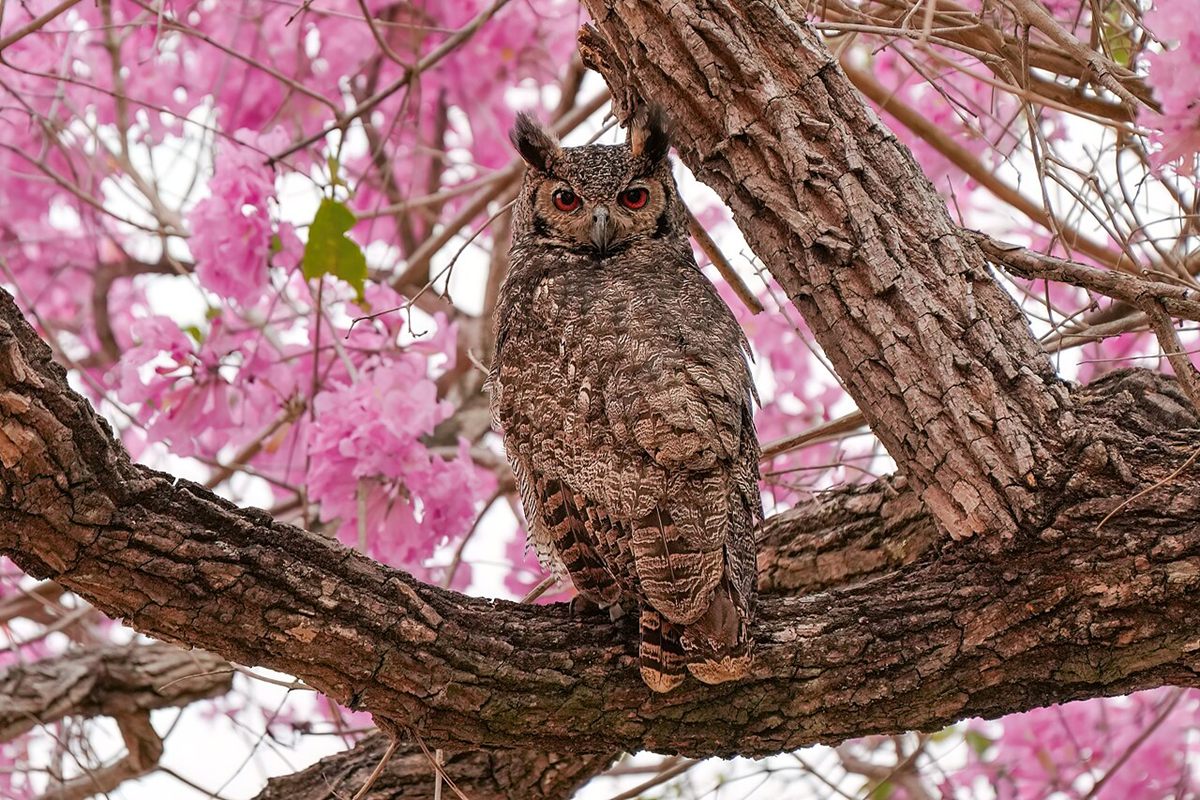
The great horned owl (Bubo virginianus) is a powerful, widely distributed owl of the Americas, easily recognized by its prominent feather tufts ('horns'). It hunts everything from mice to skunks and other owls.
The great horned owl (Bubo virginianus) is a powerful, widely distributed owl of the Americas, easily recognized by its prominent feather tufts ("horns"). It hunts everything from mice to skunks and other owls.
🧬 Field Guide Specimen: Open Great Horned Owl in the CRV Science Field Guide to log the specimen, see its place among the Reptilia lineages in the Cladogram Explorer, and test your recall in the Red List conservation game.
A Silent Hunter
Soft fringes on the flight feathers muffle the sound of its wings. Large eyes gather light, and ears placed asymmetrically on the skull locate prey in total darkness by sound.
A Crushing Grip
The talons can exert a force of over 100 pounds per square inch, enough to sever the spine of its prey. The owl is one of the few animals that routinely eats skunks, and is said to have little sense of smell.
Adaptable and Early Nesting
It uses nests abandoned by hawks, crows and herons and begins breeding in midwinter. See Snowy Owl.
Great Horned Owl at a Glance
| Property | Value |
|---|---|
| Scientific name | Bubo virginianus |
| Kingdom | Animalia |
| Phylum | Chordata |
| Class | Aves |
| Order | Strigiformes |
| Family | Strigidae |
| Field Guide group | Reptilia: Aves (Birds) |
| Diagnostic feature (Field Guide) | Powerful nocturnal predator of the Americas with prominent feather tufts ('horns') on the head, mottled bark-camouflaged plumage, a white throat patch, and a crushing talon grip. |
| IUCN Red List status | Least Concern (LC), assessed 2018 |
| Family | Strigidae |
| Tufts | Feather tufts, not ears |
See Also
- Snowy Owl — a close relative
- Red-tailed Hawk — a diurnal raptor