Keratella Rotifer
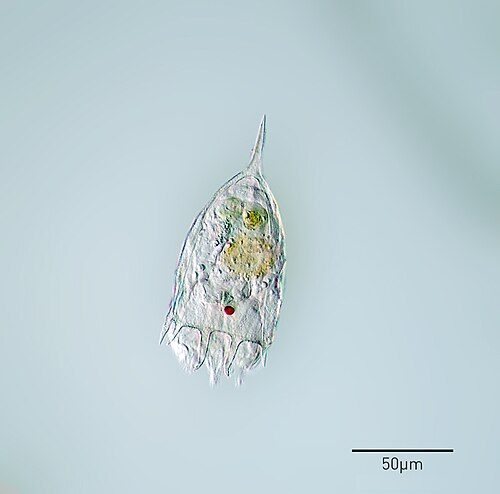
Keratella cochlearis is a tiny planktonic rotifer, only a fraction of a millimeter long, found in lakes and ponds around the world. Its body is enclosed in a sculpted, plate-like shell called a lorica.
Keratella cochlearis is a tiny planktonic rotifer, only a fraction of a millimeter long, found in lakes and ponds around the world. Its body is enclosed in a sculpted, plate-like shell called a lorica.
🧬 Field Guide Specimen: Open Keratella Rotifer in the CRV Science Field Guide to log the specimen, see its place among the Lophotrochozoa lineages in the Cladogram Explorer, and test your recall in the Red List conservation game.
Spines on Demand: What Is Cyclomorphosis?
The length of the spine at the rear of the lorica varies with the season and with the presence of predators. Chemical cues from predatory rotifers can trigger offspring with longer spines that are harder to eat, an inducible defense.
A Link in Lake Food Webs
Keratella filters algae and bacteria with its ciliary crown and is eaten by larger zooplankton and young fish. The species is common in nutrient-rich lakes and is used as an indicator of water quality. See Eutrophication.
Reproduction
Like other planktonic rotifers, it reproduces by parthenogenesis for most of the season, with occasional sexual generations producing resting eggs.
Keratella Rotifer at a Glance
| Property | Value |
|---|---|
| Scientific name | Keratella cochlearis |
| Kingdom | Animalia |
| Phylum | Rotifera |
| Class | Eurotatoria |
| Subclass | Monogononta |
| Order | Ploima |
| Field Guide group | Lophotrochozoa: Worms, Shells & Allies |
| Diagnostic feature (Field Guide) | Tiny plankton animal with a sculptured plated armor (lorica), a single long posterior spine, and a crown of beating cilia for filter-feeding. |
| Phylum | Rotifera |
| Defense | Predator-induced spines |