Lettuce Sea Slug
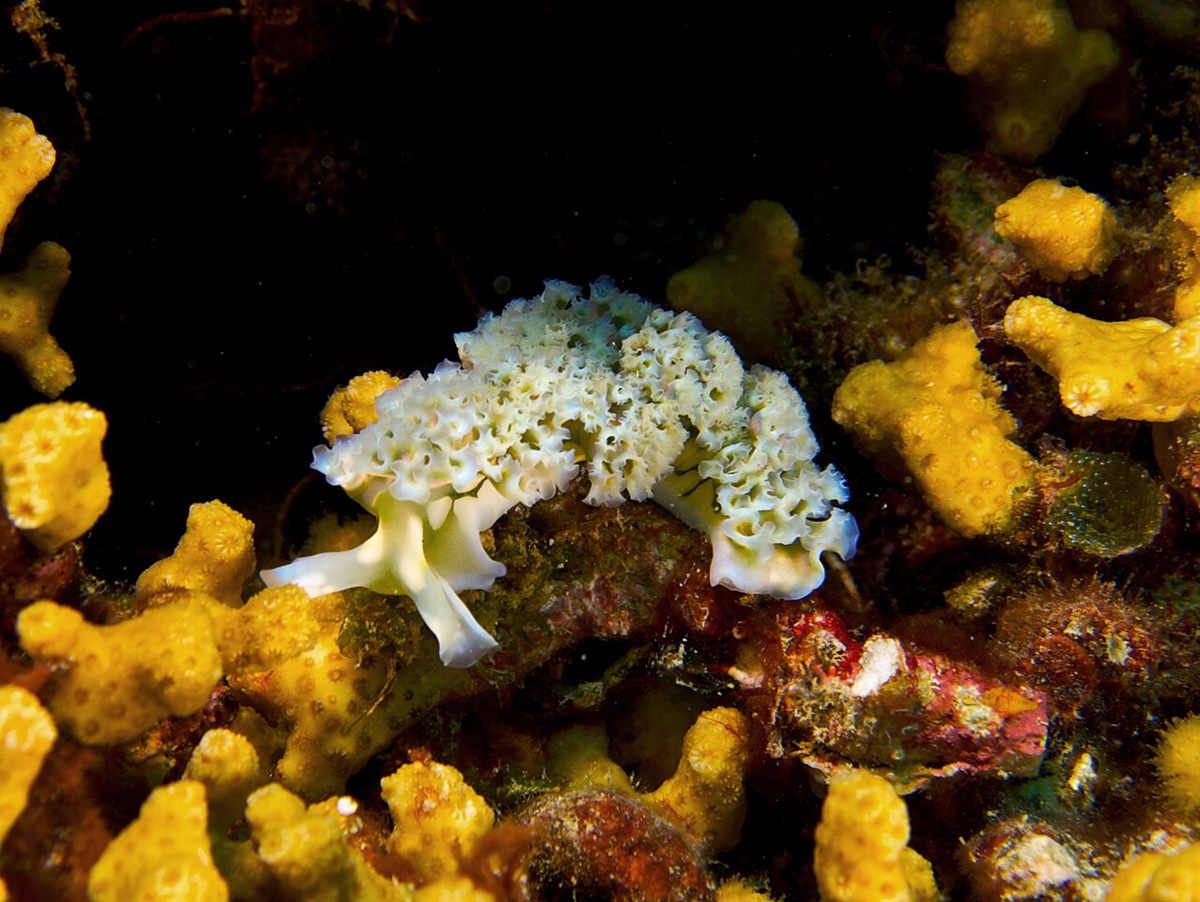
The lettuce sea slug (Elysia crispata) is a frilly green sea slug of Caribbean reefs that looks like a lettuce leaf. Like its relative the eastern emerald elysia, it keeps chloroplasts stolen from the algae it eats.
The lettuce sea slug (Elysia crispata) is a frilly green sea slug of Caribbean reefs that looks like a lettuce leaf. Like its relative the eastern emerald elysia, it keeps chloroplasts stolen from the algae it eats.
🧬 Field Guide Specimen: Open Lettuce Sea Slug in the CRV Science Field Guide to log the specimen, see its place among the Lophotrochozoa lineages in the Cladogram Explorer, and test your recall in the Red List conservation game.
Lettuce Sea Slug at a Glance
| Property | Value |
|---|---|
| Scientific name | Elysia crispata |
| Kingdom | Animalia |
| Phylum | Mollusca |
| Class | Gastropoda |
| Order | Sacoglossa |
| Family | Plakobranchidae |
| Field Guide group | Lophotrochozoa: Mollusca (Mollusks) |
| Diagnostic feature (Field Guide) | Shell-less Caribbean reef dweller whose ruffled, curly dorsal folds (parapodia) resemble green leaf lettuce and house functional chloroplasts stolen intact from the algae it pierces and sucks. |
| Habitat | Caribbean reefs |
Evolutionary Systematics and Comparative Anatomy
Elysia crispata (formerly frequently placed in the genus Tridachia) is a marine heterobranch gastropod belonging to the family Plakobranchidae within the superorder Sacoglossa, the clade of sap-sucking sea slugs. Molecular phylogenetic analyses integrating mitochondrial (COI, 16S rRNA) and nuclear (28S rRNA, histone H3) markers demonstrate that E. crispata forms a species complex across the tropical Western Atlantic and Caribbean Sea, closely allied to Elysia clarki (now widely synonymized with E. crispata as an ecophenotypic variant of mangrove and lagoonal habitats) and Elysia patagonica.
Unlike shelled oxynoacean sacoglossans, adult E. crispata lack an external or internal calcium carbonate shell, which is cast off shortly after larval metamorphosis. Adults reach lengths of 50 to 75 mm and widths of 20 to 30 mm, making this one of the largest sacoglossan species in the Atlantic basin. Its most conspicuous anatomical feature is the pair of extensively folded, undulate lateral body flaps known as parapodia. In E. crispata, the parapodial margins undergo secondary and tertiary crenellation (ruffling), creating a dense, ruffled dorsal canopy that mimics a frond of curly leaf lettuce or a foliose reef macroalga. Anteriorly, the head bears a pair of rolled, grooved rhinophores rich in chemosensory and mechanosensory cilia, positioned just above a pair of simple subepidermal cerebral eyes.
Beneath the translucent dorsal epidermis, the digestive gland (hepatopancreas) ramifies into an intricate, finely branched network of diverticula that extend throughout the parapodia and along the dorsal vessels from the pericardial prominence. The buccal apparatus displays the diagnostic synapomorphy of the Sacoglossa: a uniseriate radula bearing a single longitudinal file of blade-shaped, dagger-like chitinous teeth. Rather than discarding worn anterior teeth into the gut like other gastropods, E. crispata retains its discarded radular teeth inside a blind ventral storage sac called the ascus, from which the taxon derives the name Ascoglossa.
Physiology, Biomechanics, and Sensory Biology
Functional Kleptoplasty and Plastid Maintenance
Like its temperate Northwest Atlantic relative the Solar-powered Sea Slug (Elysia chlorotica), E. crispata is a long-term functional kleptoplast: it sequesters intact, photosynthetically active Chloroplast organelles (kleptoplasts) from siphonous green algae and maintains them inside specialized phagocytic cells lining the digestive gland tubules for 40 to 90 days. During feeding, the slug punctures the multinucleate coenocytic filaments of ulvophycean algae, sucks out the cytoplasm, digests the algal nuclei, mitochondria, and endomembranes, and engulfs the undamaged plastids into host symbiosomes or releases them directly into the digestive cell cytosol.
Within the animal host, these stolen plastids continue to perform oxygenic photosynthesis, splitting water (H2O), driving photosynthetic electron transport through Photosystems II and I, and fixing dissolved inorganic carbon (HCO3- and CO2) via the Calvin-Benson-Bassham cycle into triose phosphates, glucose, and galactose. Pulse-amplitude-modulated (PAM) fluorometry of E. crispata shows maximum quantum yields of Photosystem II (Fv/Fm) between 0.60 and 0.72, comparable to intact algal thalli, while stable isotope (13C-bicarbonate) tracer studies confirm that photosynthetically fixed carbon is translocated from the kleptoplasts to the slug's mucus-secreting pedal glands, gonads, and general somatic tissues, supplying up to 35% to 60% of the animal's daily respiratory carbon budget and enabling survival during weeks of starvation.
Because algal plastid genomes encode only about 10% of the proteins required for photosynthetic function and repair—and RNA-sequencing studies of E. crispata have found no horizontally transferred algal nuclear genes integrated into the slug's nuclear genome—long-term plastid survival relies on two complementary mechanisms:
- Intrinsic plastid robustness: Siphonous bryopsidalean and dasycladalean algae possess sturdy plastids encoding plastid-resident FtsH proteases and stress-response chaperones that slow photooxidative damage to the D1 reaction-center protein (PsbA).
- Behavioral and structural photoprotection: When exposed to excessive downwelling irradiance (above 500 to 800 micromol photons m-2 s-1), E. crispata curls its ruffled parapodia inward over the dorsal midline to shade the digestive diverticula, while synthesizing ultraviolet-absorbing mycosporine-like amino acids (MAAs) and carotenoids in the outer epidermis.
Secondary Metabolites and Chemical Defense
Having lost its protective shell, E. crispata relies on crypsis and chemical defense against reef predators such as wrasses, damselfishes, and xanthid crabs. In addition to sequestering diterpenoid metabolites (such as halimedatetraacetate and caulerpenyne) from its algal diet, E. crispata synthesizes endogenously derived polypropionate pyrones—specifically crispatic acid, tridachiapyrone A–F, and phototridachiapyrone—directly from photosynthetically fixed propionate and acetate precursors via polyketide synthase pathways. Concentrated in the ruffled parapodial margins, these polypropionates both deter fish predation and undergo light-driven pericyclic rearrangements that absorb damaging UV-B radiation.
Trophic Ecology, Life History, and Reproduction
Ontogenetic Diet Shifts and Polyphagous Grazing
Inhabits shallow coral reefs, back-reef rubble zones, seagrass beds, and mangrove prop-root channels from Florida, the Bahamas, and Bermuda south throughout the Caribbean Sea to Venezuela and Brazil at depths of 0.5 to 25 m. Unlike stenophagous sacoglossans restricted to a single algal host, E. crispata is polyphagous, harvesting kleptoplasts from a diverse suite of siphonous ulvophycean macroalgae, including Bryopsis plumosa, Derbesia tenuissima, Penicillus capitatus, Halimeda incrassata, Udotea flabellum, and Acetabularia crenulata.
DNA barcoding of sequestered plastid rbcL and tufA genes reveals a distinct ontogenetic diet shift. Newly metamorphosed juveniles feed preferentially on thin-walled, filamentous algae such as Bryopsis and Derbesia whose delicate cell walls can be pierced by small juvenile radular teeth (15 to 25 micrometers long). As the slug grows and develops larger, stiffer radular blades (up to 90 micrometers long), it transitions to calcified or thick-walled siphonous genera such as Halimeda and Penicillus, whose plastids exhibit greater longevity inside the digestive diverticula. Variations in the proportions of chlorophyll a, chlorophyll b, siphonaxanthin, and siphonein among these algal hosts, combined with epidermal pigment synthesis, produce the wide color polymorphism seen across Caribbean populations—ranging from emerald green and olive to pale blue, lavender, and yellow-trimmed morphs.
Hermaphroditic Mating and Poecilogony
Elysia crispata is a simultaneous hermaphrodite possessing an ovotestis that produces both spermatozoa and ova, paired with complex reproductive ducts including an albumen gland, capsule gland, bursa copulatrix, and an unarmed conical penis behind the right rhinophore. Mating occurs via reciprocal or unilateral hypodermic insemination or gonopore copulation, after which individuals deposit flat, spiral ribbons of gelatinous white or yellowish egg masses cemented to rock or algal fronds.
Caribbean populations of the E. crispata / E. clarki complex display developmental plasticity in larval life history. Depending on maternal lineage and local habitat conditions, egg ribbons contain either numerous small ova (90 to 110 micrometers) linked to meager extra-zygotic yolk reserves that hatch after 12 to 15 days into planktotrophic veliger larvae requiring 3 to 4 weeks of pelagic feeding before settlement, or fewer large ova (160 to 210 micrometers) accompanied by nutrient-rich extra-capsular yolk granules that support intracapsular metamorphosis, hatching after 22 to 28 days directly as crawling, benthic juveniles or short-lived lecithotrophic veligers.
Frequently Asked Questions
How does the lettuce sea slug keep stolen algal chloroplasts alive without algal nuclei?
Although the lettuce sea slug does not acquire algal nuclear genes through horizontal gene transfer, it specifically feeds on siphonous green algae (Halimeda, Penicillus, Bryopsis) whose chloroplasts naturally possess enhanced self-repair machinery and low reactive oxygen generation. Furthermore, the slug actively shields its kleptoplasts from photodamage by folding its ruffled parapodia over its back under intense sunlight and screening ultraviolet rays with polypropionate compounds.
Why do lettuce sea slugs vary in color from bright green to blue, yellow, and purple?
The base green coloration of Elysia crispata comes directly from the chlorophyll a, chlorophyll b, and siphonaxanthin pigments inside the thousands of stolen chloroplasts packed into the branched digestive tubules beneath its transparent skin. Superimposed on this green base are epidermal pigments—carotenoids, biliproteins, and UV-filtering polypropionates—that vary with the specific algal species eaten, ambient light intensity, and genetic background.
What is the function of the ascus in the feeding apparatus of Elysia crispata?
The ascus is a blind-ending muscular pouch located beneath the radular sac that is diagnostic of the sea slug superorder Sacoglossa. Because a sacoglossan pierces tough algal cell walls with a single leading tooth at a time, old teeth wear down rapidly; instead of shedding worn teeth into the digestive tract, the slug stores every discarded tooth in chronological order inside the ascus, preserving a complete record of its growth from hatching to adulthood.
References
- Pierce, S. K., Curtis, N. E., & Middlebrooks, M. L. (Apr 6, 2015). Sacoglossan sea slugs make routine use of photosynthesis by a variety of different mechanisms. Invertebrate Biology, 134(2), 103–115. https://doi.org/10.1111/ivb.12082
- Krug, P. J., Vendetti, J. E., & Valdés, Á. (Aug 9, 2016). Molecular and morphological systematics of Elysia Risso, 1818 (Heterobranchia: Sacoglossa) from the Caribbean region. Zootaxa, 4148(1), 1–137. https://doi.org/10.11646/zootaxa.4148.1.1
- Middlebrooks, M. L., Bell, S. S., & Pierce, S. K. (Sep 23, 2012). The kleptoplastic sea slug Elysia clarki prolongs photosynthesis by synthesizing chlorophyll a and b. Symbiosis, 57(3), 127–132. https://doi.org/10.1007/s13199-012-0187-x
- Wägele, H., Deusch, O., Händeler, K., Martin, R., Schmitt, V., Christa, G., ... & Martin, W. (Jan 1, 2011). Transcriptomic evidence that longevity of acquired plastids in the photosynthetic slugs Elysia timida and Plakobranchus ocellatus does not entail lateral transfer of algal nuclear genes. Molecular Biology and Evolution, 28(1), 699–706. https://doi.org/10.1093/molbev/msq239