Solar-powered Sea Slug
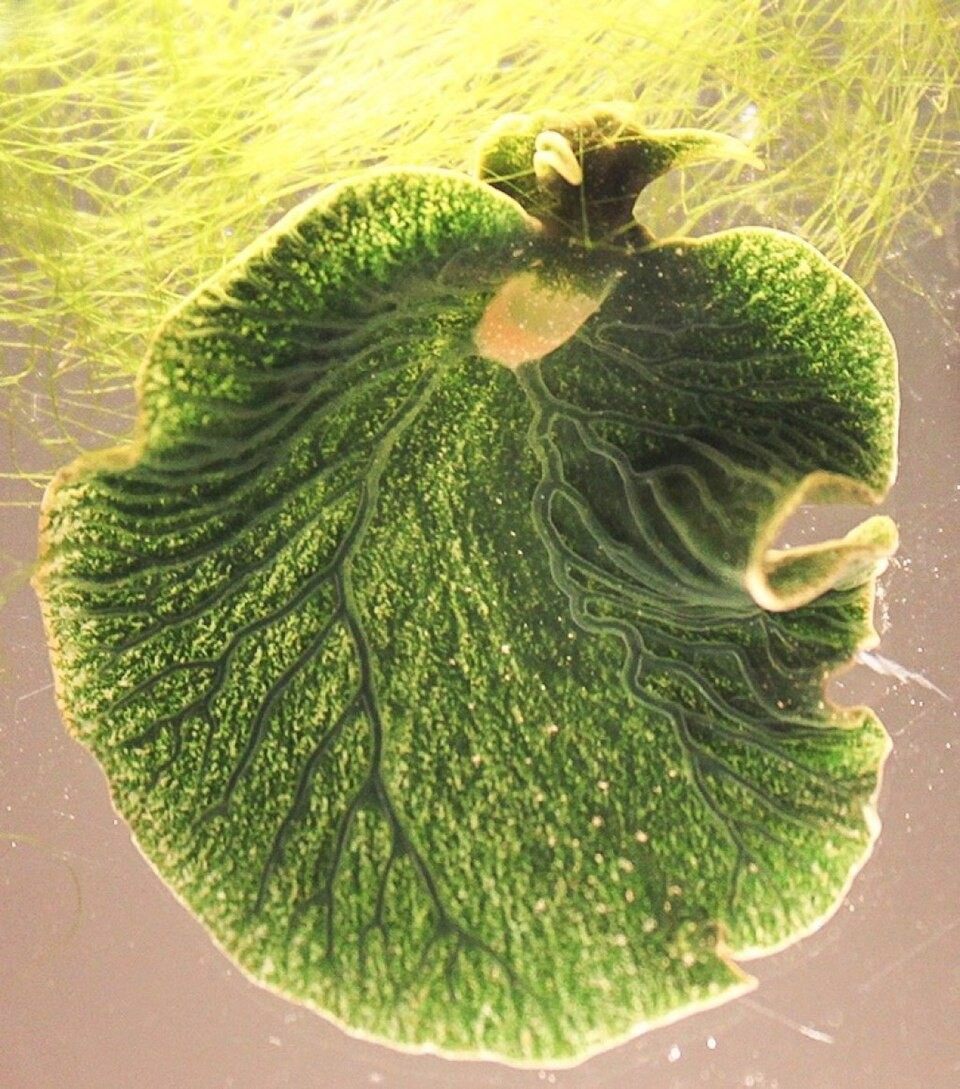
The solar-powered sea slug or eastern emerald elysia (Elysia chlorotica) is a small green sea slug of salt marshes in the northeastern United States.
The solar-powered sea slug or eastern emerald elysia (Elysia chlorotica) is a small green sea slug of salt marshes in the northeastern United States. It steals chloroplasts from the algae it eats and keeps them working inside its own cells, a phenomenon called kleptoplasty.
🧬 Field Guide Specimen: Open Solar-powered Sea Slug in the CRV Science Field Guide to log the specimen, see its place among the Lophotrochozoa lineages in the Cladogram Explorer, and test your recall in the Red List conservation game.
Solar-powered Sea Slug at a Glance
| Property | Value |
|---|---|
| Scientific name | Elysia chlorotica |
| Kingdom | Animalia |
| Phylum | Mollusca |
| Class | Gastropoda |
| Order | Sacoglossa |
| Family | Plakobranchidae |
| Field Guide group | Lophotrochozoa: Mollusca (Mollusks) |
| Diagnostic feature (Field Guide) | Bright green leaf-like sacoglossan sea slug, parapodia harboring intact stolen Vaucheria chloroplasts via kleptoplasty. |
| Stolen organelle | Chloroplasts |
Evolutionary Systematics & Comparative Anatomy
Elysia chlorotica, first described by American conchologist Augustus Addison Gould in 1870, is a marine heterobranch gastropod belonging to the superorder Sacoglossa ("sap-sucking sea slugs") and family Plakobranchidae. Within Sacoglossa—a clade of roughly 300 species characterized by a uniseriate radula with a single row of blade-like teeth and an ascus sac that retains discarded worn teeth—long-term functional kleptoplasty (retention of active photosynthetic plastids for weeks to months) has evolved in only six species across four genera (Elysia chlorotica, Elysia timida, Elysia crispata/clarki, Elysia viridis, Plakobranchus ocellatus, and Costasiella ocellifera). Phylogenetically, E. chlorotica occupies a western North Atlantic lineage distributed across intertidal salt marshes, brackish creeks, and tidal pools from Nova Scotia, Canada, south to southern Florida and Texas.
Adult Elysia chlorotica lose their larval shell at metamorphosis and develop a dorsoventrally flattened, leaf-shaped body measuring 20 to 30 millimeters in routine length, with large specimens reaching up to 45 to 60 millimeters. The lateral margins of the mantle are expanded into two wide, wing-like fleshy flaps called parapodia. When the slug rests on illuminated mudflats, it unfolds these parapodia flat like a dicotyledonous plant leaf—complete with pale branching ridges that resemble leaf veins—to maximize surface area for photon capture; when disturbed or swimming, it rolls the parapodia upward over its dorsal midline. The head bears a pair of rolled, ear-like chemosensory rhinophores that detect dissolved algal metabolites.
Internally, the anatomy of E. chlorotica is dominated by a finely ramified digestive gland (hepatopancreas) whose diverticula branch symmetrically throughout the entire volume of the dorsal body wall and both parapodia, terminating directly beneath the transparent, mucus-secreting epidermis. These digestive diverticula are lined by specialized phagocytic epithelial cells that engulf and house millions of intact algal plastids, imparting a vibrant emerald-green coloration to the adult animal. Simultaneously, the network of dorsal vessels and pericardial complex—visible as the "veins" across the inner parapodial surface—functions both in hemolymph circulation and in distributing dissolved oxygen (O2), carbon dioxide (CO2), and translocated photosynthates between the kleptoplasts and the animal's non-photosynthetic tissues.
Physiology, Biomechanics & Sensory Biology
The hallmark of Elysia chlorotica is its capacity for long-term endosymbiotic kleptoplasty: the intracellular sequestration and maintenance of functional Chloroplast organelles harvested from its obligate heterokont algal prey, the coenocytic (multinucleate, siphonous) yellow-green xanthophyte Vaucheria litorea (or Vaucheria compacta). During feeding, the slug clasps a tubular filament of V. litorea with its grooved oral lobes, punctures the cellulosic cell wall using its single leading chisel-shaped radular tooth (measuring 25 to 30 micrometers), and sucks out the pressurized cytoplasm using a muscular pharyngeal bulb. Inside the digestive tract, the algal nuclei, mitochondria, and vacuoles are enzymatically digested, whereas the secondary plastids—derived evolutionarily from a red algal endosymbiont and surrounded by four envelope membranes—are selectively phagocytosed intact by the digestive gland cells, stripped of their outer endoplasmic reticulum membranes, and maintained free within the animal cytosol.
Once incorporated into the digestive diverticula, the stolen plastids carry out oxygenic Photosynthesis for up to 9 to 10 months in the absence of any further algal ingestion—a duration longer than that of any other known sacoglossan. Illuminated slugs fix inorganic bicarbonate (HCO3−) and CO2 via the Calvin-Benson cycle into soluble carbohydrates (principally glucose and galactose) and lipids, which are exported to the host animal cells to fuel basal metabolism, mucus synthesis, and gametogenesis. How Vaucheria plastids remain photosynthetically competent for months inside an animal cell without the algal nucleus—which normally encodes roughly 90 percent of the proteins required for chloroplast repair, including photosystem II (PSII) reaction-center turnover—has been the subject of intense molecular scrutiny. While early PCR-based studies proposed widespread Horizontal gene transfer (HGT) of algal nuclear genes (such as psbO, prk, and ftsH) into the sea slug's germline chromosomes, chromosome-level genome sequencing and transcriptomics of E. chlorotica have found zero evidence of functional algal nuclear genes integrated into the slug's nuclear DNA.
Instead, the longevity of kleptoplasts inside Elysia chlorotica stems from three complementary mechanisms. First, the plastid genome (cpDNA) of Vaucheria litorea is genetically more autonomous than that of land plants or green algae: it retains the gene ftsH (encoding the metalloprotease required to degrade photo-damaged D1 proteins in PSII) and tufA (translation elongation factor Tu), enabling the isolated plastid to synthesize replacement D1 reaction-center proteins and repair photoinhibition on its own. Second, the plastids exhibit high cyclic electron flow around photosystem I and non-photochemical quenching that minimize singlet oxygen (1O2) generation. Third, the host slug dynamically regulates light exposure by opening or folding its parapodia and upregulates endogenous animal stress-response, antioxidant, and lipid-peroxidation repair pathways while suppressing lysosomal digestion of functional plastids. Moreover, residing in northern estuarine salt marshes, E. chlorotica is a euryhaline osmoconformer capable of surviving salinities from 5 to 35 practical salinity units (PSU) and subfreezing winter marsh temperatures down to −2 °C by accumulating intracellular free amino acids (taurine, glycine, alanine, and proline) and betaines.
Trophic Ecology, Life History & Reproduction
In the wild, Elysia chlorotica is an obligate stenophagous herbivore restricted to intertidal and subtidal mats of the xanthophyte alga Vaucheria litorea along the muddy banks of Spartina (Sporobolus alterniflorus) salt marshes and tidal creeks. Because Vaucheria filaments grow as multinucleate coenocytic tubes lacking internal cross-walls (septa), a single radular puncture allows the slug to drain thousands of chloroplasts from a long segment of filament in seconds without ingesting bulky structural cell walls. Once a juvenile slug has fed intensively on V. litorea for 7 to 14 days following metamorphosis, its digestive diverticula become saturated with kleptoplasts, and the slug can survive the remainder of its 9- to 11-month adult lifespan on light, CO2, and dissolved mineral nutrients in seawater—although wild individuals periodically graze on Vaucheria when available to replenish senescent plastids.
The life history of E. chlorotica follows an annual, synchronized cohort cycle coupled with obligate plastid-mediated metamorphosis. Adults are simultaneous hermaphrodites possessing an ovotestis; in spring (April to May), pairs cross-fertilize by hypodermic insemination or copulation and deposit gelatinous, spiral ribbons containing 10,000 to 50,000 fertilized eggs attached to Vaucheria mats or marsh peat. Importantly, kleptoplasts are not inherited vertically through the eggs; embryos develop for 7 to 10 days into shell-bearing, planktonic veliger larvae devoid of chloroplasts. The translucent veligers swim and feed on unicellular phytoplankton in the water column for 2 to 3 weeks before settling onto filamentous mats of Vaucheria litorea, triggered by chemical cues from the alga and its associated biofilm bacteria.
Upon settlement, the veliger sheds its larval shell and velum to become a translucent, reddish-brown juvenile slug. If the juvenile is deprived of Vaucheria litorea at this stage, development arrests and the animal dies within days; only after feeding on V. litorea for 5 to 7 days and sequestering its first stable cohort of kleptoplasts does the juvenile undergo secondary metamorphosis, expanding its lateral parapodia and turning permanently emerald green. Following a single year of growth and spring reproduction, the entire adult generation undergoes a synchronized, programmed post-reproductive senescence and mortality event across the population. At that moment of synchronized death, tissues of E. chlorotica spontaneously express high titers of endogenous retroviruses, coupled with autophagic degradation of the digestive cells and kleptoplasts. While not formally evaluated by the IUCN Red List, Elysia chlorotica populations are patchy and ephemeral, making local salt marsh cohorts sensitive to coastal dredging, marsh ditching, nutrient eutrophication that smothers Vaucheria mats under Ulva blooms, and sea-level rise.
Frequently Asked Questions
How can the solar-powered sea slug survive for months on sunlight alone?
When Elysia chlorotica feeds on the yellow-green alga Vaucheria litorea, it punctures the algal filaments and sucks out the cytoplasm. Rather than digesting the entire meal, specialized cells lining its branched digestive tract engulf the algal chloroplasts intact and keep them alive inside the animal's cells—a process called kleptoplasty—allowing the slug to photosynthesize sugars and lipids for up to 9 to 10 months.
Did Elysia chlorotica steal photosynthetic genes from its algal food?
Although early studies suggested that Elysia chlorotica had acquired algal nuclear genes via horizontal gene transfer, whole-genome sequencing of the sea slug proved that no functional algal nuclear genes are present in the slug's chromosomes. Instead, the stolen Vaucheria chloroplasts survive because their own plastid DNA retains repair genes (like ftsH and tufA) that most plant chloroplasts lost to the nucleus.
Are baby solar-powered sea slugs born with chloroplasts already inside them?
No, kleptoplasts are not passed down in the eggs. Every generation hatches as a transparent, shelled planktonic veliger larva without any chloroplasts. After swimming in the ocean for several weeks, the larva must locate a mat of Vaucheria litorea, shed its shell, and feed on the alga for about a week to restock its cells with chloroplasts and develop its green leaf-like parapodia.
References
- Rumpho, M. E., Pelletreau, K. N., Moustafa, A., & Bhattacharya, D. (Jan 15, 2011). The making of a photosynthetic animal. Journal of Experimental Biology, 214(2), 303–311. https://doi.org/10.1242/jeb.046540
- Bhattacharya, D., Pelletreau, K. N., Price, D. C., Sarver, K. E., & Rumpho, M. E. (May 2, 2013). Genome analysis of Elysia chlorotica Egg DNA provides no evidence for horizontal gene transfer into the germ line of this kleptoplastic mollusc. Molecular Biology and Evolution, 30(8), 1843–1852. https://doi.org/10.1093/molbev/mst084
- Cai, H., Li, Q., Fang, X., Li, J., Curtis, N. E., Altenburger, A., Shibata, T., Feng, M., Ma, T., & Pierce, S. K. (Feb 19, 2019). A draft genome assembly of the solar-powered sea slug Elysia chlorotica. Scientific Data, 6(1), 190022. https://doi.org/10.1038/sdata.2019.22
- Pelletreau, K. N., Weber, A. P. M., Weber, K. L., & Rumpho, M. E. (May 14, 2014). Lipid accumulation during the establishment of kleptoplasty in Elysia chlorotica. PLOS ONE, 9(5), e97477. https://doi.org/10.1371/journal.pone.0097477