Spotted Salamander
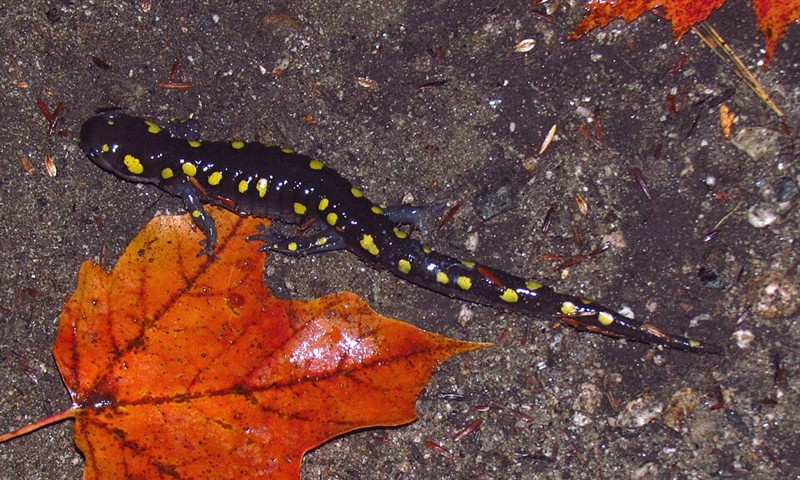
The spotted salamander (Ambystoma maculatum) is a black, yellow-spotted salamander of eastern North American forests that spends most of its life underground and gathers in vernal pools on rainy nights in spring to breed.
The spotted salamander (Ambystoma maculatum) is a black, yellow-spotted salamander of eastern North American forests that spends most of its life underground and gathers in vernal pools on rainy nights in spring to breed.
🧬 Field Guide Specimen: Open Spotted Salamander in the CRV Science Field Guide to log the specimen, see its place among the Tetrapoda lineages in the Cladogram Explorer, and test your recall in the Red List conservation game.
Spotted Salamander at a Glance
| Property | Value |
|---|---|
| Scientific name | Ambystoma maculatum |
| Kingdom | Animalia |
| Phylum | Chordata |
| Class | Amphibia |
| Order | Urodela |
| Family | Ambystomatidae |
| Field Guide group | Tetrapoda: Amphibia (Frogs, Salamanders & Caecilians) |
| Diagnostic feature (Field Guide) | Stout fossorial Eastern North American woodland amphibian with slate-black skin marked by two irregular rows of bright yellow or orange spots; its aquatic egg masses host endosymbiotic green algae (Oophila amblystomatis) inside embryonic cells. |
| IUCN Red List status | Least Concern (LC), assessed 2022 |
| Egg symbiont | Green algae |
Evolutionary Systematics & Comparative Anatomy
Ambystoma maculatum is the type species of the genus Ambystoma and family Ambystomatidae (the mole salamanders), an endemic North American clade of ~32 species within the suborder Salamandroidea (advanced internally fertilizing urodeles). Whereas some ambystomatids, most famously the Mexican Axolotl (Ambystoma mexicanum), are obligate neotenic paedomorphs that retain larval gills and aquatic habits throughout adulthood, A. maculatum undergoes complete thyroid-hormone-driven metamorphosis from an aquatic, external-gilled larva into a fossorial terrestrial adult. Phylogeographic analyses of mitochondrial DNA across its range—extending from Nova Scotia and southern Quebec west to Lake Superior and south to eastern Texas and Georgia—identify two deep genealogical clades (an interior-western clade and a coastal-northern clade) that diverged during the Pliocene and recolonized glaciated northeastern forests from southern Pleistocene refugia following the retreat of the Laurentide Ice Sheet.
Adult A. maculatum are stout-bodied amphibians measuring 15 to 25 cm in total length, with females typically attaining larger body sizes and heavier trunk girths than males. The trunk is segmented externally by 11 to 13 prominent costal grooves that channel surface moisture across the permeable epidermis via capillary action. The dorsal integument is slate-black, bluish-black, or dark charcoal-gray, contrasted by two irregular dorsolateral rows of 24 to 45 round spots running from the head to the tail tip; spots on the head and shoulders are frequently bright orange, while those along the trunk and tail are canary-yellow, serving an aposematic warning function.
Skeletal features reflect its burrowing lifestyle and salamandroid affinities. The skull is broad and well-ossified with curved vomers bearing a transverse row of small, pedicellate vomerine teeth behind the internal nares, used in concert with a fleshy, protrusible tongue to grip invertebrate prey. Vertebrae are amphicoelous (biconcave) and reinforced by short ribs, while the limbs are robust with four unwebbed digits on the forefeet and five on the hindfeet. Clusters of large granular poison glands (parotoid-like glands) are concentrated behind the eyes and along the dorsal ridge of the laterally compressed tail; when seized by a mammalian or avian predator, the salamander arches its tail and exudes a milky, noxious mucopolysaccharide and protein secretion that adheres to the attacker's oral membranes.
Physiology, Biomechanics & Sensory Biology
Ambystoma maculatum is renowned in cellular and evolutionary biology for hosting the only documented naturally occurring intracellular endosymbiosis between a vertebrate and a photosynthetic eukaryote—a partnership distinct from the kleptoplastic chloroplast sequestration seen in marine sacoglossan gastropods such as the Solar-powered Sea Slug (Elysia chlorotica). Female A. maculatum encapsulate their clutches of 50 to 250 eggs inside dense, globular outer jelly matrices composed of cross-linked glycoproteins and mucopolysaccharides. While this thick jelly coat prevents desiccation and deters fish, frog tadpole, and caddisfly predators, its low diffusion coefficient for dissolved gasses creates severe hypoxia inside the interior egg capsules and traps toxic embryonic metabolic waste.
Within hours of oviposition in sunlit vernal pools, flagellated zoospores of the unicellular chlamydomonad green alga Oophila amblystomatis penetrate the egg capsules and proliferate to high densities around the developing embryo, turning the egg mass emerald green. Using light energy to drive Photosynthesis (6CO2 + 6H2O → C6H12O6 + 6O2), the extra-embryonic algae consume embryonic CO2 and assimilate excreted ammonia (NH3/NH4+), while raising daytime intracapsular oxygen partial pressures to hyperoxic levels. Reciprocally, radiolabeled carbon-14 (14C) tracer experiments demonstrate that photosynthetically fixed glucose and maltose translocate from the alga to the salamander embryo, accelerating embryonic growth rates, synchronizing hatching, and reducing developmental deformities.
In 2011, transmission electron microscopy and chlorophyll autofluorescence imaging revealed that O. amblystomatis cells do not remain merely in the extracapsular fluid: during neurulation, algae enter the embryonic tissues via the blastopore and invade somatic and germ-layer cells, where they become surrounded by host mitochondria. Because vertebrates possess an adaptive immune system (recombinase-activating genes RAG1/RAG2, MHC class I and II receptors, and T-cell surveillance) that normally rejects foreign cells, transcriptomic profiling of invaded salamander cells showed muted NF-κB inflammatory signaling alongside metabolic reprogramming of the intracellular alga from aerobic photosynthesis toward fermentation, indicating physiological accommodation prior to the maturation of larval adaptive immunity.
Noticeable polymorphism also occurs in the maternal oviductal jelly proteins of A. maculatum: across sympatric populations, females lay either clear, transparent egg masses (formed by water-soluble glycoprotein fibers) or opaque, milky-white egg masses (containing hydrophobic, crystalline protein inclusions). While clear morphs transmit roughly 2.5 times more photosynthetically active radiation to endosymbiotic O. amblystomatis and support higher algal growth, white morphs exhibit distinct chemical and physical jelly properties that confer superior larval survival and size at hatching in low-nutrient vernal pools alongside altered susceptibility to egg-mass predators such as wood frog (Lithobates sylvaticus) tadpoles and caddisfly larvae.
Trophic Ecology, Life History & Reproduction
Outside of its brief 1-to-3-week spring breeding season, Ambystoma maculatum is strictly fossorial, spending more than 90 percent of the year in subterranean mammal burrows (particularly those excavated by short-tailed shrews Blarina brevicauda and woodland voles), root channels, and decaying hardwood logs at soil depths of 10 to 120 cm within mature deciduous and mixed-hardwood forests. Underground and under nocturnal leaf litter during warm summer rains, adults forage as sit-and-wait and active predators on earthworms (Lumbricidae), terrestrial gastropods (slugs and snails), millipedes, spiders, crickets, and carabid beetles. During winter, adults retreat below the frost line in upland forest soils to avoid freezing.
Reproduction is triggered in late winter or early spring (February to April, depending on latitude) by the convergence of thawing ground temperatures, snowmelt, and warm nocturnal rainfalls (typically > 7 °C)—an ecological event known across eastern North America as "Big Night." Guided by olfactory soil cues and magnetic/topographic orientation, hundreds of adult salamanders emerge simultaneously and migrate 100 to 800 m from upland forest burrows back to their natal vernal pools—ephemeral, snowmelt- and rain-fed woodland depressions that dry up by mid-to-late summer and therefore cannot support predatory fish populations. Because adult A. maculatum exhibit strong philopatry (returning to the same vernal pool over lifespans of 18 to 30 years), road networks bisecting upland forest and wetland basins cause severe annual road mortality, prompting conservation engineers and citizen-science brigades to construct under-road amphibian tunnels and close migration corridors on rainy spring nights.
Males arrive at the vernal pools several days before females and gather in writhing nocturnal "congresses" of dozens of individuals. During courtship, males nudge females with their snouts, fan waterborne proteinaceous pheromones secreted from their cloacal glands via tail undulations, and deposit multiple gelatinous, pedestal-shaped spermatophores capped with white sperm packets onto submerged dead leaves and twigs. A receptive female straddles a spermatophore and draws the apical sperm cap into her cloacal spermatheca, where sperm fertilize the ova internally as they pass through the oviducts.
Within 24 to 48 hours of insemination, the female attaches 1 to 3 globular egg masses (measuring 5 to 12 cm across) to submerged stems 10 to 30 cm below the water surface. Embryos hatch after 4 to 7 weeks into aquatic larvae equipped with feathery external gills, broad tail fins, and balancers. Larvae are voracious gape-limited carnivores in the vernal pool food web, feeding on cladocerans (Daphnia), copepods, ostracods, mosquito and chironomid larvae, and smaller amphibian larvae. Over a larval period of 60 to 110 days—accelerated if water temperatures rise and pool volume shrinks—the larvae develop lungs, resorb their external gills and tail fins, acquire yellow dorsal spots during metamorphosis, and disperse into the surrounding forest floor leaf litter on rainy late-summer nights.
Frequently Asked Questions
How do photosynthetic green algae help spotted salamander embryos survive inside their egg masses?
Spotted salamander egg masses are encased in thick jelly that protects the eggs from predators and drying out, but restricts oxygen diffusion. Symbiotic green algae (Oophila amblystomatis) colonize the egg capsules and even enter the embryo's cells, using sunlight to produce oxygen and sugars for the developing salamander while absorbing its carbon dioxide and nitrogenous waste.
Why is the intracellular symbiosis in the spotted salamander so unusual among vertebrates?
Vertebrates possess an adaptive immune system that recognizes and destroys foreign cells inside the body. The spotted salamander is the only known vertebrate whose cells harbor an intracellular photosynthetic symbiont in nature, achieved because Oophila algae enter the embryo early in development and trigger suppressed immune inflammatory signaling inside host cells.
What is "Big Night," and why do spotted salamanders breed only in temporary vernal pools?
"Big Night" refers to the first warm, rainy nights of early spring when thousands of spotted salamanders emerge from underground forest burrows to migrate to breeding ponds. They breed in temporary vernal pools that dry up each summer because these ephemeral ponds lack predatory fish that would otherwise eat the defenseless salamander eggs and gilled larvae.
References
- Kerney, R., Kim, E., Hangarter, R. P., Heiss, A. A., Bishop, C. D., & Hall, B. K. (Apr 19, 2011). "Intracellular invasion of green algae in a salamander host." Proceedings of the National Academy of Sciences, 108(16), 6497–6502. https://doi.org/10.1073/pnas.1018259108
- Burns, J. A., Zhang, H., Hill, E., Kim, E., & Kerney, R. (May 2, 2017). "Transcriptome analysis illuminates the nature of the intracellular interaction in a vertebrate-algal symbiosis." eLife, 6, e22054. https://doi.org/10.7554/eLife.22054
- Ruth, B. C., Dunson, W. A., Rowe, C. L., & Hedges, S. B. (Sep 1993). "A Molecular and Functional Evaluation of the Egg Mass Color Polymorphism of the Spotted Salamander, Ambystoma maculatum." Journal of Herpetology, 27(3), 306–314. https://doi.org/10.2307/1565152
- Pintar, M. R., & Resetarits, W. J. (Apr 7, 2017). "Persistence of an egg mass polymorphism in Ambystoma maculatum: differential performance under high and low nutrients." Ecology, 98(5), 1349–1360. https://doi.org/10.1002/ecy.1789
- Zamudio, K. R., & Savage, W. K. (Jul 2003). "Historical isolation, range expansion, and secondary contact of two highly divergent mitochondrial lineages in spotted salamanders (Ambystoma maculatum)." Evolution, 57(7), 1631–1652. https://doi.org/10.1111/j.0014-3820.2003.tb00370.x