Oolitic Limestone
Oolitic limestone is a limestone made of ooids, tiny spheres about 0.2 to 2 millimeters across with concentric layers of calcium carbonate, resembling fish roe. The name comes from the Greek for 'egg.'
Oolitic limestone is a limestone made of ooids, tiny spheres about 0.2 to 2 millimeters across with concentric layers of calcium carbonate, resembling fish roe. The name comes from the Greek for "egg."
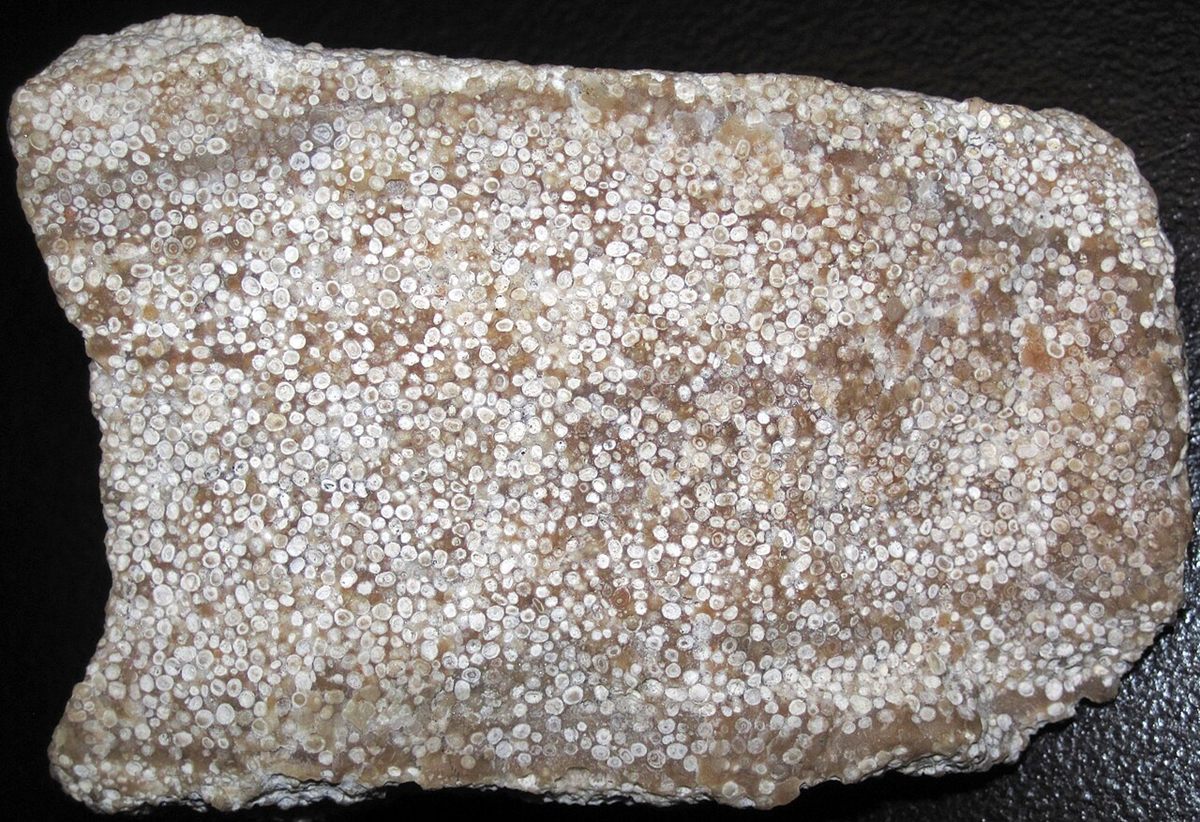
🪨 Geology Guide Specimen: Open Oolitic Limestone in the CRV Science Rock & Mineral ID Guide to log the specimen, compare it with the other 6 subgroups of Sedimentary, and test your eye in LithoClade.
Ooids: How Do Spheres of Lime Grow?
Ooids grow in warm, shallow, carbonate-saturated water that is constantly agitated by waves or tidal currents. Layers of calcium carbonate precipitate around a nucleus such as a shell fragment or sand grain as it rolls back and forth, and the result is a rounded grain with a growth-ring structure.
Tidal Shoals: Where Do Ooids Form Today?
Active ooid sands accumulate on the Bahama Banks and in the Persian Gulf, in shoals swept by tides. The ancient rock is a grainstone, in which the ooids touch and are cemented by calcite, and Jurassic oolites are widespread in England.
Building Stone: Why Is Oolitic Limestone Used?
Oolitic limestone cuts easily and weathers evenly, so it is a favorite building stone. Indiana limestone, quarried near Bedford, was used to clad the Empire State Building, and the Jurassic limestones of the Cotswolds give English villages their golden color. Compare travertine, another chemically precipitated limestone.
Oolitic Limestone at a Glance
| Property | Value |
|---|---|
| Type / variety | Concentric Calcite-Ooid Grainstone |
| Composition | >95% CaCO₃ • Spherical Concentric Ooids (0.2–2 mm) in Sparry Calcite Cement |
| Geology Guide group | Sedimentary Rocks (Clastic, Chemical & Biogenic) |
| Rock Classification | Carbonates (Limestones & Dolostone) |
| Mohs hardness | Mohs 3 |
| Texture / habit | Uniform, fish-roe-like spherical grains (0.5–1.5 mm) with concentric rings |
| Density | 2.55–2.70 g/cm³ |
| Lustre and cleavage | Cream-to-buff uniform grainstone; fizzes strongly in dilute HCl |
| Geological setting | Warm, wave-agitated tropical tidal shoals (e.g., Bahama Banks, Indiana Bedford stone) |
| Diagnostic feature (Geology Guide) | Uniform cream-colored rock composed of millions of tiny, millimeter-sized spheres ('fish-roe' texture) that show concentric onion-like layers of sparry calcite when sliced open and fizz in dilute acid. |
| Grain type | Ooids, with concentric calcite layers |
| Modern analog | Bahama Banks |