Fossiliferous Limestone
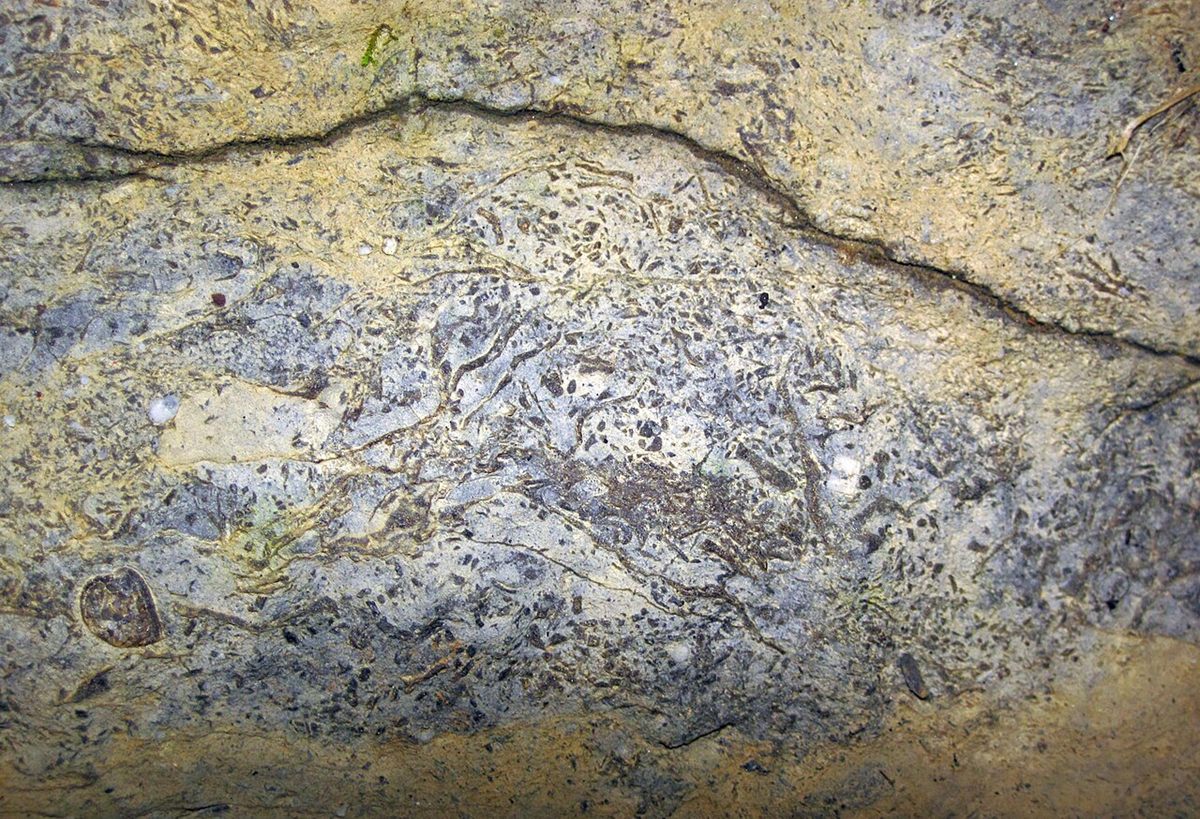
Fossiliferous limestone is a limestone packed with shells and other skeletal remains of marine organisms, held in a matrix of fine lime mud or calcite cement. It is made mostly of calcite (CaCO₃) and fizzes in cold dilute acid.
Fossiliferous limestone is a limestone packed with shells and other skeletal remains of marine organisms, held in a matrix of fine lime mud or calcite cement. It is made mostly of calcite (CaCO₃) and fizzes in cold dilute acid.
🪨 Geology Guide Specimen: Open Fossiliferous Limestone in the CRV Science Rock & Mineral ID Guide to log the specimen, compare it with the other 6 subgroups of Sedimentary, and test your eye in LithoClade.
Skeletal Limestone: Where Does the Lime Come From?
Most limestone is biogenic. Marine animals and algae build shells and skeletons of calcium carbonate, and when they die the pieces accumulate with lime mud on warm, shallow sea floors. Brachiopods, bryozoans, crinoids and corals are the common contributors in ancient limestones.
Reading the Fossils: What Do They Tell Us?
Fossils date the rock and reveal how it formed. A rock rich in articulated brachiopods and crinoid stem segments points to a warm, sunlit, clear, shallow sea. Modern relatives include the lamp shells, such as the Parrot's Beak Lamp Shell, and the stalked and free-living feather stars.
The Acid Test: Why Does It Fizz?
Calcite reacts with acid to release carbon dioxide, which is why a drop of dilute hydrochloric acid makes limestone effervesce. The same reaction links limestone to the carbonate-silicate cycle and to ocean acidification, which threatens shell builders today.
Fossiliferous Limestone at a Glance
| Property | Value |
|---|---|
| Type / variety | Bioclastic Brachiopod–Crinoid Calcite Limestone |
| Composition | >95% Calcite (CaCO₃) • Skeletal Fossils in Micrite or Sparite Matrix |
| Geology Guide group | Sedimentary Rocks (Clastic, Chemical & Biogenic) |
| Rock Classification | Carbonates (Limestones & Dolostone) |
| Mohs hardness | Mohs 3 |
| Texture / habit | Whole and fragmented marine shells embedded in fine lime mud |
| Density | 2.65–2.72 g/cm³ |
| Lustre and cleavage | Light-to-medium grey; fizzes vigorously in cold dilute HCl |
| Geological setting | Warm, sunlit epicontinental seas and coral-crinoid shelves |
| Diagnostic feature (Geology Guide) | Light-to-medium grey marine rock packed with articulated brachiopod shells, bryozoan fronds, and circular crinoid stem disks (Mohs 3) that fizzes vigorously on contact with dilute acid. |
| Main mineral | Calcite |
| Acid test | Fizzes in cold dilute HCl |
See Also
- Coquina — limestone made of shell fragments only
- Chalk — limestone made of microscopic plates
- Carbonate-Silicate Cycle — the long-term role of carbonate rocks